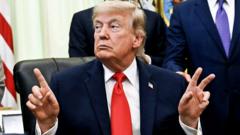
Donald Trump extracted more than $1.4 billion from cryptocurrency ventures during his first year back in the White House, according to a massive 927-page federal financial disclosure released by the Office of Government Ethics. The filings reveal that the president turned his political return into an unprecedented corporate cash machine, generating vastly more money from digital tokens in twelve months than his traditional real estate empire produced over several decades. While everyday retail buyers suffered steep financial losses on these same state-sanctioned digital assets, the Trump family structure insulated itself from market risk by sucking out massive, fixed royalty fees and upfront equity liquidations.
The documents paint a clear picture of a modern presidency operating as a commercial token issuer. The sheer scale of the revenue raises fundamental questions about where public policy ends and private enrichment begins. For a more detailed analysis into similar topics, we suggest: this related article.
The Anatomy of a Risk Free Windfall
Traditional real estate requires brick, mortar, zoning permits, and years of construction management. Digital assets require none of these things. By leveraging his name and the authority of his office, the president created a multi-tiered corporate apparatus designed to collect capital directly from global crypto markets without taking on the downside exposure that typically breaks ordinary investors.
The financial disclosures separate this windfall into two primary channels. The first is CIC Digital LLC, the corporate shell used to license the president's likeness for a meme coin dubbed $TRUMP. This entity brought in $636 million in total income for the fiscal year 2025. Nearly all of this cash arrived through a direct royalty agreement with an outside vehicle called Celebration Coins. For further background on this topic, comprehensive analysis can be read on Financial Times.
The mechanics of this arrangement are ruthlessly efficient. When the token debuted on the Solana blockchain in January 2025, speculative mania drove its theoretical market value to billions of dollars almost overnight. The coin spiked toward $74 before entering a prolonged downward spiral that eventually wiped out most of its value, leaving the token trading around $1.68. Blockchain ledger analysis cited in public filings indicates that roughly 764,000 individual digital wallets hold realized or unrealized losses on the asset.
Trump did not lose a dime. Because his trust structured the deal around intellectual property licensing fees rather than token retention, the cash hit his balance sheet regardless of the coin's performance on secondary exchanges. The money was locked in. He walked away with hundreds of millions of dollars while the public absorbed the market crash.
Policy Choices and Parallel Profits
The second pillar of this financial apparatus is World Liberty Financial, a decentralized finance project co-founded by the president, his sons, and political allies like Steven Witkoff, who now serves as a diplomat in the administration. World Liberty Financial generated more than $500 million via the sale of governance tokens to the public.
Governance tokens are a peculiar financial instrument. They offer no equity, pay no corporate dividends, and grant no actual ownership over the underlying platform. They merely allow buyers to vote on administrative protocol changes. Despite these structural limitations, buyers poured half a billion dollars into the project. The president's corporate vehicle, DT Marks Defi LLC, pulled in more than $150 million in raw Ethereum and $56 million in stablecoins directly from these token sales.
This capital inflow happened alongside significant policy shifts in Washington. Throughout 2025, the administration actively altered the regulatory environment for digital assets. The president used executive actions to systematically halt active federal investigations into digital asset firms. He championed the GENIUS Act, a legislative push explicitly designed to integrate crypto assets into the federal financial system. White House spokespeople have defended these moves as efforts to make America the global capital of crypto.
The financial overlap is impossible to ignore. A president pushing policies that pump value into an asset class while his personal trust actively cashes out hundreds of millions of dollars from that exact market has no historical precedent.
Sovereign Capital and Stablecoin Dividends
The financial disclosure document also highlights deeper international financial ties. A corporate entity named DT Marks SC LLC, which is tied directly to the president's revocable trust, holds a 38.25% equity stake in an entity called Stablecoin Holdco LLC. During 2025, this specific entity paid out $196 million in direct dividends to the president.
The underlying funding for this stablecoin venture involves prominent international figures. Prominent foreign backers, including Sheikh Tahnoon bin Zayed Al Nahyan of Abu Dhabi, have been tied to the broader capitalization of the project. This introduces a distinct layer of geopolitical complexity. Foreign leaders and international business conglomerates are no longer just buying hotel rooms or renting floors in a Manhattan skyscraper to gain proximity to power. They are anchoring themselves into the foundational liquidity pools of the president's private financial network.
Consider how these numbers compare to the president's traditional income streams.
- CIC Digital LLC (Meme Coin Royalties): $635 million
- World Liberty Financial (Token Sales & Equity): $588 million
- Stablecoin Holdco LLC (Dividends): $196 million
- Mar-a-Lago Club (Resort Revenue): $77 million
- Trump National Golf Club Virginia: $25 million
The legacy portfolio is completely overshadowed. Golf courses require constant maintenance, seasonal labor, and heavy capital expenditure. Digital wallets require an internet connection and an official endorsement. The profit margins are incomparable.
The Broad Shift in Executive Wealth
This wealth accumulation is not isolated to the top of the ticket. Vice President JD Vance also reported his first direct holdings in cryptocurrency, listing a Bitcoin position valued between $250,000 and $500,000. While Vance’s holdings represent passive investment positions, they confirm that the executive branch is now fundamentally aligned with the economic performance of decentralized networks.
Critics point out that this massive parallel economy undermines the regulatory credibility of the state. When the primary financial watchdog agencies are ordered to step back, and retail investors lose billions while the executive family collects massive loyalty payouts, the traditional boundary between public service and venture capitalism dissolves entirely. The administration's legal defense relies on the fact that these assets are handled by a revocable trust run by the president's adult sons. But a trust that constantly updates its 927-page disclosure forms with billion-dollar entries offers little real insulation from the realities of executive influence.
The business model relies entirely on the scarcity of presidential attention and the immense value of branding. By converting federal policy into a marketing funnel for digital tokens, the administration has created a self-sustaining financial ecosystem. The money flows in from global speculators, filters through complex layers of Delaware registered corporate shells, and settles safely into cold storage wallets. The traditional guardrails meant to prevent conflicts of interest were designed for an era of physical assets, corporate stocks, and land deeds. They are completely useless against a presidency that can mint its own capital at will on a public blockchain.