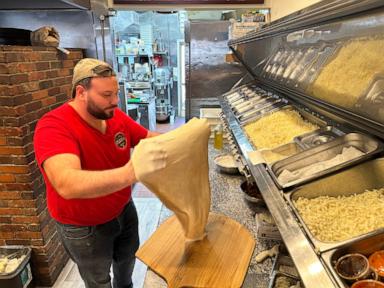
The pre-dawn air in Brooklyn carries a distinct geometry. It smells of damp concrete, exhaust fumes, and the sweet, yeasty breath of fermenting flour escaping through sidewalk grates. Walk down any block at 4:00 AM, and you will find a baker whose forearms are permanently dusted white. They are wrestling with 50-pound lumps of dough, racing against the sunrise to ensure that when New York wakes up, the bagels are glossy and the pizza crusts have that perfect, structural chew.
New Yorkers take this texture for granted. We treat it as a birthright. We credit the Catskill water, the ancient ovens, the technique passed down through generations.
But there is a quieter, less romantic ingredient hiding in that dough. It does not appear on the chalkboard menus. It has no flavor. Yet, it is currently at the center of a quiet war raging between the state legislature in Albany and the kitchens that define the city's culinary soul.
Lawmakers are moving to ban potassium bromate and azodicarbonamide (ADA)—two chemical additives that have quietly underpinned American commercial baking for decades. To some, this is a long-overdue public health victory. To others, it feels like an existential threat to the city's iconic food culture.
To understand why a handful of chemical compounds can cause a panic in a pizzeria, you have to look at the chemistry of a stretch.
The Secret Chemistry of the Perfect Chew
Flour is alive. Left to its own devices, freshly milled flour is actually quite difficult to bake with. It is weak. The gluten strands are tangled and fragile. Historically, millers had to let flour sit in warehouses for weeks, allowing the oxygen in the air to naturally age it, strengthening the proteins so the dough could hold its shape.
Time, however, is expensive.
In the mid-20th century, industrial baking discovered a shortcut: potassium bromate.
Imagine gluten as a net. In untreated flour, that net is full of holes, prone to tearing under the pressure of expanding gas. Potassium bromate acts as a structural welder. It oxidizes the dough, knitting those protein strands tightly together.
The result? Dough that can be stretched to the thinness of a windowpane without ripping. Dough that rises higher, bakes faster, and yields a predictable, uniform crunch every single time.
Azodicarbonamide, or ADA, performs a similar miracle of efficiency. It bleached the flour white and puffed it up, earning it the nickname the "yoga mat chemical" because it is also used to add elasticity to plastics.
For decades, these additives were the invisible backbone of the neighborhood bakery. They turned temperamental, weather-dependent baking into a precise, bulletproof science. A baker could open a bag of bromated flour and know exactly how the dough would behave, whether it was a humid July morning or a freezing January night.
But that reliability came with a hidden cost.
The Ghost in the Oven
The argument for potassium bromate has always been that it disappears. Bakers will tell you that the intense heat of a 500-degree deck oven transforms the bromate into harmless bromide. If the timing is perfect, nothing remains but a crispy crust.
"If" is a heavy word when it comes to human health.
If the dough is too cold, if the oven has a cool spot, or if the baker uses just a fraction too much powder, unreacted potassium bromate stays in the food. The International Agency for Research on Cancer classifies it as a classmate of known carcinogens. In animal studies, it has been linked to kidney and thyroid tumors.
Because of these findings, the European Union banned potassium bromate in 1990. Canada followed suit. So did the United Kingdom, Brazil, and even China. Walk into a bakery in Paris or Rome, and the bakers there achieve world-class texture using nothing but flour, water, salt, and time.
Yet, in the United States, the Food and Drug Administration has largely relied on voluntary industry reductions. It was a classic American compromise: let the market regulate itself.
California broke the stalemate by passing the California Food Safety Act, outlawing these substances alongside several artificial dyes. Now, New York is poised to follow. If the pending legislation passes, using these additives will become a violation of state law.
For a specific kind of old-school New York craftsman, this feels like an eviction notice for their livelihood.
The Baker’s Dilemma
Consider a hypothetical baker named Sal. He runs a multi-generational pizzeria in Queens. His father taught him how to stretch dough using a specific brand of flour in a blue paper bag—flour that contains potassium bromate.
Sal isn't trying to poison his customers. He feeds this pizza to his own kids. To him, bromated flour is simply the tool that allows him to pay his rent. It behaves beautifully in his 60-year-old gas oven. It handles the brutal pounding of Friday night rushes.
If you tell Sal he has to switch to unbromated flour tomorrow, he faces a steep, terrifying learning curve.
Without those chemical welders, the dough becomes fragile. It requires longer fermentation times to develop natural strength. It means Sal needs more refrigeration space to let the dough rest overnight—space he does not have in his cramped, high-rent kitchen. It means his pizzas might take an extra ninety seconds to bake, slowing down his output when a line is stretched out the door.
In a business where profit margins are sliced as thin as prosciutto, those ninety seconds matter. The fear among small business owners isn't just about changing a recipe; it is about the collateral damage of disruption. They worry that their signature crunch will vanish, and with it, the loyalty of neighbors who have been buying their slices since the Carter administration.
The transition is painful because we have spent seventy years outsourcing the labor of patience to the laboratory.
The Return of the Long Ferment
But there is another side to this narrative, one found in the new wave of sourdough block-bakers and neapolitan pizzaiolos who view the ban not as a catastrophe, but as a liberation.
Go to any of the city’s highly acclaimed new-wave pizzerias, and you will not find a speck of bromated flour. These bakers are proving that the chemical shortcut was never actually necessary. It was just convenient.
To get that legendary New York chew without chemicals, you have to embrace time. You have to let the dough sit in a cold room for 24, 48, or even 72 hours. During this slow sleep, natural enzymes break down starches into complex sugars, creating a deep, nuanced flavor that no chemical can mimic. The gluten aligns itself naturally, creating a crust that is not only strong but far easier on the human digestive system.
Many people who believe they are sensitive to gluten find they can eat traditional, long-fermented bread without issue. The problem was never the wheat; it was the speed at which we forced the wheat to become bread.
The real challenge of the New York additive ban is an infrastructure problem. Large commercial mills will have to adjust their lines. Distributors will have to recalibrate their inventory. Small bakeries will need to learn how to manage temperature and time rather than relying on a chemical safety net.
Change is messy, and it always demands a sacrifice.
The transition will likely be bumpy. For a few months, your favorite morning bagel might feel a little different, or your local slice might have a bit less structural integrity as the person behind the counter learns to dance with a new, live ingredient. We will have to endure the clunky calibration of an industry rediscovering its roots.
But eventually, the ovens will get hot again. The flour will settle.
We might finally realize that the magic of New York food was never found in a factory-made white powder. It was always in the hands of the person waking up at 4:00 AM, turning the lights on in the dark, and giving the dough the time it needed to grow.