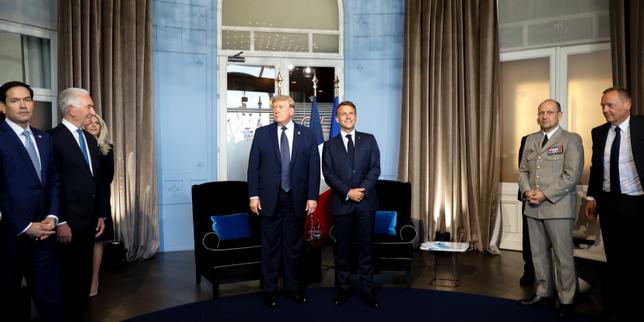
The rain in Evian-les-Bains does not just fall. It bleeds into the lake, a heavy, gray sheet that blurs the line between the French sky and the deep waters of Lake Geneva. Inside the gilded rooms of the luxury resort hosting the G7 summit, the atmosphere is no less suffocating. Presidents and prime ministers move through these corridors under the constant hum of camera shutters, but the real history happens in the quiet corners. It happens in the brief, unscripted moments between formal sessions, where the destiny of millions is bartered in hushed tones over lukewarm coffee.
On this particular afternoon, the focus of the world shifted to a private room where Donald Trump and Emmanuel Macron sat opposite one another.
To the casual observer scrolling through a news feed, the headline read like standard diplomatic boilerplate: leaders meet to discuss regional stability and ongoing conflicts. But diplomacy is rarely about the words printed in a press release. It is about the friction between two drastically different worldviews, the body language of two men who hold the levers of global power, and the invisible stakes that affect ordinary citizens thousands of miles away.
The Anatomy of a Handshake
Every encounter between the American president and his French host carries a certain theatrical tension. They represent two poles of modern geopolitics. One champions a transactional, immediate approach to international relations; the other fights to preserve the traditional alliances of the post-war order.
When they shook hands this time, there was less of the performative white-knuckle gripping that characterized their early meetings. Instead, there was the heavy weariness of two leaders who know exactly what the other wants—and exactly how little they are willing to give.
Outside the resort, the world was burning in two distinct theaters. To the east, the plains of Ukraine remained locked in a brutal war of attrition. To the south, the Middle East teetered on the edge of a wider regional conflagration. The men in the room did not need to look at maps to understand the geography of these crises. They could see it in the economic indicators, the refugee statistics, and the intelligence briefings piling up on their respective desks.
Consider the reality of a family in Kharkiv, waking up to the sound of air raid sirens, or a shopkeeper in Beirut watching the horizon for smoke. For them, the conversation in Evian is not an abstract exercise in political science. It is a matter of survival. The decisions made—or avoided—in these private bilateral meetings dictate whether artillery shells keep flying or whether a diplomatic off-ramp can finally be constructed.
The Eastern Front and the Price of Hesitation
The discussion quickly turned to Ukraine. The conflict has reached a phase where the initial shock has worn off, replaced by a grueling, costly reality. Macron has increasingly positioned himself as one of Europe’s more hawkish voices, warning that a Russian victory would fundamentally compromise European security for a generation. For France, and for Europe as a whole, the war is an existential threat knocking directly on the mansion door.
Trump’s perspective has always been fundamentally different. He views the conflict through the lens of cost and commitment, frequently questioning the scale of American aid and demanding that European nations shoulder a far greater share of the burden.
The tension in the room during this segment of the talk was palpable. It is the classic debate between long-term strategic stability and immediate financial realism. Macron sought to convince his American counterpart that supporting Ukraine is not an act of charity, but a necessary investment in global stability. Trump, conversely, pressed for a rapid resolution, driven by the belief that prolonged conflicts bleed resources that could be better used elsewhere.
The tragedy of this debate is that while the leaders argue over budgets and strategic doctrines, the timeline on the ground is measured in human lives. Every month the impasse continues, the cemetery plots expand. The hidden cost of political disagreement in the West is paid in the currency of young lives on the front lines.
A Powder Keg in the Middle East
If Ukraine was a heavy cloud hanging over the room, the situation in the Middle East was a lightning rod. The region has become a complex matrix of proxy conflicts, historical grievances, and immediate humanitarian disasters.
Here, the two leaders found themselves navigating a minefield of conflicting interests. The United States remains bound by deep historical ties and strategic commitments, yet faces immense domestic pressure to avoid being dragged into another endless conflict. France, with its unique historical ties to Lebanon and North Africa, views the Mediterranean basin as its own backyard, where any explosion directly triggers social and political ripples at home.
During their discussion, the conversation focused heavily on preventing a total breakdown of regional order. It is a delicate balancing act. How do you deter aggression without provoking a full-scale war? How do you address the legitimate security concerns of nations while simultaneously preventing a humanitarian catastrophe that fuels the next generation of extremism?
The difficulty lies in the fact that there are no clean solutions left on the table. Every option carries a penalty. To intervene is to risk escalation; to stand back is to allow the vacuum to be filled by chaos. Macron and Trump spoke not as partners with a unified plan, but as two captains trying to steer the same ship through a storm while disagreeing on which direction the shore lies.
The Human Element Behind the Protocol
It is easy to become cynical about summits like the G7. They are often dismissed as expensive photo opportunities where wealthy leaders issue non-binding communiqués that change little on the ground. There is some truth to that cynicism. The gap between the luxury of Evian and the mud of a trench in Donbas is vast, almost obscene.
Yet, to completely dismiss these meetings is to misunderstand how the world is governed. In the absence of face-to-face dialogue, misunderstanding breeds miscalculation. When leaders stop talking, armies start moving.
The true value of the encounter between Trump and Macron did not lie in any signed treaty or formal declaration. It lay in the raw, unvarnished exchange of realities. It forced each man to look at the world through the other’s eyes, if only for an hour. Trump was forced to confront the deep, visceral anxiety of a Europe that feels its borders threatened. Macron was forced to confront the pragmatic, transactional demands of an American political landscape that is turning inward.
The rain eventually stopped in Evian, leaving the air cold and clear. As the delegations packed their briefcases and the motorcades prepared to return to the airport, the fundamental questions remained unanswered. The wars did not pause for the G7, and the civilians caught in the crossfire woke up to the same dangers they faced the day before.
But for a few hours in a quiet room overlooking a gray lake, the trajectory of global conflict was weighed, measured, and debated by the only two men who had the power to change it. The world waits to see who shifted.