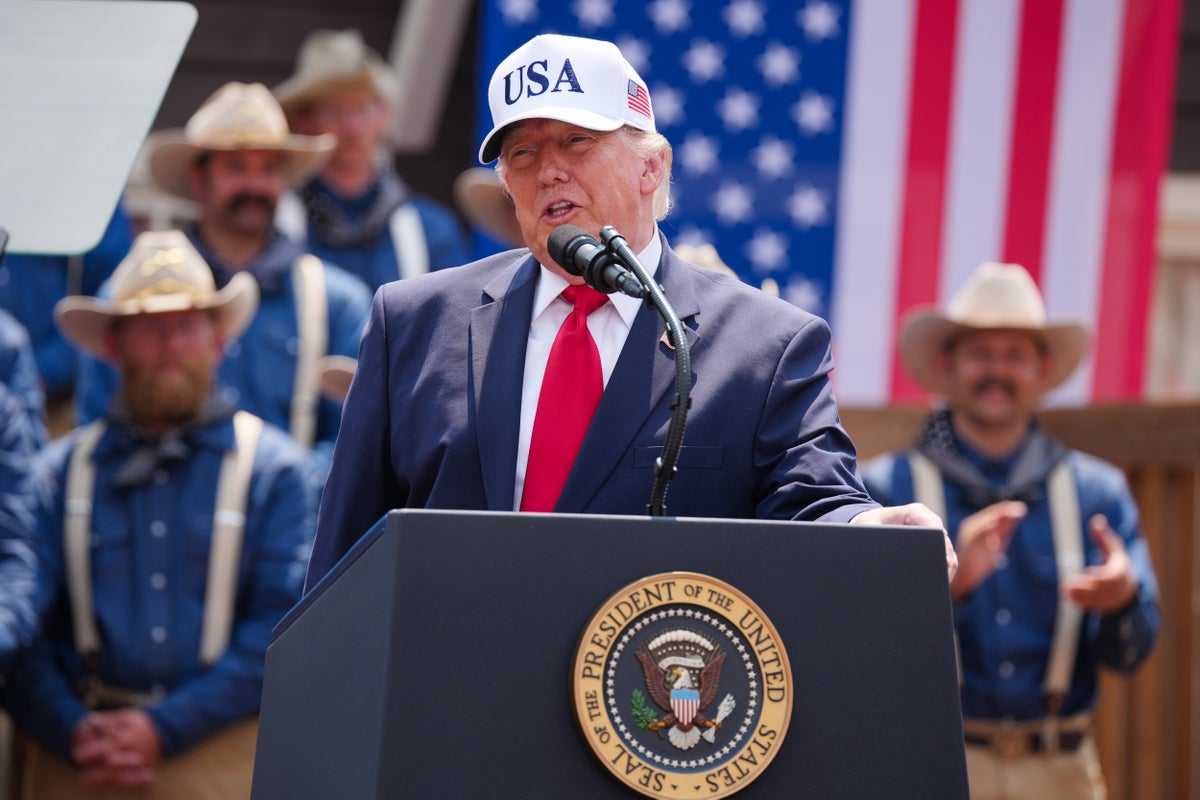
The wind in Medora, North Dakota, does not gently blow; it sweeps across the badlands with a heavy, historic weight, carrying the scent of dry clay and long-faded campfires. It is the kind of landscape that makes human ambition feel both staggeringly small and desperately loud. On a recent Wednesday, the barren beauty of this terrain served as the backdrop for the grand opening of the Theodore Roosevelt Presidential Library. A $450 million monument to a man who lived by the ethos of the big stick and the strenuous life.
But as the current president took the stage, the ghost of 1898 felt less like textbook history and more like an active operational brief.
Standing where Roosevelt once roamed as a grief-stricken young cowboy, Donald Trump looked past the immediate crowd of local dignitaries and out toward a much warmer, more volatile horizon. He spoke of the Rough Riders. He spoke of San Juan Hill. Then, with the casual cadence of a man reading a weather report, he pivoted ninety degrees south, ninety miles off the coast of Florida.
"And speaking of Cuba," he said, his voice cutting through the North Dakota air. "After many, many decades, it’s coming our way."
The phrase hung in the air, ambiguous and heavy. To understand the friction behind those words, one has to look past the podium and into the lived reality of those caught in the geopolitical crosscurrents. Consider someone like Mateo—a hypothetical but deeply representative composite of the modern Havana survivor. For decades, men like Mateo have watched the Malecón seawall not just as a place to fish, but as a boundary line of an agonizing waiting game. For him, American rhetoric isn't a soundbite on a cable news loop. It is a seismic shift that dictates whether his family eats, whether the lights stay on, or whether the slow-burning economic strangulation of his homeland intensifies into something far more acute.
When an American president hints that an island nation is "moving in our direction," it isn't an observation of plate tectonics. It is an assertion of gravity.
The administration had already laid the heavy groundwork months prior. In late January, Washington enacted strict duties on third-party countries supplying Cuba with vital oil, simultaneously declaring a state of emergency over what it termed an imminent threat to U.S. national security. Havana, predictable in its defiance, called the moves an act of unwarranted hostility. Yet, the pressure cooker was intentionally set to high. The language used in Medora wasn't an isolated burst of bravado; it was the continuation of a narrative arc that began earlier in the year when the administration openly teased that Cuba would follow the geopolitical trajectory of a heavily pressured Venezuela.
"Cuba's next, by the way," the president had teased to a crowd weeks before, only to mockingly ask the media to disregard the statement.
But nothing is disregarded. Every word is mapped.
The strategy relies on a deliberate psychological tension. By channeling the spirit of Theodore Roosevelt—the ultimate symbol of American expansionism and muscular diplomacy—the current administration seeks to frame modern embargoes and trade chokeholds not as cold economic warfare, but as destiny. It is a legacy play. The presentation of Roosevelt's original Congressional Medal of Honor to the new library was a masterful piece of political theater, linking the raw military triumphs of the 19th century directly to the slow-drip diplomatic coercion of the 21st.
For the people living through the consequences, the uncertainty is the most exhausting part. Policy changes mean shortages; shortages mean lines; lines mean a fracturing of daily dignity. The macro-level chess pieces moved by Washington translate directly to micro-level survival in the streets of Old Havana. The true stakes are never purely ideological. They are human.
Whether Cuba is truly "coming our way" through eventual economic collapse or forced diplomatic realignment remains an unwritten chapter. But beneath the big sky of North Dakota, the message was unmistakable. The frontier hasn't closed. It has merely shifted back to the Caribbean, wrapped in the mantle of old heroes, waiting for the final pieces to fall.