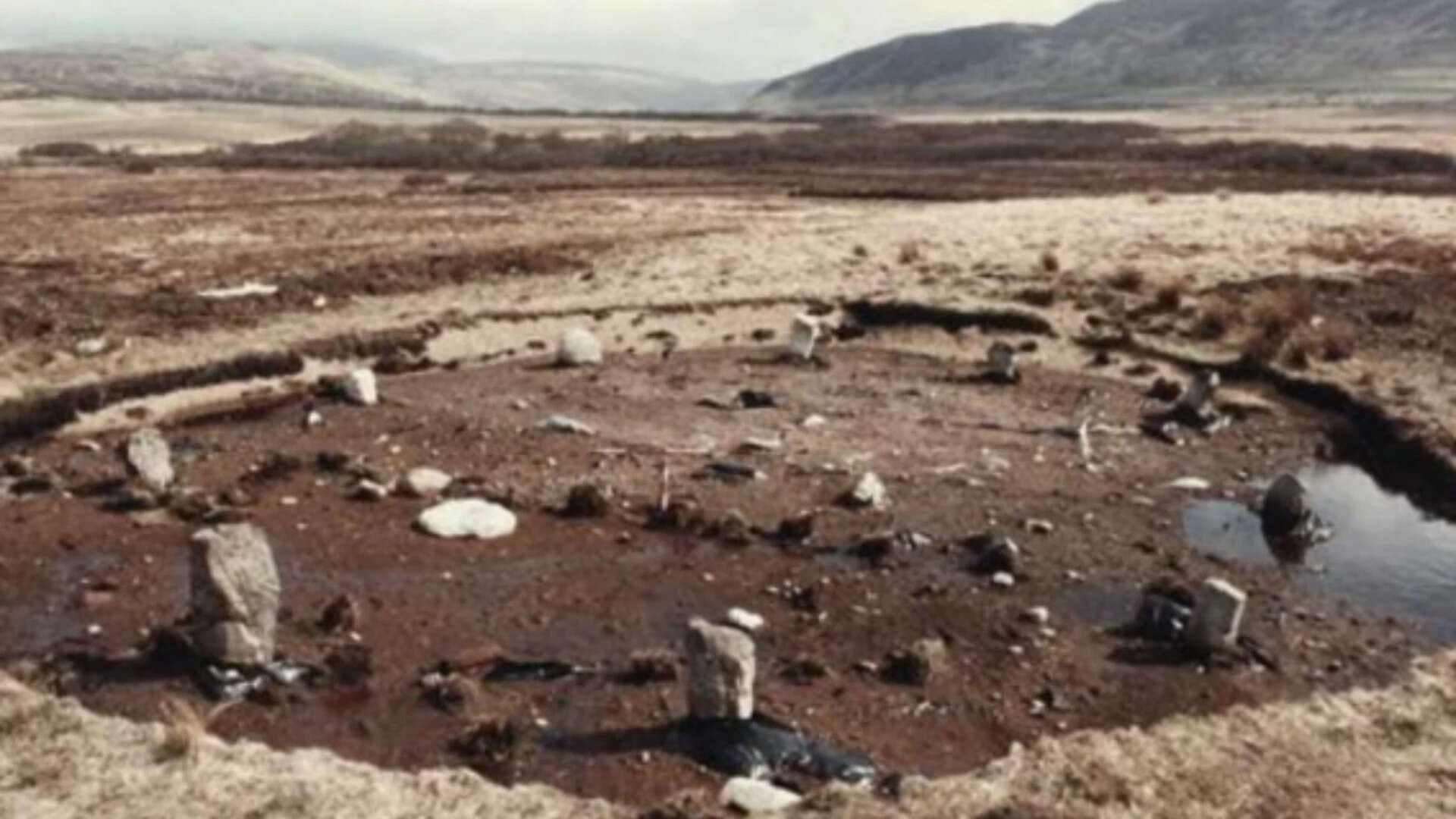
The rain on the Isle of Arran does not just fall. It bleeds into the peat, heavy and constant, carrying the scent of salt and crushed heather. Standing on the island’s western coast, you can feel the isolation in your bones. It is a place where the modern world feels like a distant rumor, muffled by the constant groan of the Atlantic.
For generations, farmers and crofters walked a specific patch of boggy moorland near Tormore, completely unaware of what lay beneath their boots. To the naked eye, it was just rough grazing land, a muddy expanse of rushes and moss. But history has a strange way of breathing through the soil. If you found value in this post, you might want to read: this related article.
Archaeologists recently stared at this identical plot of land without moving a single grain of dirt. They did not use trowels. They did not bring heavy machinery. Yet, they uncovered a massive, 5,000-year-old monument hidden entirely beneath the turf. A prehistoric ritual circle, sprawling and intact, had been found without a single spade striking the earth.
It changes how we look at the ground beneath us. For another perspective on this development, check out the latest update from National Geographic Travel.
The Ghosts in the Data
To understand how you find a monument without digging, you have to look at the technology that bridged five millennia. The discovery was made using LiDAR—Light Detection and Ranging.
Think of LiDAR as a laser-based flashlight strapped to an aircraft. As the plane sweeps across the sky, the device fires hundreds of thousands of laser pulses per second down at the landscape. These beams pierce through the thick ferns, the heather, and the dense grass. They bounce off the hard earth and return to the sensor, measuring the distance to the ground with millimeter precision.
When researchers stripped away the digital vegetation on their computer screens, the modern topography vanished. In its place emerged a ghostly, three-dimensional blueprint of the ancient past.
There it was. A massive cursus monument.
These are giant, elongated rectangular enclosures bounded by banks and ditches. This particular circle stretched across the landscape, a monumental feat of Neolithic engineering. Imagine a structure built by hundreds of people, working in concert, using nothing but antler picks and wooden shovels. They moved thousands of tons of earth to create a sacred space aligned with the sky.
But why did they build it here, on this damp Scottish island?
The Architecture of Belonging
Picture a community five thousand years ago. Life was brutal, short, and governed entirely by the seasons. The winter darkness on Arran is absolute, a heavy velvet that swallows the sea. In that world, the return of the sun wasn't just a astronomical event; it was a matter of literal survival.
Hypothetically, let us name a builder of this monument Calum. He would not have understood the concept of a weekend, or a career, or technology. But he understood the rhythm of the tides and the exact point where the sun dipped behind the jagged peaks of the Arran hills.
For Calum and his people, digging this massive ditch was an act of profound devotion. It was a physical anchor in an uncertain universe. The ritual circle was likely used for gatherings, religious ceremonies, or perhaps as a celestial calendar to mark the changing seasons. It was a cathedral made of earth.
As the centuries bled into millennia, the monument was abandoned. The wooden posts rotted away. The ditches slowly filled with centuries of decaying vegetation, turning into peat. The monument didn't disappear; it was swallowed by the island itself. It became a secret kept by the mud.
The Problem With the Spade
Traditionally, archaeology is destructive. To learn about the past, you must destroy the context of the present. You dig a trench, you remove the layers of soil, and in doing so, you alter that site forever. Once a site is excavated, it can never be un-excavated.
Furthermore, traditional digging is slow, expensive, and limited by physical constraints. An archaeological team might spend years excavating a tiny fraction of a field, completely missing a massive structure just ten yards away.
LiDAR flips the script. It allows scientists to see the entire macro-landscape all at once. It reveals how individual monuments connect to rivers, hills, and other ancient sites across miles of terrain. On Arran, this technology revealed that the newly discovered circle sits in a wider, incredibly dense prehistoric landscape, just a stone's throw from the famous Machrie Moor standing stones.
It turns out Machrie Moor was not an isolated holy site. It was part of a sprawling, interconnected network of sacred architecture that dominated the entire island.
The Weight of What We Cannot See
There is a distinct vulnerability in realizing how much history we walk over every day. We treat the surface of the Earth as a permanent, static reality. We build roads, pour concrete, and boundary our properties, assuming the ground is a blank canvas.
It isn't. The past is huddled right under the surface, waiting for the right light to reveal its outline.
The discovery on Arran reminds us that the landscape is a manuscript that has been written over, erased, and rewritten a thousand times. The people who raised those earthworks were not primitive anomalies. They were innovators, community builders, and stargazers who looked at the same Scottish sky we see today, feeling the exact same human desire to leave a mark that survived their brief existence.
The wind still howls across the Tormore moorland, biting and cold. The sheep still graze on the rough grass, untroubled by the digital lasers that pierced their quiet home. But the secret is out. The earth has spoken, and the silent monument of Arran stands revealed, preserved perfectly in its cradle of peat.


/i.s3.glbimg.com/v1/AUTH_51f0194726ca4cae994c33379977582d/internal_photos/bs/2025/i/r/awbO2yQqaKlcaE88EbfQ/saveinsta.to-487450509-18505253173001043-4348954377809315877-n.jpg)