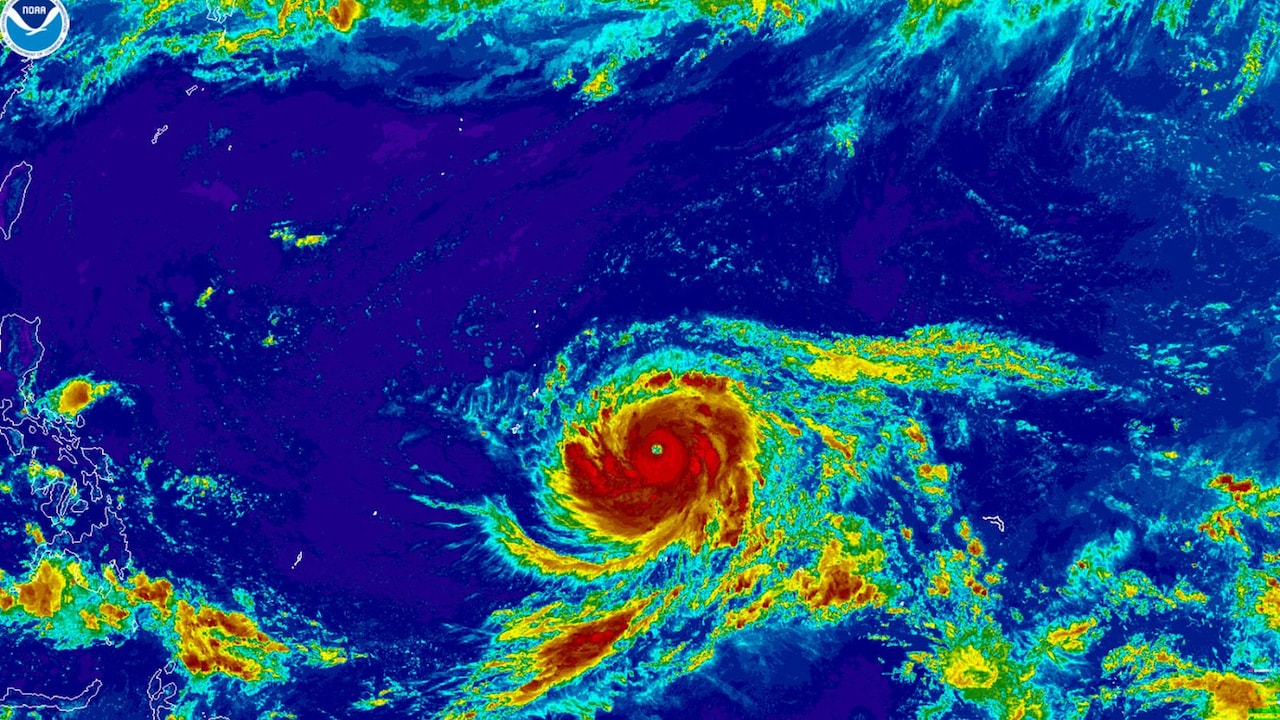
Super Typhoon Bavi is screaming across the western Pacific with sustained winds of 269 kilometers per hour, tracking directly toward the United States territories of Guam and the Commonwealth of the Northern Mariana Islands. The storm threatens to slam into these critical American outposts by Monday, packing the destructive energy of a Category 5 hurricane. While federal authorities declare emergencies and local residents board up concrete homes, this impending disaster exposes a much deeper, more unsettling reality about America’s strategy in the Pacific. These territories are increasingly being asked to serve as the nation's frontline military bastions while remaining structurally vulnerable to the escalating fury of a warming ocean.
It is a double blow. Only three months ago, Super Typhoon Sinlaku ripped through the same region, leaving infrastructure weakened and local economies reeling. Now, the roughly 200,000 American citizens inhabiting these islands find themselves in the crosshairs of another historic tempest. Gas stations are choked with vehicles. Hardware stores have been cleaned out of plywood, and supermarket shelves sit empty as families prepare to lose power and running water for weeks.
Behind the immediate scramble for canned goods lies a massive logistical and structural crisis that Washington has consistently failed to resolve.
The Logistics of Extreme Isolation
Guam sits roughly 6,000 miles from the continental United States. This vast distance creates an immediate vulnerability when a catastrophic weather event cuts off maritime supply lines and closes airports. The island relies heavily on the Jones Act, a century-old piece of maritime legislation requiring goods shipped between U.S. ports to be carried on vessels built, owned, and operated by United States citizens. When a disaster strikes, this law routinely inflates the cost of incoming relief materials and delays the arrival of critical supplies.
The supply chain is fragile. A single major port handles the vast majority of commercial goods entering Guam, and if the cranes at Apra Harbor are damaged by Bavi’s projected 324 kilometer-per-hour gusts, the entire island faces immediate isolation.
During the aftermath of Super Typhoon Mawar in 2023, the port suffered extensive damage that crippled recovery efforts for months. Residents waited in blistering heat for hours just to secure a few gallons of fuel or clean drinking water. The current emergency plans rely on the hope that federal agencies can fly in supplies quickly after the storm passes. Yet, when an airfield is littered with debris and hangar doors are blown off their tracks, heavy cargo planes cannot land.
The Northern Mariana Islands face an even steeper uphill battle. Saipan, Tinian, and Rota are smaller, less developed, and possess far less infrastructure than their southern neighbor. The eye of Super Typhoon Bavi is currently projected to pass directly over Rota, a tiny island with fewer than 3,000 residents and highly limited medical facilities. For the people living there, help will not arrive hours after the storm. It will take days. Possibly weeks.
The Strategy of Exposure
Washington views these islands through a very specific lens. To the Pentagon, Guam is an unsinkable aircraft carrier, a vital piece of geography positioned to project power across Asia and deter foreign adversaries. Billions of dollars are pouring into the expansion of Andersen Air Force Base and Naval Base Guam to accommodate thousands of additional Marines and advanced weapon systems.
This massive military buildup sits in stark contrast to the civilian reality outside the base gates. The local electrical grids are notoriously unstable, relying on outdated power generation facilities and overhead wires that snap instantly in high winds. Water systems depend heavily on electric pumps, meaning that when the power grid goes down, the taps run dry almost immediately.
Local activists and officials have long pointed out the stark disparity between the fortified military facilities and the fragile civilian communities that surround them. The military bases possess their own hardened power generation systems, underground communication lines, and dedicated supply channels. The civilian population, meanwhile, must rely on local government agencies that are chronically underfunded and overwhelmed.
This creates a dangerous imbalance. As the United States increases its military presence on these islands, it inadvertently elevates their status as strategic targets while leaving the local population exposed to the devastating collateral damage of both geopolitical friction and natural disasters.
The Fuel of the New Western Pacific
The rapid intensification of Super Typhoon Bavi is not a freak occurrence. Meteorologists have watched the storm transform from a disorganized tropical system into a monster with maximum sustained winds exceeding 160 miles per hour in a window of just dozens of hours.
The mechanism behind this rapid growth is simple physics. The waters of the western Pacific are exceptionally warm, driven to historic temperatures by a combination of global atmospheric trends and an active El Niño pattern. These warm ocean waters act as high-octane fuel for tropical cyclones. As the storm passes over these deep pools of thermal energy, it sucks up moisture and heat, allowing the central pressure to drop precipitously and the wind fields to expand dramatically.
The storms are changing. Historical data shows that while the total number of tropical cyclones in the Pacific may not be increasing significantly, the proportion of storms that reach Category 4 or Category 5 intensity is rising sharply.
This shift alters the math of disaster recovery. In the past, an island group might expect a catastrophic storm once every decade, providing ample time to rebuild homes, repair roads, and replenish financial reserves. Now, the window between disasters is shrinking to months. The fact that Bavi is arriving a mere ninety days after Super Typhoon Sinlaku means the local community has had no time to recover emotionally, physically, or financially.
The Human Toll of Permanent Preparedness
Living in a constant state of emergency takes a heavy toll on the population. The psychological strain of preparing for a storm of this magnitude is palpable across the communities of Saipan and Guam.
Plywood boards are hammered into place over windows that were replaced only a year ago. Families sit in concrete rooms, listening to the rising wind, wondering if their roofs will hold or if they will be forced to spend the next month cooking over open fires and bathing with buckets of collected rainwater. The financial strain is equally severe. Buying emergency supplies, securing property, and purchasing fuel for generators strains the budgets of families who are already dealing with an exceptionally high cost of living driven by shipping monopolies.
The territorial status of these islands complicates every aspect of the recovery process. Because residents of Guam and the Northern Marianas are U.S. citizens who lack voting representation in Congress, their political leverage in Washington is minimal. When funding fights break out on Capitol Hill, territorial aid packages are frequently delayed or used as bargaining chips in domestic political disputes.
Federal emergency response agencies do their best to position personnel and assets ahead of time, but the sheer distance makes a sustained, long-term recovery operation incredibly difficult to maintain. The temporary housing units, power line repairs, and agricultural assistance that mainland states take for granted often arrive in the territories at a agonizingly slow pace.
Reimagining the Frontline
The current approach to defending and supporting these Pacific territories is unsustainable. Treating these islands solely as strategic military assets while ignoring the profound fragility of their civilian infrastructure guarantees that every major typhoon will result in a humanitarian crisis.
Hardening the civilian infrastructure is the only viable path forward. This requires a massive, sustained federal investment to bury power lines underground, modernize water distribution systems, and construct deep-water port facilities capable of withstanding the extreme weather patterns that define the modern Pacific.
Security cannot be measured purely by the number of fighter jets stationed at an airbase or the number of submarines docked in a harbor. True security requires resilient communities, stable power grids, and a reliable supply chain that can survive the worst that the Pacific Ocean can throw at it. As the outer bands of Super Typhoon Bavi begin to darken the skies over Guam and Saipan, the immediate focus must be on survival. Once the winds subside, the conversation must shift away from short-term disaster relief and toward a fundamental reassessment of what the nation owes to the citizens who live on its most vulnerable geographic frontier.