Seven years.
That is how long it takes for a rubber sandal to rot in the monsoon mud of Cox’s Bazar, for a child born in a bamboo shelter to learn how to spell the name of a country she has never seen, and for the world’s loudest headlines to quiet down into a whisper.
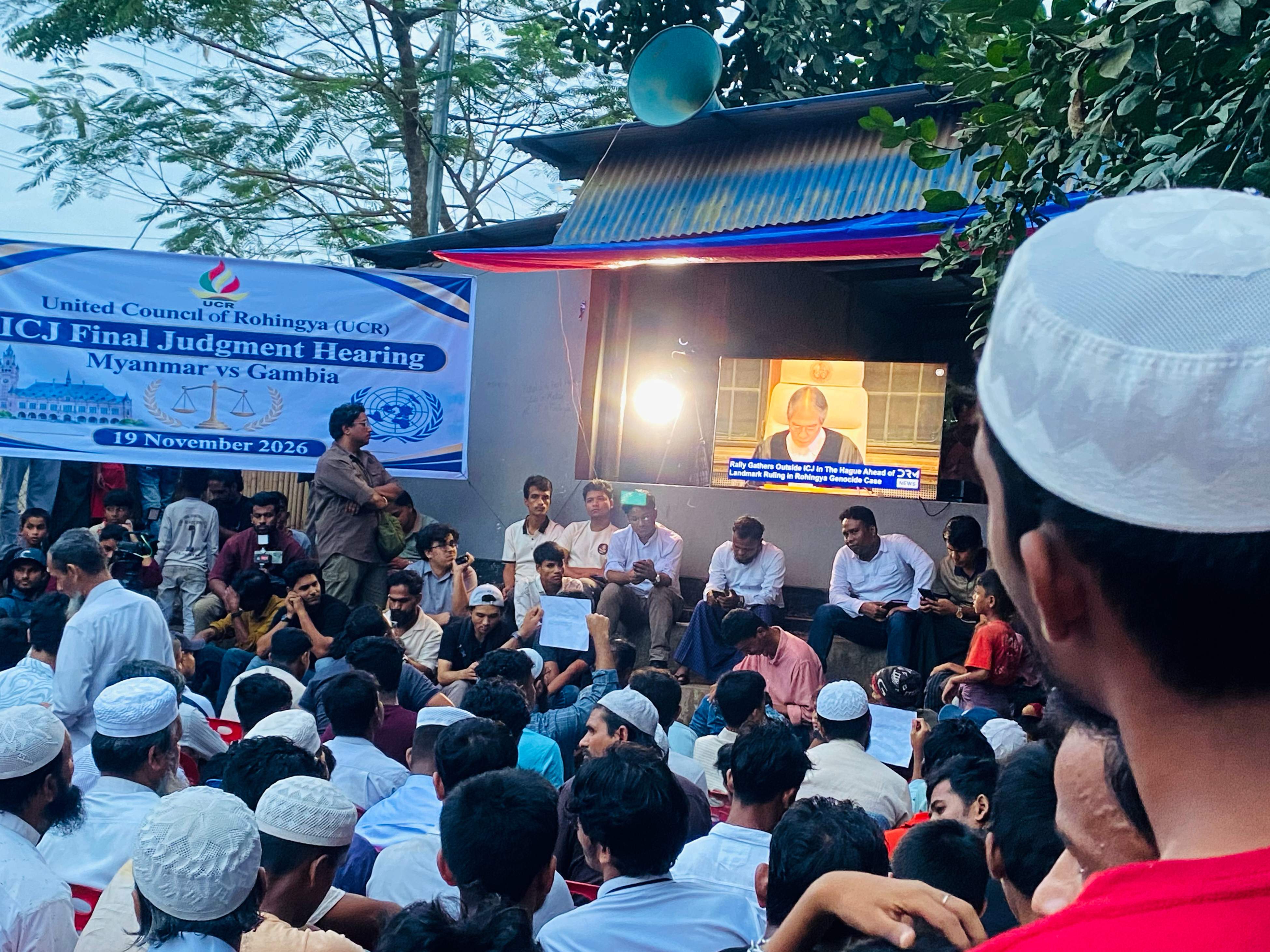
When the International Court of Justice in The Hague finally delivered its landmark judgment finding Myanmar guilty of committing genocide against the Rohingya, the news alerts pinged across millions of glowing screens for roughly forty-eight hours. Journalists typed out the sterile vocabulary of international law. State responsibility. Dolus specialis. The 1948 Genocide Convention. Then, the digital tide pulled back, leaving behind a dry shoreline of legal jargon.
I have walked through those sprawling refugee camps in southern Bangladesh. I have smelled the sharp, inescapable tang of woodsmoke, wet earth, and open drainage clinging to the back of my throat for weeks after leaving. When you sit on a plastic mat inside a cramped tarpaulin tent, listening to a mother describe the exact sound a machete makes against bone, the legal phrase genocidal intent stops being an abstract concept debated by judges in crimson robes. It becomes a physical weight in your chest.
To understand why this ruling matters—and why it almost didn't happen—you have to strip away the marble pillars of the Peace Palace and look at what happens when a nation tries to erase an entire people not just from its soil, but from human memory.
The Architecture of Erasure
Before a single village burned in August 2017, the erasure was already complete on paper.
Consider a hypothetical scenario, built directly from the verified testimonies of hundreds of survivors. Imagine waking up tomorrow in the house your grandparents built. You walk down to the local municipal office to renew your identification, only to be told that your name, your language, and your lineage do not exist in the national registry. You are handed a blank slip of paper and informed that you are an illegal immigrant in the only town you have ever known.
This was not a metaphor for the Rohingya in Myanmar’s Rakhine State. It was Tuesday.
For decades, the Burmese military—known as the Tatmadaw—and successive civilian governments engineered a slow, suffocating bureaucracy of exclusion. The 1982 Citizenship Law stripped the Rohingya of their legal identity, rendering more than a million people stateless overnight. Without citizenship, you cannot travel to the next township without a permit. You cannot attend university. You cannot even visit a hospital without risking arrest at a checkpoint.
Historians recognize this pattern immediately. Mass atrocities rarely begin with gunfire; they begin with paperwork. First, you turn neighbors into strangers. Then, you turn strangers into threats. By the time the military launched its "clearance operations" in late August 2017, the psychological groundwork had been laid for generations. State media referred to the Rohingya not as citizens, nor even as an ethnic minority, but as "Bengali interlopers" and "fleas."
When the violence finally erupted, it was breathtaking in its speed and coordination. Satellite imagery analyzed by human rights investigators later revealed the systematic destruction of nearly four hundred Rohingya villages. Entire communities were wiped off the map in weeks. Over seven hundred thousand people fled across the Naf River into Bangladesh, carrying whatever they could balance on their heads, leaving behind thousands dead in mass graves.
A Tiny Nation Steps Into the Breach
If you had asked any seasoned diplomat in 2018 whether Myanmar would ever face genuine accountability in a world court, they would have offered you a sad, knowing smile.
International justice is notoriously slow, deeply political, and easily paralyzed. Myanmar was not a party to the International Criminal Court, meaning prosecutors there faced massive jurisdictional hurdles. Meanwhile, the United Nations Security Council remained gridlocked by veto powers shielding the generals in Naypyidaw. For the survivors rotting in the camps of Kutupalong—the largest refugee settlement on Earth—justice felt like a cruel rumor.
Then came an unlikely intervention from nearly seven thousand miles away.
In November 2019, The Gambia—a tiny West African nation with a population smaller than the city of Chicago—filed a formal application against Myanmar at the International Court of Justice. Acting on behalf of the 57-member Organisation of Islamic Cooperation, Gambia’s then-Attorney General Abubacarr Tambadou did something audacious. Having previously worked as a prosecutor at the tribunal for the Rwandan genocide, Tambadou visited the Rohingya camps in Bangladesh and recognized the unmistakable stench of systematic extermination.
He invoked a legal mechanism that few nations ever dare to touch: erga omnes partes.
In plain English, think of the 1948 Genocide Convention like a neighborhood pact where every homeowner agrees to put out a fire on any street, even if their own house isn't burning. Because genocide is a crime against all of humanity, any country that signed the treaty has the legal standing to haul another signatory before the World Court—even if the accuser has zero direct connection to the victims.
It was a masterstroke of legal strategy. Unlike the International Criminal Court, which puts individual warlords and generals on trial, the International Court of Justice settles disputes between entire nations. Myanmar had signed the Genocide Convention in 1956 without reservations. They could not simply ignore the summons.
The Day the Mask Slipped
The courtroom scenes that unfolded in The Hague over the ensuing years felt like theater of the absurd.
In December 2019, during the initial hearings on emergency provisional measures, Aung San Suu Kyi—once the darling of the Western world, a Nobel Peace Prize laureate who had spent fifteen years under house arrest fighting for democracy—flew to the Netherlands to personally defend the very military that had once imprisoned her.
Watching her sit quietly in that wood-paneled hall while her legal team dismissed mass rape and infanticide as "clearance operations" against terrorists was a sobering lesson in political disillusionment. It forced observers to confront an uncomfortable truth: democracy in Myanmar had never been built to include everyone. When the generals needed a respectable face to shield them from global outrage, the icon stepped forward.
Then, in February 2021, the illusion shattered completely. The Myanmar military staged a coup, ousting Aung San Suu Kyi, throwing her back into prison, and turning their guns on the ethnic Burmese majority who had once cheered or ignored the crackdown in Rakhine State.
Suddenly, the procedural maneuvering in The Hague grew even stranger. A junta that had seized power by force claimed the right to represent Myanmar before the World Court, arguing that The Gambia lacked standing and that the court had no jurisdiction. In July 2022, the judges rejected every single one of Myanmar’s preliminary objections, clearing the path for a full trial on the merits.
Proving the Unprovable
To understand the magnitude of the court’s final verdict, you have to understand how impossibly high the legal bar is for genocide.
In everyday conversation, we use the word "genocide" to describe any horrific mass killing. In international law, however, numbers alone do not prove the crime. You can slaughter tens of thousands of people, burn their homes, and drive them across a border, and a court might still rule that your actions constitute crimes against humanity or war crimes—not genocide.
To win a genocide conviction, prosecutors must prove dolus specialis—the specific intent to destroy, in whole or in part, a national, ethnical, racial, or religious group, as such.
Think of it like trying to prove arson when the matchbook burned up in the fire. Unless a general leaves behind a signed memo explicitly ordering the biological extermination of a people, judges have to infer that intent from a mosaic of indirect evidence. They look at the scale of the atrocities, the targeting of children and pregnant women, the destruction of cultural and religious sites, and the dehumanizing language used by state officials.
For years, legal scholars worried that the judges in The Hague would balk at crossing that threshold. The court has historically been conservative, setting an extraordinarily strict standard in previous cases involving the Balkans. There was a very real fear that the judges would condemn Myanmar’s brutality while stopping just short of using the G-word.
When the court’s president read out the ruling, that fear evaporated.
By an overwhelming majority, the judges found that Myanmar had breached its obligations under the Genocide Convention. They ruled that the patterns of violence—the burning of villages while sparing neighboring ethnic Rakhine homes, the systematic sexual violence designed to destroy the social fabric of the community, the hateful propaganda disseminated by state-backed accounts on social media, and the deliberate creation of conditions calculated to bring about physical destruction—could only point to one conclusion.
The state of Myanmar had intended to destroy the Rohingya.
What a Verdict Can and Cannot Do
I admit, when the news broke, my first reaction wasn't triumph. It was exhaustion.
If you spend enough time covering human rights crises, you develop a protective cynicism. You start asking cold, practical questions. The International Court of Justice has no police force. It has no army to march into Naypyidaw, arrest Min Aung Hlaing, and hand the keys of Rakhine State back to the refugees. Furthermore, the court does not throw individuals in jail; that remains the slow, grinding work of the separate International Criminal Court, which is still pursuing arrest warrants against senior junta leaders.
So what does a piece of paper signed in the Netherlands actually change for a twenty-two-year-old man sitting idle in a bamboo shack in Bangladesh, barred from working legally, watching his youth slip away?
More than you might think.
First, it shatters the lie of impunity. For decades, the Myanmar military operated on the assumption that if you erase a people thoroughly enough, history will eventually accept the new reality. The ruling permanently etches the truth into the highest register of international law. No future government in Myanmar—whether military or democratic—can ever rewrite the history of 2017 without running headfirst into a binding judgment of the United Nations’ highest court.
Second, the ruling carries teeth in the real world of geopolitics and finance. A formal finding of state responsibility for genocide triggers legal obligations for every other nation on Earth. Countries that continue to sell aviation fuel, weapons, or dual-use technology to the Myanmar junta can no longer hide behind diplomatic ambiguity; they are actively aiding a state adjudicated to be guilty of the crime of crimes. It strengthens the hand of activists pushing for targeted sanctions, freezes the junta out of international banking systems, and gives donor nations a moral and legal mandate to fund long-term support for the refugees.
Third, and perhaps most crucially, it validates the survivors' humanity.
During one of my visits to the camps, I spoke with an elderly former schoolteacher named Abdul. He had carried a battered, water-stained plastic folder across the river in 2017. Inside were his old teaching certificates, a faded photograph of his brick house, and a crumpled tax receipt from 1978. He kept them wrapped in three layers of polythene to protect them from the monsoon damp.
"They told the world we were ghosts who wandered in from nowhere," he told me, tapping his finger against the faded ink on the receipt. "I keep these so my grandchildren know we were real."
For seven years, Abdul’s battered folder stood alone against the machinery of an entire state. His truth was treated as an allegation, a dispute, a matter of competing narratives.
When the judges in The Hague spoke, they didn't rebuild Abdul’s house. They didn't clear the landmines from his village or guarantee his safe return tomorrow morning. What they did was simpler, and infinitely heavier: they looked at the battered folder, looked at the ashes of four hundred villages, and told the world that he was telling the truth.
In a muddy tent on the edge of the Bay of Bengal, an old man finally unfolded his plastic bag, knowing he no longer had to prove he existed.


