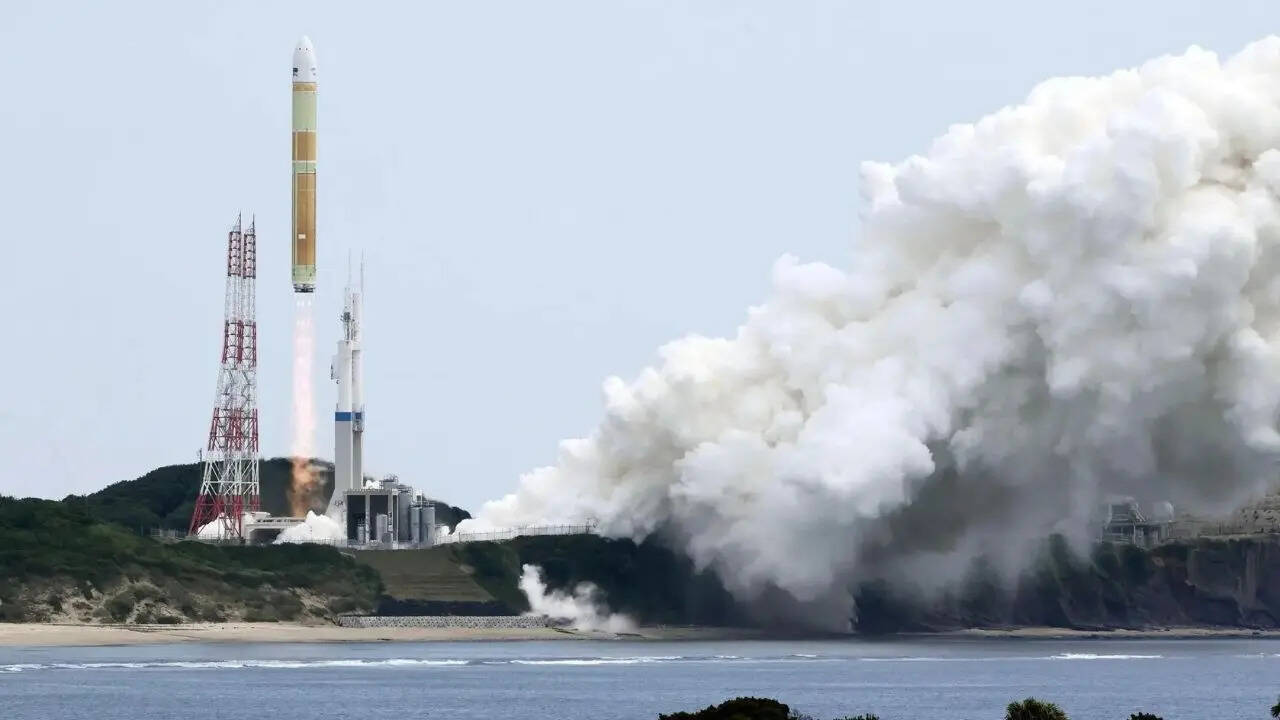
The control room at the Tanegashima Space Center always smells faintly of stale coffee and excessive air conditioning. It is a sterile, quiet sort of tension. On the monitors, Japan’s H3 rocket sits enveloped in the Pacific mist, looking less like a triumph of modern engineering and more like a multi-million-dollar monument to anxiety.
To understand what happened on that jagged coastline, you have to understand the silence that precedes a countdown. It is not peaceful. It is the suffocating quiet of a hundred engineers holding their breath, remembering the ghost of a machine that tore itself apart in the sky just a few years prior. If you found value in this post, you should check out: this related article.
When the H3’s maiden flight failed in March 2023, it did not just destroy a piece of hardware. It shattered a national pride. The order to self-destruct was sent after the second-stage engine refused to ignite, turning a state-of-the-art Earth observation satellite into an expensive shower of shooting stars over the ocean. In the brutal, unforgiving economy of modern aerospace, a single failure can set a country back a decade.
Japan found itself grounded. Its reliable workhorse, the H-IIA, was nearing retirement. Its smaller solid-fuel rocket, the Epsilon, had suffered its own catastrophic failure. The global satellite market was moving fast, dominated by the reusable, cut-throat efficiency of SpaceX. Meanwhile, Japan’s flagship ticket to the stars was stuck on the tarmac, branded with the worst label an aerospace program can wear: unreliable. For another look on this event, check out the recent coverage from ZDNet.
But engineering is not a discipline of permanent defeat. It is a stubborn, iterative conversation with physics.
The Price of Admission to the Cosmos
For decades, getting to space was an exercise in geopolitical vanity. Governments threw blank checks at aerospace agencies because the payload was national prestige. Today, the metric has changed. The cosmos is a marketplace. If you cannot launch cheaply, you do not launch at all.
The original H3 design was already an attempt to slash costs, aiming to cut the price per launch in half compared to its predecessor. But after the 2023 disaster, the Japan Aerospace Exploration Agency (JAXA) and its prime contractor, Mitsubishi Heavy Industries, faced an existential crossroads. They did not just need the rocket to fly. They needed it to be fiscally ruthless.
Enter the low-cost variant of the H3, designated H3-30.
To the untrained eye, it looks virtually identical to its ill-fated sibling. To an engineer, it represents a radical exercise in minimalism. The standard H3 relies on solid rocket boosters strapped to its sides to provide the brute force needed to escape Earth's gravity well. The low-cost variant strips those boosters away entirely. It relies solely on the raw, unassisted power of its liquid-fueled LE-9 main engines.
Think of it as stripping the luxury trim, the turbochargers, and the leather seats out of a sports car to make it light enough to win a drag race on a budget.
By removing the solid boosters, JAXA eliminated a massive chunk of manufacturing complexity and hardware cost. They also altered the vehicle's flight profile entirely. Without that initial kick from the boosters, the rocket’s ascent is a slower, agonizing burn. It places an immense amount of pressure on the main engines to perform flawlessly from the very millisecond of ignition.
It was a massive gamble. If the LE-9 engines faltered even slightly during the initial climb, the rocket would lack the velocity to escape, tumbling back into the sea.
The Machinery of Redemption
The morning of the return flight brought the kind of crisp, clear skies that launch directors pray for. The previous test flight in February 2024 had proven the core design could reach orbit, breathing life back into the program. But this flight was different. This was the debut of the stripped-down, commercial-ready configuration. This was the version meant to prove Japan could compete with commercial titans.
Inside the bunker, the atmosphere was thick. Every chart, every telemetry graph, every flickering green line of code was a reminder of the thousands of variables that had to align perfectly.
Consider the sheer violence of a rocket launch. You are controlled-exploding hundreds of tons of cryogenic liquid hydrogen and liquid oxygen. The plumbing required to move that fuel at supersonic speeds through pumps spinning at tens of thousands of revolutions per minute is a mechanical nightmare. A speck of dust in the wrong valve can cause a pressure spike. A pressure spike causes a detonation.
At T-minus zero, the three LE-9 engines ignited.
There was no immediate roar in the bunker, only the low, sub-audible vibration that rattles the teeth in your skull before the sound waves travel across the water. On the tracking cameras, the H3-30 lifted. It lacked the blinding, smoky fury of a booster-assisted launch. Instead, it rose with a deliberate, stately momentum, riding a column of clean, translucent blue flame.
The telemetry numbers began to climb. Sixty seconds. Ninety seconds. The vehicle cleared the period of maximum aerodynamic pressure, where the atmosphere tries its best to crush the hull like an aluminum can.
But the real test lay ahead. The ghost of 2023 lived at the staging sequence.
Clearing the Hurdle
The separation of the first stage is always a cinematic moment, but for the JAXA team, it was a psychological hurdle. The spent lower core fell away into the darkness of the upper atmosphere. Then came the silence. The brief, agonizing pause before the second-stage engine was scheduled to fire.
In 2023, that pause had stretched into eternity.
This time, the monitor updated instantly. A steady glow on the infrared tracking cameras confirmed ignition. The electrical system, completely redesigned after engineers traced the previous failure to an electrical glitch that tripped the engine's breaker, performed exactly as intended.
The relief in the room did not manifest as cheering. It was a collective exhale. A straightening of shoulders.
The H3-30 was carrying a dummy payload, a mass simulator designed to mimic the weight of a heavy satellite without risking a real piece of infrastructure. The objective was purely to demonstrate the vehicle's orbital insertion precision. As the second-stage engine cut out precisely on schedule, placing the simulator into its target orbit, the narrative of Japanese aerospace shifted.
The New Baseline
SpaceX has spent the last several years convincing the world that reusability is the only metric that matters. Their Falcon 9 rockets land, refurbish, and fly again with the regularity of commercial airliners. It is an impressive feat of engineering that has radically lowered the barrier to entry for orbit.
Japan is betting on a different philosophy with the H3.
Instead of investing the immense capital required to develop vertical-landing technologies and the heavy infrastructure needed to support it, JAXA chose to optimize expendable manufacturing. The H3 utilizes commercial, off-the-shelf automotive components where possible rather than specialized, space-grade electronics that cost ten times as much. The low-cost variant pushes this logic to its absolute limit.
By offering a modular design—allowing customers to choose between zero, two, or four solid boosters depending on the weight of their satellite—Japan can tailor the price of admission for every specific mission.
It is a quiet, pragmatic approach to the space race. It acknowledges that not everyone needs a reusable mega-rocket; some just need a reliable, cost-effective delivery truck to get their hardware to the correct cosmic zip code.
The success of the low-cost H3 variant means Japan is no longer watching the commercial satellite boom from the sidelines. It gives the country a sovereign gateway to space, ensuring they are not dependent on foreign entities to launch their defense, scientific, and meteorological payloads. It restores a critical piece of the global supply chain.
The mist eventually rolled back over the Tanegashima launchpad, swallowing the scorched concrete structures and the empty gantry. The monitors in the control room were finally turned off, their screens fading to black. The engineers would sleep for the first time in weeks, knowing that the sky above them was no longer a place of unavenged failure, but a corridor they had successfully reopened.