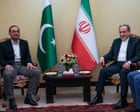
The ink in a diplomat’s pen weighs almost nothing, yet it carries the crushing pressure of millions of lives. In the quiet, wood-paneled rooms of Geneva or the sterile corridors of Doha, men in expensive suits trade clauses and sub-clauses while families three thousand miles away check their phones for news that might mean they can finally sleep through the night.
A ceasefire is not merely a legal document. It is a collective sigh of relief that hasn't happened yet.
When we talk about the proposed Iran ceasefire deal, the conversation usually shifts toward geopolitical chess pieces: enrichment levels, ballistic ranges, and regional proxies. But go deeper. Look at the bazaar in Tehran where a merchant watches the currency rates flicker like a dying pulse. Look at the student who wonders if their degree will ever be worth the paper it’s printed on if the world remains closed to them. The deal on the table is a map of compromise, drawn in the sand, hoping the wind won't blow it away before the ink dries.
The Anatomy of the Pause
The architecture of this proposal rests on a series of "ifs" that feel as fragile as glass. At its core, the deal seeks to freeze a clock that has been ticking toward a midnight no one wants to see.
The first pillar is the most technical: the physical limitation of nuclear capabilities. To the layman, the difference between 3.67% and 60% enrichment sounds like a math problem. To a nuclear physicist, it is the difference between a lightbulb and a mushroom cloud. The deal demands a reversal—a literal draining of the tanks. It asks Iran to mothball centrifuges that have been spinning for years, effectively trading their primary source of international leverage for a chance to breathe.
But what does Iran get in exchange for turning off the lights in its most secure facilities? The answer is "liquidity." For years, billions of dollars in Iranian assets have been frozen in foreign banks, sitting in digital vaults while the domestic economy withered. The proposal outlines a phased release of these funds. It is a slow-motion infusion of oxygen into a suffocating market.
The Ghost of 2015
Trust is the most expensive commodity in the Middle East, and currently, nobody can afford it. Every negotiator in the room is haunted by the ghost of the 2015 Joint Comprehensive Plan of Action (JCPOA).
Consider the perspective of an Iranian official who saw years of diplomacy shredded with a single signature in 2018. From their vantage point, a deal is a trap that resets their progress while offering no long-term security. Then, look through the eyes of a Western negotiator. They see a nation that has consistently pushed the boundaries of every agreement, using the shadows to expand influence while smiling at the cameras.
This friction creates the "Verification Gap." The current proposal doesn't just ask for promises; it demands cameras. Thousands of them. It requires International Atomic Energy Agency (IAEA) inspectors to have the kind of access usually reserved for a landlord checking a derelict apartment. They want to see the logs, the seals on the doors, and the data from the sensors. Without this, the paper is worthless.
The Invisible Stakes of the Regional Ripple
A ceasefire between Iran and the broader international community is never just about Tehran. It is about the flickering lights in Beirut, the shipping lanes in the Red Sea, and the silent drones over the desert.
The deal supposedly includes "under the table" understandings regarding regional stability. It suggests that if the nuclear tension cools, the proxy fires must be dimmed as well. This is where the narrative becomes a ghost story. How do you verify a "reduced intent" to support a militia? How do you measure the absence of a shipment of missiles that hasn't happened yet?
The regional neighbors—Saudi Arabia, the UAE, and Israel—watch these negotiations with a cold, focused dread. For them, a deal that only addresses nuclear enrichment is a failure. They argue that giving Iran back its frozen billions is like giving a bully a better set of brass knuckles. They fear the "Salami Slicing" tactic: where Iran gives up a little bit of its nuclear program to gain a massive amount of economic power, which it then uses to fund regional chaos.
The Human Cost of the Status Quo
Let’s step away from the maps and look at a hypothetical citizen—let’s call her Maryam. Maryam is a 24-year-old software engineer in Isfahan. She is brilliant, fluent in three languages, and spends her days navigating a "halal internet" that blocks the tools she needs to compete globally.
To Maryam, the ceasefire deal isn't about centrifuges. It’s about the price of medicine for her father, which has tripled because of sanctions. It’s about the possibility of a visa to attend a conference in Berlin. It’s about the hope that her country will stop being a "pariah state" and start being a place where she can build a life.
The tragedy of these high-level negotiations is that Maryam’s life is the bargaining chip. If the deal fails, the "Maximum Pressure" campaign continues. The currency devalues further. The shadow economy grows. The hardliners within the government point to the failed diplomacy as proof that the West can never be trusted, tightening their grip on the internal mechanics of the country.
The Fragility of the "Sunset"
One of the most contentious points in the proposed framework is the "Sunset Clause." This is the expiration date on the restrictions. Critics argue that a deal with an end date is just a delayed disaster. They claim it provides a legal pathway to a bomb, allowing Iran to wait out the clock while rebuilding its economy.
Proponents, however, see it as a "Cooling Off Period." They argue that ten or fifteen years of normalized relations could change the internal fabric of Iran. They bet on the idea that once a population tastes the benefits of global integration, it becomes much harder for a government to drag them back into isolation and conflict. It is a gamble on human nature versus ideological rigidity.
The deal also addresses the "Breakout Time"—the duration it would take for Iran to produce enough fissile material for a single weapon. Currently, that time is measured in weeks, perhaps days. The proposal seeks to push that back to a year. That year is the "Safety Buffer." It is the time required for the international community to detect a violation and react before it is too late.
The Shadow of the Domestic Front
Politics is the art of looking over your shoulder. In Washington, any deal with Iran is treated as political radioactive waste. Any concession is labeled as "appeasement." In Tehran, any concession is "surrender."
This creates a paradox where both sides must win enough to save face, but not so much that the other side looks like they lost. The current proposal tries to thread this needle by using "Parallel Steps."
- Iran stops enrichment at high levels.
- The U.S. issues a waiver for specific oil sales.
- Iran allows inspectors back into a specific site.
- The EU releases a tranche of humanitarian funds.
It is a choreographed dance where neither partner wants to lead. If one person trips, the music stops, and the lights go out.
The real danger isn't necessarily a "bad deal," but the "No Deal" vacuum. In the absence of a framework, the only remaining tools are sabotage, cyberwarfare, and eventually, kinetic strikes. We have seen the "Shadow War" play out for years—mysterious explosions at facilities, assassinations of scientists, and tanker seizures. A ceasefire is an attempt to move the conflict from the dark of the docks to the light of the table.
The Lingering Question
As the sun sets over the Alborz mountains, the people of Iran wait. They have heard these rumors before. They have seen the headlines of "Imminent Breakthroughs" that turned into "Stalled Talks" by the following Tuesday.
The proposed deal is a skeleton. It lacks the meat of long-term trust and the skin of true cultural reconciliation. It is a technical fix for a moral and historical chasm. Yet, it remains the only door left unlocked in a hallway of slammed exits.
The negotiators will continue to argue over the purity of uranium and the wording of sanctions relief. They will trade technicalities like baseball cards. But the true measure of their success won't be found in the text of the treaty. It will be found in whether or not a young woman in Isfahan can finally look at the horizon and see a future that belongs to her, rather than a headline she can't control.
The pen is hovering. The paper is waiting. The world is holding its breath, hoping that this time, the ink actually holds.