Ash smells like wet cardboard and melted copper.
If you have never stood in the skeletal remains of your own living room at six in the morning while gray sludge drips from exposed rafters, you cannot quite grasp how quiet a burned house becomes. The fire trucks leave. The neighbors go back inside to make coffee. And suddenly, the entire physical architecture of your life—the oak table where your kids did algebra, the cedar chest holding your grandmother's quilts, the cheap plastic spatula you flipped pancakes with every Sunday—has been reduced to black geometry.
Then the real fire starts.
It begins not with a spark, but with a PDF. Specifically, a request for proof of loss.
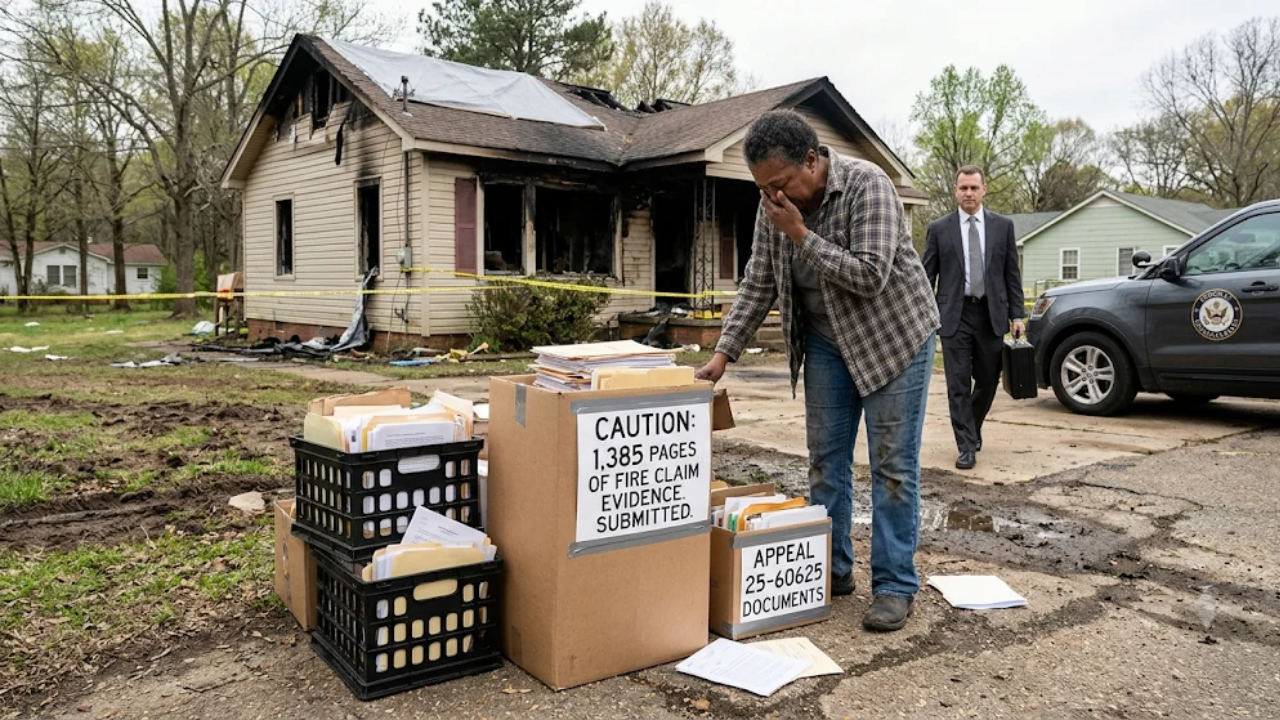
Consider a real-world headline out of Mississippi that reads like a clerical typo until you feel the weight of the paper in your hands. Following a devastating 2023 house fire that inflicted roughly $440,000 in structural and personal property damage, a Mississippi homeowner compiled a staggering 1,385-page insurance claim. Think about that number for a second. One thousand, three hundred, and eighty-five pages. That is longer than War and Peace. That is an encyclopedia of a human life, reconstructed line by line from memory, bank statements, charred receipts, and sheer desperation.
And what did the insurance carrier do with that monumental stack of human grief and meticulous accounting?
They rejected it.
The Architecture of Exhaustion
To understand how a person ends up typing out a 1,385-page inventory only to have a door slammed in their face, you have to understand the invisible asymmetry built into every standard homeowners insurance policy.
When you buy coverage, the transaction feels warm, almost protective. A friendly agent talks about peace of mind. You pay your premiums on time, month after month, year after year, treating the policy like a safety net stretched tight beneath your family's finances. You assume that if the worst happens, the company you paid to catch you will simply open its checkbook and make you whole.
That assumption is a dangerous fiction.
Let us step into a hypothetical scenario to see how the machinery actually grinds. Imagine a composite homeowner—let us call him Marcus—standing on his driveway in a small Mississippi town the morning after an electrical fire guts his home. Marcus is not a forensic accountant. He is a high school shop teacher who knows how to frame a wall and fix a carburetor, not how to navigate a labyrinth of policy exclusions.
Within forty-eight hours, an adjuster arrives with a clipboard and a sympathetic nod. The adjuster explains that before the carrier can release funds for personal property—known in policy jargon as Coverage C—Marcus must submit an itemized inventory of every single item destroyed in the blaze. Not categories. Not "kitchenware, roughly four thousand dollars." Every spoon. Every pair of socks. Every paperback novel, extension cord, and half-empty bottle of olive oil.
For each item, Marcus must provide a description, an approximate age, a replacement cost, and ideally, proof of ownership.
How do you prove you owned a toaster that burned to ash?
You dig through three years of credit card statements. You ask relatives to text you photos of Thanksgiving dinner so you can zoom in on the background and prove you owned a dining set. You walk through the ruins with a flashlight, photographing melted lumps of aluminum and praying the serial number on a charred washing machine is still legible.
Month after month, Marcus sits at a folding table in a cramped rental apartment, typing rows into a spreadsheet until his eyes burn. Every row is a tiny resurrection of something he lost, followed immediately by the sickening realization that he has to assign a dollar value to a memory. By the time he hits print, the document stretches to 1,385 pages. It represents hundreds of unpaid hours, a second full-time job performed while grieving, all to claim the $440,000 needed to rebuild a life.
And then comes the letter. Denied.
Why Insurers Say No to Everything
Why would an insurance company reject a claim backed by more than a thousand pages of documentation? If you think the answer is fraud, you are looking at the exception rather than the rule. In the vast majority of disputed large-loss fire claims, rejection is not a moral judgment; it is a business model.
Insurance carriers operate on a simple financial float. Every dollar they hold onto for an extra month, an extra quarter, or an extra year stays invested in interest-bearing accounts. When a catastrophic claim of $440,000 lands on a claims manager's desk, paying it out immediately hurts the quarterly loss ratio. Delaying it, disputing it, or rejecting it outright shifts the leverage entirely onto the company's side of the table.
We call this strategy "delay, deny, defend," and it relies on predictable human exhaustion.
When an insurer rejects a massive claim, they rarely say, "We just do not want to pay you." Instead, they weaponize technicalities buried in sixty pages of dense policy language. Look closely at the mechanisms routinely used to invalidate a homeowner's mountain of proof:
- The Material Misrepresentation Trap: If a stressed, exhausted homeowner accidentally lists a television as two years old when the receipt shows it was four, or includes an item that was actually stored in a shed that did not burn, the carrier may cry fraud. Under many policy clauses, a single innocent error across 1,385 pages can be used to void the entire claim from top to bottom.
- The Strict Proof-of-Loss Deadline: Most policies give homeowners a narrow window—often just sixty days—to submit a sworn proof of loss. Compiling a thorough inventory for a $440,000 loss in sixty days while displaced from your home is practically impossible. Miss the deadline by twenty-four hours, and the carrier has a legal excuse to walk away.
- Actual Cash Value vs. Replacement Cost Holdbacks: Even when a claim is not fully rejected, insurers routinely slash payouts by applying aggressive depreciation. They might argue your five-year-old roof or ten-year-old furniture has lost seventy percent of its value, leaving you with a fraction of what it actually costs to buy new materials in today's economy.
- The "Duty to Cooperate" Maze: Insurers can demand Examination Under Oath sessions—essentially high-stakes depositions conducted by insurance defense attorneys—alongside years of tax returns, phone records, and bank statements. If the homeowner balks at handing over unrelated personal data, the claim is rejected for non-cooperation.
Think about the psychological toll of this gauntlet. You are homeless. Your kids are sleeping on air mattresses. Contractors are demanding deposits before lumber prices jump again. And the giant corporation you trusted is treating you like a criminal suspect because you could not produce a paper receipt for a lawnmower you bought at a yard sale in 2019.
Eventually, most people break. Faced with the prospect of hiring a lawyer and waiting three years for a court date, a desperate homeowner will often accept a lowball settlement of forty or fifty cents on the dollar just to get a roof over their family's head.
The insurer saves two hundred thousand dollars. The homeowner never fully recovers.
The Anatomy of a Policy Blind Spot
I learned this lesson the hard way years ago, though on a smaller scale, when a pipe burst behind a plastered wall in my own home and flooded two floors while I was out of town. Standing in three inches of stagnant water, watching drywall crumble like wet saltines, I felt a strange wave of relief. Thank God I have good insurance, I told myself.
That relief lasted until the adjuster explained the difference between sudden water discharge and "gradual seepage."
Suddenly, I was no longer a customer. I was an adversary. Every word I spoke during our recorded phone call was parsed for ambiguity. Did I notice a damp spot on the baseboard three weeks ago? Had I checked the shutoff valve recently? I realized in that cold, fluorescent-lit kitchen that an insurance policy is not a promise of care; it is a unilateral contract written entirely by the party holding the money.
Most homeowners never read their policy declarations until disaster strikes. Even fewer understand the specific traps lurking inside standard fire coverage.
Take the concept of co-insurance penalties and underinsurance gaps. Construction costs across the American South—and particularly in states like Mississippi, where severe weather and supply chain bottlenecks have driven up labor and material rates—have surged dramatically over the past few years. A home insured for $300,000 in 2018 might easily cost $440,000 to rebuild today. If your policy does not include an extended replacement cost endorsement, you are on the hook for every dollar above your coverage limit, even if the insurer approves your claim.
Then there is the agonizing reality of unscheduled personal property. Standard policies cap payouts for entire categories of belongings. Jewelry, firearms, silverware, electronics, and tools often carry strict sub-limits—sometimes as low as $1,500 or $2,500 total—regardless of how many pages of documentation you submit. If a homeowner had $30,000 worth of woodworking tools in a garage that burned down, and never purchased a separate rider for them, the insurer can legally reject $27,500 of that portion of the claim on sight.
And what about code upgrade coverage? When a $440,000 fire guts an older home, you cannot simply rebuild it the way it was constructed in 1985. Modern electrical, plumbing, and wind-load building codes require massive upgrades. Without specific "Ordinance or Law" coverage in your policy, the insurance company will pay to replace your old, outdated wiring—and refuse to pay a dime for the mandatory modern electrical panel required by the city inspector before you are allowed to move back in.
How to Bulletproof Your Claim Before the Smoke Rises
If a 1,385-page paper trail can still be rejected by a determined insurance carrier, what hope does an ordinary homeowner actually have?
The answer lies in flipping the timeline. You cannot build your defense while standing in the ashes. You have to build it on a sunny Tuesday afternoon when nothing is wrong, using tools that remove every ounce of subjectivity from the claims process.
First, stop relying on memory and paper receipts. Once a month, take your smartphone, hit record on video, and walk slowly through every room of your house. Open every closet door. Pull out every kitchen drawer. Open the cabinets in the garage. Narrate out loud as you walk: "Here is the DeWalt miter saw, bought in 2022. Here are the winter coats. Here is the stainless steel cookware set." Speak clearly, linger on brand names and serial numbers, and upload that video immediately to a cloud server—not a hard drive sitting on your desk that will melt in a fire. That ten-minute video is worth more than a thousand pages of post-fire spreadsheets because it proves possession and condition simultaneously.
Second, never sign a blank authorization or give an unrecorded, off-the-cuff statement after a major loss. When an adjuster calls you hours after a fire, your brain is flooded with cortisol and shock. You are in no condition to answer technical questions about electrical maintenance or occupancy timelines. Tell the carrier politely that you are focusing on your family's immediate safety and will provide written responses once you have reviewed your policy.
Third, understand when to bring in your own heavy artillery. When a loss crosses six figures—like a $440,000 fire—you are no longer dealing with a routine claim; you are entering a high-stakes financial negotiation against professionals who handle catastrophic losses every single day. Hiring a licensed public adjuster—an independent claims professional who works exclusively for you, not the insurance company—levels the playing field immediately. Public adjusters speak the exact forensic accounting language carriers use, know how to format line-item estimates using industry software like Xactimate, and prevent you from falling into procedural traps. And if a carrier still issues an unjust denial on a massive claim, bad-faith insurance attorneys exist specifically to hold companies accountable in court, where punitive damages can turn a $440,000 rejection into a multi-million-dollar liability for the insurer.
The Ashes and the Ledger
We buy insurance because we want to believe that catastrophe has a safety valve. We want to believe that if the worst night of our lives arrives—if flames tear through the roof while our family escapes into the yard in bare feet—there will be an orderly, fair system waiting on the other side to help us put the pieces back together.
That Mississippi homeowner who spent months assembling 1,385 pages of proof believed in that bargain. Every single page in that stack was an act of good faith, an attempt to play by the rules of a game written by someone else, hoping that sheer diligence would be enough to earn back what the fire took away.
The rejection of that claim is a cold wake-up call for anyone holding a mortgage and a policy folder tucked away in a filing cabinet. Paper alone will not save you. Good faith will not save you.
Until you document what you own before the smoke rises, read the fine print while the walls are still standing, and recognize that a major insurance claim is not a customer service request but a legal battle for your financial survival, you are standing on a floor thinner than you think.