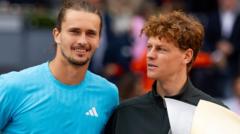
The locker room beneath Centre Court possesses a specific, institutional quietness in the hours before a final. It smells of liniment, freshly laundered white towels, and the faint, damp scent of crushed ryegrass tracking in from the corridors. For Jannik Sinner, this space is not a sanctuary, but a crucible. The world looks at his lean frame, his shock of red hair, and the effortless velocity of his baseline strokes and sees a machine calibrated for modern tennis. They see a young man who has collected Grand Slam trophies like standard milestones.
But machines do not feel the tightening in the chest when the afternoon shadows begin to stretch across the lawn.
To understand Sinner on the eve of a Wimbledon final is to understand a man who respects danger. He does not view his opponents as obstacles to be brushed aside; he views them as puzzles that can, if misread by even a millimeter, explode in his face. And there is no puzzle in the modern game quite as volatile, or quite as imposing, as Alexander Zverev.
The public narrative surrounding a major final usually relies on a simple script. The champion is supposed to radiate absolute certainty. The pre-match press conferences are filled with standard, sanitized quotes about focusing on one's own game and executing the game plan. Yet, behind closed doors, the reality is entirely human. Sinner knows that tennis is a game of microscopic margins. He knows that being the favorite is a psychological construct created by people who do not have to return a 135-mile-per-hour serve on a slippery, worn-down baseline.
Consider what happens when the first ball is struck. The grass at Wimbledon changes over a fortnight. In the first week, it is lush, green, and predictable. By the second Sunday, the baseline is a strip of hard, dust-colored dirt, while the grass just beyond it remains slick. It creates an uneven terrain where the ball can stay low or shoot forward unexpectedly. For a player like Sinner, who relies on perfect timing and hitting the ball at the absolute peak of its bounce, this shifting surface requires constant, exhausting mental adjustment.
Now add Zverev into that equation.
Standing at six-foot-six, Zverev alters the geometry of a tennis court. When he is serving well, the net seems to shrink. His first serve does not just fly through the air; it crashes down from an altitude that makes the bounce incredibly difficult to read on a dying grass court. For years, pundits argued that Zverev’s game was too mechanical, too reliant on safety from the back of the court, and prone to fracturing under the ultimate pressure of a Grand Slam final. But Sinner does not watch pundits. He watches film. He remembers the matches where Zverev’s backhand became an impenetrable wall, refusing to give up a single error, suffocating opponents through sheer consistency and length.
There is a distinct vulnerability in admitting that an opponent frightens you tennis-wise. It contradicts the modern athletic creed of total dominance. But Sinner’s wariness is not fear; it is the highest form of tactical awareness.
Imagine standing on a surface where your footing is always slightly uncertain. Every time you plant your left foot to slide into a forehand, there is a micro-second where you might lose traction. In that same micro-second, a yellow ball is hurtling toward your backhand wing at a speed that defies normal human reaction time. If you cheat to one side, Zverev’s serve pushes you out of the tramlines. If you stay central, he burns you down the T. This is the tactical prison that Sinner spends his nights trying to dismantle.
The two men carry entirely different histories onto the court. Sinner represents the ascension of a new order, a transition from the era of aging titans into a sleek, hyper-athletic future. His rise has felt inevitable to many, a natural progression of a talent nurtured in the quiet mountain towns of San Candido, where the stillness teaches you how to focus. Zverev, by contrast, has lived a tennis life of intense drama, massive triumphs, agonizing injuries, and a lingering sense of unfulfilled destiny at the absolute highest level. When a man with that much scar tissue finds himself one match away from the ultimate prize on grass, he becomes dangerous in a way that data cannot quantify.
Desperation is a powerful fuel. Sinner knows this. He has used it himself when coming back from sets down in his young career.
But the real problem lies elsewhere, far deeper than the technical analysis of serves and returns. The true battle of a Wimbledon final is the management of internal silence. When twenty thousand people in the stadium fall dead quiet right before a serve, the sound of your own heartbeat becomes loud. Every doubt you tried to bury during your morning warm-up comes rushing to the surface.
Sinner’s team, led by the calm, analytical presence in his box, has spent months refining his movement on grass. They used to say he moved like a hard-court player who happened to be wearing grass shoes. He would slide too much, risking his ankles, failing to find the low center of gravity required to dig out low slices. Over the past two seasons, that has changed. He has learned the short, choppy steps. He has learned to embrace the discomfort of playing with his knees bent so low to the ground that they are nearly scraping the turf.
Yet, Zverev presents a unique physical challenge because he refuses to give away free points when he is locked in. His wingspan means that shots which would be clean winners against eighty percent of the tour are caught, neutralized, and sent back with interest. To beat him, Sinner cannot just hit through him; he has to out-think him, out-last him, and out-suffer him.
The locker room attendant knocks on the door. It is the fifteen-minute warning.
Sinner stands up, adjusts the white sweatbands on his wrists, and takes a deep breath. He knows the stadium outside is buzzing with expectation, expecting a coronation, a spectacular display of his signature power. They want the narrative of the unstoppable champion. But as he walks down the wooden stairs, past the framed photographs of past champions looking down with frozen, timeless smiles, Sinner is thinking only of the first return. He is thinking of the towering figure waiting at the net, a man who wants the exact same piece of history, and who has the weapons to take it.
The walk from the clubhouse to Centre Court is short, but it feels like an eternity. The applause hits them like a physical wave as they step out onto the grass. The sun is bright, glinting off the metal chairs and the white lines. Sinner looks across the net during the warm-up, watching the ball leave Zverev’s racquet. The sound is clean. The pace is heavy.
There are no secrets left between these two. There is only the grass, the ball, and the quiet, stubborn refusal to blink first.