Doha was vibrating.
November 2022. The air in Qatar was thick with the artificial chill of stadium air conditioning and the breathless anxiety of a billion screens tuned to a single desert peninsula. The World Cup is rarely just about football. It is a proxy war played in shorts and cleats. It is a stage where nations with deep, historic hatreds are forced to share a 115-by-74-yard rectangle of manicured grass. Meanwhile, you can explore similar events here: The Myth of Argentina's Greatness and Why Austria Actually Exposed the Champions.
But before the whistle even blew for the defining match of Group B, the conflict had already started. It didn’t begin with a slide tackle. It didn’t begin with a fiery press conference.
It began with a delete button. To understand the full picture, we recommend the excellent article by Sky Sports.
On a weekend in late November, the United States Soccer Federation posted a graphic to its social media channels showing the standings for Group B. England, Iran, USA, Wales. A standard digital flyer.
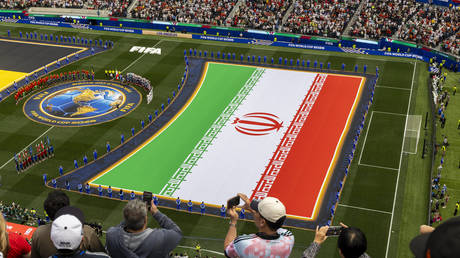
Except something was missing. The Iranian flag, normally bearing the stylized red emblem of the Islamic Republic—a symbol designed in 1980 to represent the word "Allah" and the phrase "There is no god but God"—was gone. In its place was a blank strip of white, sandwiched between green and red.
A void.
US Soccer was swift to explain. This was not a mistake. It was a calculated act. A spokesperson stated the graphic was a show of support for the women in Iran fighting for basic human rights.
Back in Iran, the streets were burning. Months earlier, 22-year-old Mahsa Amini had died in the custody of the country's morality police. Her death ignited a nationwide uprising. Young women were cutting their hair in public squares. Protesters were dying. The scent of tear gas was settling into the fabric of Tehran's neighborhoods.
From a boardroom in Chicago, an American PR team decided to strip the emblem from the flag to stand with those women.
The reaction from Tehran was immediate. Visceral. The Iranian football federation did not see solidarity; they saw an act of digital imperialism. They saw a violation of sovereignty. State media erupted, demanding the US team be immediately expelled from the tournament. They pulled out the rulebook.
They had a point.
Section 13 of the FIFA disciplinary code is clear. "Any person who offends the dignity or integrity of a country, a person or group of people through contemptuous, discriminatory or derogatory words or actions... shall be suspended for at least ten matches."
Ten matches. Expulsion.
Iran slammed the paperwork down on FIFA’s desk. They demanded action. They demanded the governing body of world football punish the United States for erasing their national identity.
FIFA did nothing.
Silence.
This is where the story stops being about a soccer graphic and starts being about the heavy, uncomfortable reality of selective justice.
FIFA is an organization that regulates the exact millimeter width of a sponsor’s logo on a player’s sock. They will fine a player for lifting a jersey to reveal a handwritten birthday message to their mother. They operate with a ruthless, micromanaging obsession with their own rules. "Keep politics out of sports" is their eternal, golden shield.
Yet, when a national federation intentionally altered the flag of a geopolitical rival during the most heavily publicized tournament on earth, FIFA froze.
The inaction spoke louder than any sanction could have.
To understand the sheer emotional weight of this moment, you have to step away from the corporate offices of FIFA and the state broadcasters of Tehran. You have to put yourself in the shoes of an ordinary Iranian fan. Let’s imagine a young woman named Zara. She lives in the diaspora now, maybe in London or Los Angeles, watching the tournament on a laptop.
For Zara, the Iranian flag is a deeply painful paradox. The green, white, and red are the colors of her heritage, the food she eats, the poetry she reads, the grandparents she misses. But that central emblem? To her, and to millions of protesters, that emblem represents the regime. It represents the morality police. It represents the very entity that is beating her friends in the streets.
When US Soccer removed the emblem, a part of Zara might have felt a dark, bitter thrill. A visible middle finger to the regime.
But then the reality sets in. Who is the United States to edit her country's flag?
Solidarity from a distance is easy. It costs a graphic designer five minutes in Photoshop. It is a clean, sterile activism that carries absolutely no physical risk. The American players weren't dodging rubber bullets. The American social media managers weren't risking imprisonment.
By altering the flag, the US handed the Iranian government a massive, glittering gift. The regime, deeply unpopular and fighting a domestic uprising, suddenly had an external enemy to point at. They could play the victim. They could go on television and say, Look at the Americans. They do not respect us. They erase our identity. They break the rules, and the world lets them do it.
The regime used the US Soccer graphic to change the conversation. For a few crucial days, the international headlines were not about the brave women of Iran. They were about a bureaucratic squabble over a JPEG.
FIFA's silence only validated the Iranian state's narrative of Western hypocrisy. By refusing to enforce their own strict rules against discrimination and political messaging, FIFA signaled that the rules only apply when it is convenient. If Iran had posted an American flag with the stars removed to protest gun violence, the reaction from the Western world—and likely from FIFA—would have been volcanic.
This double standard is what the Iranian federation slammed. And frankly, the anger was justified.
A flag is not just a piece of cloth, and a digital flag is not just a collection of pixels. It is an avatar of the state. To alter it is a declaration.
The tension surrounding the impending US-Iran match reached an unbearable pitch. The pre-match press conference became a surreal theater of war. Iranian journalists peppered US captain Tyler Adams with aggressive questions about American racism and inflation. Adams, 23 years old, sat behind a microphone and answered with a quiet, stunning grace, apologizing for mispronouncing the word "Iran" and speaking thoughtfully about the slow progress of civil rights in his own country.
He was a football player forced to be a diplomat because his federation’s social media team wanted to make a point.
US Soccer eventually deleted the altered graphics. They put the emblem back. They claimed the point had been made. But the digital ghost of that empty white space lingered over the stadium when the two teams finally walked onto the pitch at Al Thumama Stadium.
The whistle blew.
For 90 minutes, the geopolitics faded into the physical reality of lungs, muscle, and sweat. The game was breathless, desperate, and beautiful. The US won, 1-0, advancing to the knockout stages and sending Iran home.
When the final whistle sounded, the American and Iranian players collapsed onto the grass. They were exhausted. They were broken.
Antonee Robinson, the American defender, walked over to Ramin Rezaeian, the Iranian defender who was weeping uncontrollably on the turf. Robinson didn't see an emblem. He didn't see a geopolitical rival. He saw a man whose dream had just died. Robinson knelt down, wrapped his arms around Rezaeian, and held him.
They stayed like that for a long time. Two young men in the desert night, holding each other in the exact space where all the noise, the posturing, and the politics finally burned away.