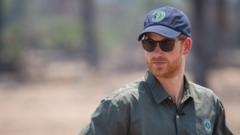
Dust gets into everything. It clings to the lenses of cameras, coats the seats of Land Rovers, and settles deep inside the lungs of anyone who spends long enough tracking the ancient paths of elephants across the baked earth of southern Africa.
For years, we told ourselves a clean story about conservation. We pictured dusty heroes in khaki shirts, standing as a bulwark between majestic creatures and the dark forces of poachers. We wanted to believe the shield was pure. We needed to believe that protecting the wild was an act of unblemished grace. In other updates, we also covered: Nitro Camden and the Algorithmic Lottery: Inside the Trauma Economy of Streaming.
Then the dust clears. And you see the bruises.
Prince Harry’s decision to quietly step down from the board of African Parks is not merely a bureaucratic footnote in the ledger of a high-profile charity. It is a fracture line. It exposes the agonizing distance between the romanticized ideal of saving nature from a London boardroom and the gritty, violent reality on the ground where the boots actually march. Associated Press has also covered this fascinating topic in great detail.
Consider what happens when a conservation model relies on militarized enforcement. (Note: This is a structural analysis of systemic law enforcement models, not a reference to a specific individual officer). Imagine a ranger patrolling a national park boundary. He is underpaid, chronically exhausted, and equipped with a rifle and the mandate of an occupying army. He bears the weight of a continent's ecological survival on shoulders already strained by poverty. When pressure mounts from donors demanding zero-poaching targets, desperation takes root. Lines blur.
Reports emerged—detailed, harrowing, and thoroughly documented by organizations like BuzzFeed News—detailing severe human rights abuses committed by rangers associated with African Parks in the Odzala-Kokoua National Park in the Republic of Congo. We are talking about indigenous Baka people. People whose ancestors walked those forests before maps were drawn. They faced beatings, torture, and intimidation, all allegedly executed in the name of preserving biodiversity.
Let that sink in.
We built a cage for the poachers, and somehow, the people who lived in the forest became the collateral damage.
When those reports first surfaced, the response from elite boardrooms followed a familiar, weary script. Deny, deflect, investigate internally, and hope the news cycle starves the scandal of oxygen. But the world has grown tired of corporate armor. Transparency is no longer a luxury item; it is the price of admission.
Harry’s departure tells us something profound about the limits of remote stewardship. You cannot manage moral hazard from a royal estate thousands of miles away. Or perhaps, you can, until the human cost becomes too loud to ignore.
I remember sitting around a fire in the Okavango Delta years ago, listening to a local guide speak about wildlife protection with a quiet weariness. He didn't talk about ivory tusks or rhino horn street values. He talked about trust. He talked about how a community will only protect a lion if that lion doesn't eat their livelihood, and more importantly, if the men with guns don't treat the villagers like the enemy.
Conservation without human rights is just colonization with better PR.
That is the uncomfortable truth that gets buried beneath glossy fundraising brochures and gala dinner speeches. When you militarize a landscape, you introduce an instrument of state-sanctioned fear. You tell the indigenous populations who have coexisted with megafauna for centuries that their presence is an inconvenience, an encroachment on the pristine playground of global tourism and carbon offsets.
African Parks manages millions of hectares across multiple nations. It is an administrative leviathan. It takes on the heavy lifting of running entire national parks where failing states have abdicated their duties. To their credit, they stepped into vacuums that would have otherwise become killing fields. Elephants were saved. Habitats were stabilized.
Yet, capability does not grant absolution.
When allegations of abuse against the Baka community broke, African Parks commissioned an independent review. They promised accountability. But for a patron whose entire personal brand is built on modernizing empathy, championing mental health, and standing up for the vulnerable, sitting on a board facing systemic torture allegations is an untenable paradox.
You cannot champion the voiceless while your own organization’s enforcers are accused of silencing them.
The resignation was not explosive. There was no theatrical press conference on the steps of Buckingham Palace, no fiery manifesto published in the tabloids. It was a quiet exit. A vanishing act.
Yet silence can be deafening.
It forces us to confront our own complicity as consumers of conservation narratives. We buy the coffee table books. We double-tap the Instagram reels of baby rhinos being released into the wild. We donate our twenty dollars a month to feel like we are stitching a torn world back together. We rarely ask about the collateral ledger. We rarely ask whose land was fenced off, whose grandfather was beaten at the forest edge, or whose survival was criminalized to make room for a tourist safari.
The wildlife is innocent. The indigenous villagers are vulnerable. The systems connecting them are broken.
Prince Harry stepped away because the math no longer worked. The conservation equation cannot balance if the variables include human suffering. As the dust settles over the Congo basin and the high-altitude offices in Europe alike, the path forward demands a radical reckoning.
We have to stop treating conservation as a wildlife problem. It is a human problem. Until we learn to protect the earth by honoring the people who share its soil, every victory parade over a saved species will carry the faint, hollow echo of a closed door.