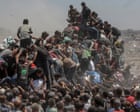
Starvation is cheap. It costs a military leader almost nothing to block a food convoy, poison a well, or burn a field of wheat. It is a highly efficient, silent weapon. Today, weaponized hunger and food-related violence are spiking globally at rates that should terrify anyone paying attention.
We often think of war as bombs, drones, and bullets. But the real devastation usually happens in the kitchen, the marketplace, and the farm. When conflict erupts, food supply chains do not just break by accident. Armies, militias, and rebel groups deliberately shatter them to force populations into submission.
Data from groups like the Armed Conflict Location & Event Data Project (ACLED) and the World Food Programme show a brutal reality. Incidents of food-related violence—which includes targeting aid workers, looting markets, and destroying agricultural infrastructure—have dramatically risen over the last few years.
Understanding why this is happening is essential. More importantly, we must look at how the international community fails to stop it, and what actually needs to change to protect vulnerable populations.
The Reality of Food-Related Violence
Food-related violence is not just a side effect of war. It is a deliberate strategy.
When a military force cuts off access to food, they are avoiding the need to fight a traditional battle. They just wait out the population. This tactic is explicitly banned under international law, specifically Rule 53 of Customary International Humanitarian Law, which prohibits using starvation of civilians as a method of warfare. Yet, enforcement is virtually nonexistent.
Look at what has happened in recent conflicts across the globe. In Sudan, the ongoing clash between the Sudanese Armed Forces and the Rapid Support Forces has turned the country's agricultural heartlands into battlefields. Farmers cannot plant crops. Markets are looted routinely. Millions face acute food insecurity because holding food hostage is a primary lever of power for both sides.
In Yemen, years of conflict saw blockades on the port of Hodeidah, the entry point for most of the country’s food imports. Cranes were bombed. Warehouses were targeted. The result was a manufactured famine.
This is not a matter of bad weather or crop failure. It is human-engineered devastation. When a missile hits a grain silo, it is not a stray shot. It is a targeted strike on the survival of an entire community.
Why Current Aid Models Are Failing
The traditional humanitarian response to conflict-driven hunger is broken. It relies on a flawed premise: that if people are hungry, you just need to ship food to them.
That does not work when the warring parties are actively using food as a chess piece.
When international aid agencies send convoys of grain into a conflict zone, those trucks often become high-value targets. Militias hijack them to feed their own fighters or to sell the food on the black market to fund their operations. In essence, sending aid without strict, secure, and independent distribution can accidentally fuel the very conflict causing the hunger.
Humanitarian workers face unprecedented danger. Gangs and state militaries regularly target aid distribution centers. When an organization pulls out of a region because its staff are being killed, the weaponization of hunger succeeds. The perpetrators achieve their goal of isolating and starving the population without firing a single bullet at the civilians themselves.
We also see bureaucratic blockades. Governments use paperwork, visa denials, and customs delays to stop food from reaching rebel-held areas. It is starvation by red tape. It is clean, it leaves no blood on the floor, and it is completely lethal.
The Economic Incentive of Starvation
War is expensive, but starving an enemy is incredibly cost-effective.
Consider the economic cycle of a war zone. When local food production is destroyed, the price of whatever food remains skyrockets. Inflation hits triple digits. Black markets thrive, and those black markets are almost always controlled by warlords or corrupt officials.
For these actors, keeping food scarce is profitable. They control the supply, so they control the price. They decide who eats and who starves based on political loyalty or the ability to pay exorbitant prices.
This completely distorts the local economy. Farmers give up because their crops will just be stolen or burned. Livestock is slaughtered early or confiscated. The entire agricultural knowledge base of a region can be wiped out in a few seasons, leaving the area dependent on external aid or black-market exploitation for decades after the fighting stops.
Fixing a Broken International Response
Stopping the surge in food-related violence requires moving past empty political statements and toothless UN resolutions.
United Nations Security Council Resolution 2417, adopted in 2018, explicitly condemns the use of starvation as a method of warfare. It was hailed as a milestone. But a resolution is just a piece of paper if no one enforces it. Since its passage, the weaponization of hunger has only intensified.
To actually change the calculus for military leaders, the international community must alter the consequences.
First, agricultural destruction and food blockades must be prosecuted aggressively as war crimes by the International Criminal Court. Currently, prosecutions focus almost entirely on direct violence like massacres or sexual violence. While those are horrific, starving one hundred thousand people through a blockade is just as devastating, yet the perpetrators rarely face a courtroom for it.
Second, tracking must improve. Organizations need to use satellite imagery and open-source intelligence to document the destruction of farms, water infrastructure, and food storage facilities in real time. Publicly naming and shaming the specific military units responsible removes the shroud of deniability.
Third, aid delivery must adapt. Decentralized aid, such as direct cash transfers or localized cryptocurrency wallets where markets still function, can be harder for militias to intercept than a massive, highly visible convoy of trucks. Supporting local, underground food production networks within besieged areas keeps communities self-sufficient and reduces the leverage of those holding blockades.
True accountability means making the weaponization of hunger more costly to the perpetrator than any strategic advantage it provides on the battlefield.