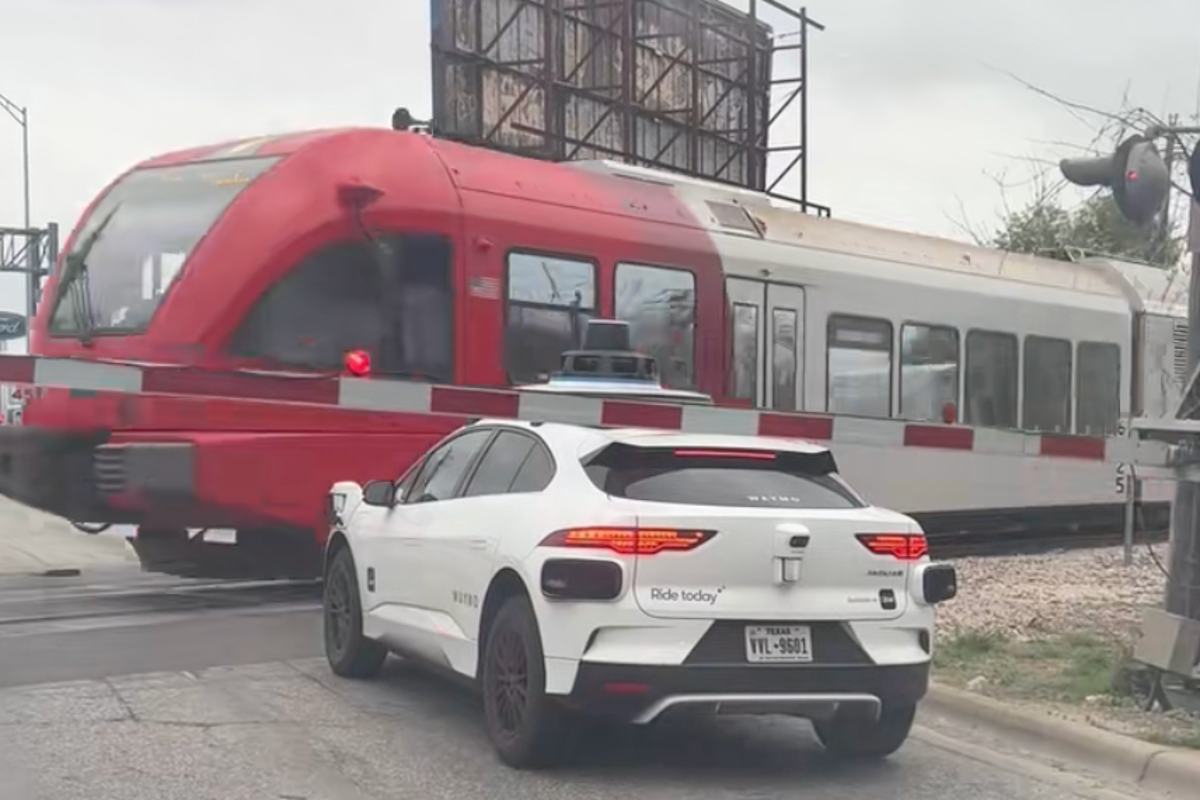
Self-driving cars were supposed to be the predictably boring solution to human error. Then a viral video from a rail crossing in California changed the conversation. You've probably seen the footage by now. A Waymo Jaguar I-Pace finds itself in the absolute worst spot imaginable: pinned between a closing gate arm and an active set of train tracks as a freight train screams past just inches from its bumper. It isn't just a "scary moment." It's a massive red flag for the entire industry.
If you're wondering how a billion-dollar sensor suite failed to account for a basic "don't stop on the tracks" rule, you're not alone. This wasn't a freak weather event or a hidden obstacle. It was a logic failure in a high-stakes environment. The car didn't crash, but it survived because of luck and a few inches of clearance, not because the software handled the situation with grace.
The geometry of a near miss
Let's look at what actually happened on those tracks. In the video, the Waymo vehicle appears to be navigating a complex intersection where the road crosses a railway. As the traffic ahead slows or the lights change, the car moves forward. Then the bells start. The gate arms begin their descent.
Most human drivers have a built-in fear of tracks. We've had it drilled into us since driver's ed: never enter the crossing unless you can clearly exit the other side. Waymo's AI is programmed with these same rules. Yet, the car ended up trapped. It stopped because the gate arm coming down in front of it was detected as an obstacle. Its primary directive—"don't hit things"—overrode the much more important directive: "get off the tracks now."
This highlights a massive problem with edge cases. When two rules conflict, the car has to choose. In this instance, the car chose to stop to avoid a plastic gate arm, essentially offering itself up to a multi-ton locomotive. It’s a classic example of "brittle" AI. The system follows the letter of the law but misses the life-saving logic of the situation.
Why sensors sometimes see too much
Waymo uses a suite of LiDAR, cameras, and radar. It sees in 360 degrees. It never gets tired. But sometimes, seeing everything is the problem.
When that gate arm started to drop, the LiDAR sensors flagged it as a solid object in the vehicle's immediate path. To the computer, that gate is a "hard stop." It doesn't necessarily weigh the risk of the gate against the risk of the train unless the train is already occupying the same spatial coordinates. By the time the train is there, it's too late.
The car's behavior suggests a gap in "spatio-temporal reasoning." That’s a fancy way of saying the car doesn't always understand how a situation will evolve over the next five seconds. A human sees the gate move and thinks train. The car sees the gate move and thinks blocked path.
The problem with stopping by default
For years, the safety pitch for autonomous vehicles (AVs) has been that they are "cautious." If they get confused, they stop. In a parking lot, that's great. In a suburban cul-de-sac, it's fine. On a railroad crossing, stopping is the most dangerous thing you can do.
We’ve seen this "freeze" behavior before. Waymo vehicles have been caught blocking ambulances or getting stuck in construction zones because they hit a logic loop they can't resolve. When the car doesn't know what to do, it defaults to a "minimal risk condition." Usually, that means pulling over or stopping. But you can't pull over on a track. This incident proves that "just stop" isn't a universal safety setting. It’s a bug that can kill.
Reality check for the robotaxi expansion
This didn't happen in a vacuum. Waymo has been aggressively expanding in cities like San Francisco, Phoenix, and Los Angeles. They're logging millions of miles. Statistically, they're safer than human drivers in many categories. They don't drink. They don't text. They don't get road rage.
But humans possess a "world model" that robots still lack. We understand the intent of a railway crossing. We know the stakes. When we see a Waymo car nearly get sliced in half by a freight train, the "safer than a human" argument feels a bit hollow. It doesn't matter if the car is 99% safer if that 1% error involves sitting still while a train approaches.
Public trust is the real casualty
Every time a video like this goes viral, the timeline for mass adoption shifts. People don't judge AI by its average performance; they judge it by its most spectacular failures. This incident gives critics plenty of ammunition. If the most advanced AV company in the world can't handle a train crossing, how can we trust them in a blizzard or a chaotic construction site?
Waymo has stayed relatively quiet about the specific technical glitch here, usually citing that they are "reviewing the incident." But we don't need a press release to see the truth. The software failed to prioritize the most lethal threat in the environment.
The technical debt of autonomous driving
Building a car that can drive 90% of the time is easy. That last 1% is where the "technical debt" lives. This 1% includes:
- Navigating around hand signals from a construction worker.
- Understanding that a ball rolling into the street means a child might follow.
- Knowing that a railroad gate is something you should probably ram through if a train is coming.
That last point is crucial. In many heavy-duty trucking manuals, drivers are told that if they're trapped on tracks, they should drive through the gate. The gate is designed to break. The train is not. Did the Waymo software know it could break the gate? Probably not. It likely viewed the gate as an indestructible wall.
What needs to change right now
If autonomous companies want to keep their licenses to operate on public roads, the "cautious stop" logic needs an overhaul.
First, there needs to be a geographic "no-stop zone" hard-coded into the maps. If the GPS coordinates say the car is on a track, the "stop for obstacles" rule should be heavily de-weighted in favor of "clear the zone." Basically, the car needs to be more aggressive when its life depends on it.
Second, the computer vision needs better recognition of railway infrastructure. It shouldn't just see a "moving pole." It should recognize the specific cadence of a railway signal and understand that the entire area is high-risk until the gates are up and the lights are off.
Third, we need more transparency. When these near-misses happen, the data should be public. We shouldn't have to wait for a bystander with a smartphone to see what's going wrong.
Watch the tracks
The reality is that we're all beta testers for this technology right now. Whether you're in the back seat of a Waymo or just driving next to one, you're part of the experiment. This railway incident is a reminder that these machines don't "think"—they calculate. And sometimes, they calculate the wrong answer.
If you find yourself sharing the road with an autonomous vehicle near a crossing, give it extra space. Don't pull up right behind it. If it gets stuck, you don't want to be the one blocking its only exit if it finally decides to reverse.
The tech is getting better, but "better" isn't "perfect." Until these cars understand the difference between a minor fender-bender and a catastrophic train collision, keep your eyes open.
Check your local city council's stance on autonomous testing. Many cities are pushing for more local control over how these fleets operate, especially near critical infrastructure like schools and train crossings. Staying informed is the only way to ensure safety isn't sacrificed for the sake of "innovation."


