The morning air in western Poland usually smells of wet reeds, woodsmoke, and the damp, metallic breath of the Oder River. It is a slow smell, the scent of a waterway that has cut through Central Europe for centuries, carrying timber, barges, and the quiet runoff of agricultural plains. But on a Tuesday in the height of summer, the air changed. It smelled of rot. It smelled of stagnant copper and closed fish tanks.
Down by the Gliwice Canal, a man named Tomasz stepped onto the concrete bank with his coffee mug, ready to check his mooring lines. He did not look at the water at first. He heard it. Or rather, he heard the absence of it—the missing slap of small fish against the hull, the missing flash of silver in the green.
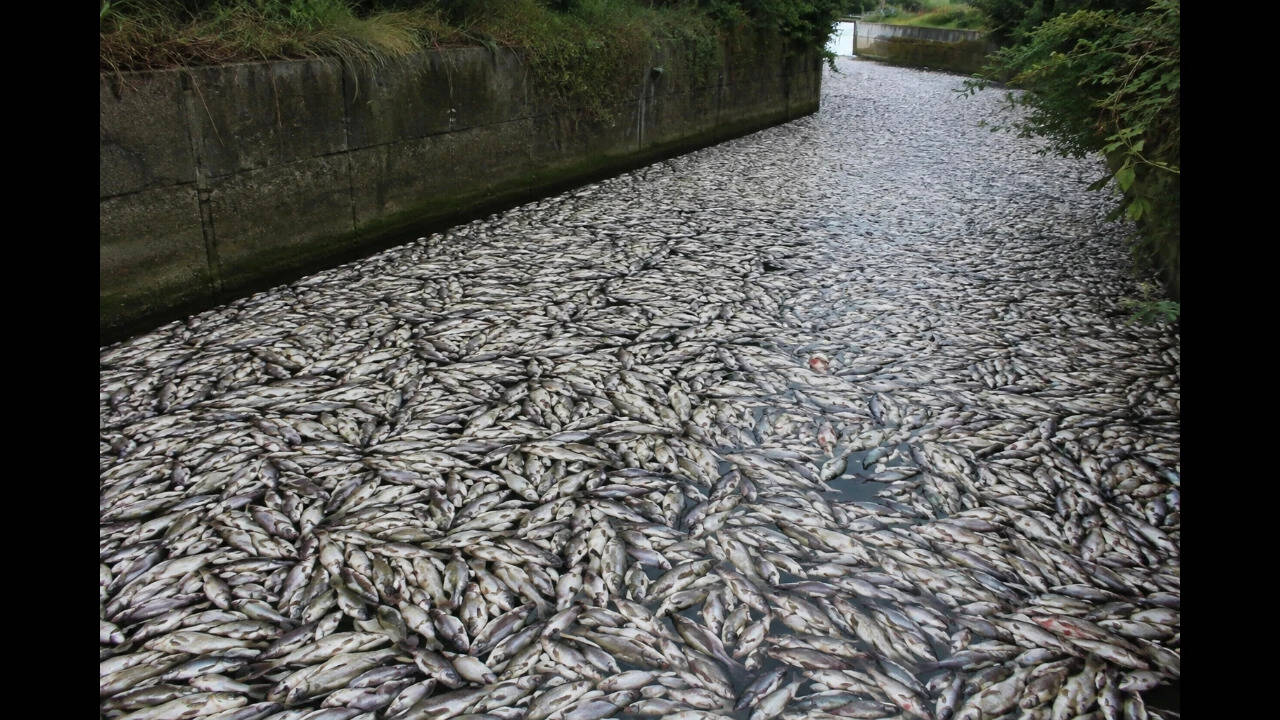
When he finally looked down, the canal was no longer water. It was a thick, rust-red soup. And floating upon it, belly up, were thousands of eyes staring blankly at a cloudless sky.
The Invisible Engine of the Bloom
To understand what happened in that Polish canal, we have to look away from the surface and down into the microscopic machinery of the water.
Water does not turn red on its own. It requires a catalyst, a quiet alchemy born of chemistry and climate. The culprit in this disaster was Prymnesium parvum, a single-celled alga commonly known as golden alga. In normal conditions, these organisms exist in small, harmless numbers, drifting quietly among the plankton. They are ancient, resilient, and remarkably indifferent to human borders.
(Note: When scientists describe golden algae, they often speak of them as invisible architects. I use that term not to romanticize them, but to capture their profound ability to alter an entire ecosystem without ever being seen until it is too late.)
What turns a background player into a tyrant is an imbalance. Imagine a tightly locked room where someone keeps turning up the heat and dumping fertilizer onto the floor. The temperature climbs. The nutrients pile up. The air runs out.
That is what the canal became. Agricultural runoff—nitrogen and phosphorus leaching from the surrounding fields—poured into the sluggish, unmoving water of the canal network. Then came the heatwave. Water temperatures spiked, evaporation concentrated the salts, and the golden algae found themselves in an accidental paradise. They multiplied exponentially, doubling and redoubling until the water column was saturated with their biomass.
And then, they began to kill.
The Poison in the Breath
Golden algae do not simply crowd out other life; they wage chemical warfare. When stressed or crowded, they release potent toxins called prymnesins. These compounds attack the gills of fish, shredding the delicate epithelial tissues that extract oxygen from the water.
The fish do not drown in the traditional sense; they suffocate while surrounded by an abundance of H2O. Their gills bleed internally. They panic, breaking the surface in frantic, disorganized schools, gasping for air that cannot save them, before sinking into the red murk.
By the time environmental inspectors arrived at the Gliwice Canal, the scale of the catastrophe defied easy accounting. Tons of dead fish—pike, perch, roach, and bream—accumulated against the lock gates like drifts of autumn leaves. Volunteers in rubber boots waded into the sludge with pitchforks and industrial bags, hauling away truckloads of decay.
The stench hung over the villages for weeks. It settled into the upholstery of local fishing boats. It ruined the honey of beekeepers whose hives sat near the banks. Worst of all, it triggered a collective psychological trauma.
The Ghost of Summers Past
For anyone who watched the catastrophic Oder River disaster of 2022, the scenes at the canal were terrifyingly familiar. Two years prior, a massive toxic bloom—driven by the same golden alga, supercharged by industrial salinity and summer heat—wiped out an estimated 300 tons of fish across hundreds of kilometers of the Oder.
Back then, the blame game was fierce and immediate. Was it industrial discharge from coal mines? Was it municipal sewage? Was it simply the cruel math of a changing climate meeting centuries of river modification?
The answer, as it turned out, was all of the above. Rivers like the Oder and its interconnected canals are no longer wild systems. They are heavily engineered plumbing networks. We straightened their bends, dammed their flow, channeled their waters to cool power plants, and salted them with industrial discharge from inland mining operations. We treated them as infinite absorbers of our waste and inexhaustible highways for our commerce.
Then the climate shifted, turning our engineered ditches into giant, sun-baked test tubes.
When the canal turned red this summer, it was not an isolated freak accident. It was a diagnostic report. It was the Earth holding up an X-ray of our water management policies and pointing directly at the dark spots.
The Choice at the Water's Edge
Standing on the bank of the Gliwice Canal today, the surface has been cleared of carcasses. The emergency teams have packed up their trucks. The water, moving slowly through the locks, looks deceptively ordinary under the afternoon sun.
Yet, Tomasz no longer drinks his coffee by the water. He knows that the algae spores are still there, resting in the sediment, waiting for the next hot week, the next surge of fertilizer, the next drop in water volume.
We have built a world where convenience flows out of our taps and consequences flow into our waterways. We treat rivers as lines on a map rather than living circulatory systems. Every ton of dead fish pulled from a red canal is a physical manifestation of a debt we have deferred for generations.
The water always remembers what we put into it. And eventually, it gives it back.