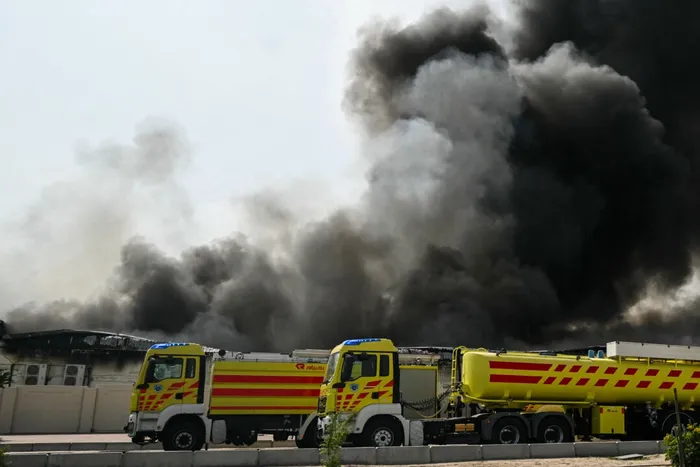
The sirens in Tel Aviv are real. The streaks of light over Dubai are real. The fear in Doha is real. But the narrative you’re being fed—the one about an "unprecedented escalation" or the "brink of regional collapse"—is a carefully choreographed illusion.
Standard news outlets love the "World War III" headline because it sells ads. They track every missile launch like a box office score. They focus on the kinetic energy of the impact while ignoring the structural physics of the geopolitical game. If you think this is a chaotic descent into madness, you aren’t paying attention to the mechanics of modern theater.
The media is obsessed with the what. They ignore the how and the why.
The Myth of the Strategic Surprise
Every time a missile battery lights up the sky over the Persian Gulf, the "experts" crawl out of the woodwork to talk about the failure of diplomacy. They treat these strikes as if they are spontaneous emotional outbursts.
They aren't.
In the high-stakes world of Middle Eastern brinkmanship, a missile launch is a press release with a payload. When Iran launches, they aren't trying to start a war they know they would lose. They are managing domestic expectations while testing the expensive toys of their neighbors.
I’ve sat in rooms with defense analysts who laugh at the way the public perceives "missile defense." The common wisdom is that systems like the Iron Dome or the Patriot batteries are a "shield." That is a dangerous oversimplification.
A missile defense system is an economic attrition machine. When a $20,000 drone or a relatively cheap ballistic missile forces the deployment of a $2 million interceptor, the "winner" isn't the one who didn't get hit. The winner is the one who forced the opponent to burn through their budget and inventory.
The "blasts" reported over Dubai and Doha aren't necessarily hits. They are often the sound of the most expensive firework show in history. We are watching the systematic exhaustion of regional defenses, masquerading as a series of isolated "scares."
The Dubai Doha Deception
Why are there reports of blasts in Dubai and Doha? The lazy analysis says, "Iran is hitting everyone."
Wrong.
The geography of a missile flight path is not a straight line on a flat map. It is a complex calculation of orbital mechanics and mid-course intercepts. Many of the "explosions" heard in neutral or third-party cities are the results of high-altitude interceptions where the debris—sometimes the size of a car—re-enters the atmosphere.
The Gulf states aren't being "targeted" in the traditional sense; they are the involuntary backdrops for a ballistic chess match. The real story isn't that a missile flew over Dubai. The real story is that the UAE and Qatar are forced to maintain a terrifyingly thin line between being a global business hub and a debris field for two powers that can’t stop poking each other.
If you are a business leader looking at the Middle East, stop looking at the "flashpoints." Look at the logistics. The moment these cities actually become targets, the global economy doesn't just "dip"—it ceases to function. The fact that the flights are still landing at DXB and the LNG tankers are still moving through the Strait of Hormuz tells you everything you need to know: the participants have agreed on the limits of the chaos.
The Iron Dome is Not a Security Strategy
People ask: "Can the Iron Dome stop a full-scale Iranian barrage?"
The honest, brutal answer? No. It was never designed to.
The Iron Dome is for short-range rockets. For the medium-range ballistic threats coming from Tehran, you need the Arrow-3 or David’s Sling. These are remarkable pieces of engineering, but they have a fatal flaw: they are finite.
- The Saturation Point: Every defense system has a "saturation point" where the number of incoming targets exceeds the number of available interceptors.
- The Economic Gap: It costs Iran significantly less to build a missile than it costs Israel or the US to shoot one down.
- The Intelligence Lag: You can only shoot down what you can see. Stealth technology isn't just for planes; it’s for the flight profiles of modern missiles.
When you see the sirens going off in Tel Aviv, don't think "safety." Think "sustainability." How many nights can a nation stay in bunkers before the psychological and economic cost outweighs the military benefit of the "shield"?
Stop Asking if War is Coming
The most common question in my inbox right now is: "Is this the start of the Big One?"
It’s the wrong question. It assumes war is a binary state—either you are at peace or you are at war.
In 2026, we live in a state of "Permanent Gray Zone Conflict." There will be no formal declaration of war. There will be no massive invasion. There will only be these periodic "surges" of kinetic activity designed to reset the status quo.
The status quo is a balance of terror. Iran needs to show its proxies it can still bite. Israel needs to show its citizens it can still bite back. The US needs to show it still owns the neighborhood.
Everyone is performing. The missiles are the props.
The Reality of Middle Eastern Airspace
Imagine a scenario where a commercial airliner is caught in the crossfire of an interception. It happened with PS752. It happened with Iran Air 655.
The real danger in the Dubai/Doha/Tel Aviv triangle isn't a deliberate strike on a civilian center. It’s the "Oops" factor. It’s the fog of war powered by AI-driven targeting systems that make a split-second decision based on a flawed sensor reading.
We have outsourced the "trigger" to algorithms. When a missile is detected, a human doesn't have time to debate. The computer decides. We are one software glitch away from a regional catastrophe that no one actually wanted.
The Misconception of "Precision"
The media loves the phrase "precision-guided." It sounds clean. It sounds surgical.
In reality, a "precision" strike in a densely populated area is like trying to perform heart surgery with a sledgehammer. Even if the missile hits the exact GPS coordinate, the kinetic energy and the secondary explosions don't care about your "surgical" intent.
The Actionable Truth for the Outsider
If you are watching this from a distance, stop looking at the maps and start looking at the money.
- Watch the Insurance Rates: When the maritime insurance for tankers in the Gulf spikes, that’s when you worry. Not when a siren goes off.
- Watch the Sovereignty Wealth Funds: If the UAE or Qatar starts moving massive amounts of capital out of regional assets and into "safe havens" in the West, the game has changed.
- Ignore the "Breaking News": Most of it is just repurposed social media footage from three years ago or "official" statements that are 90% propaganda.
The "blasts" and "sirens" are the surface tension of a much deeper, much more calculated struggle for regional hegemony. It’s not about religion. It’s not about ancient hatreds. It’s about who gets to set the price of energy and who gets to control the trade routes of the next century.
The theater will continue. The sirens will wail again. The missiles will light up the sky.
And as long as you keep falling for the "imminent apocalypse" narrative, you are just another member of the audience paying for the ticket with your attention.
The real war is being fought in the dark, in the code, and in the banks. The missiles are just the loud part.
Get out of the bunker and look at the ledger.