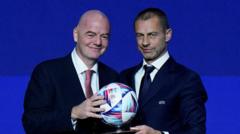
The top table of global football is broken. What started as a professional disagreement between old colleagues has devolved into an open war, exposing a deep ideological chasm between European traditionalism and FIFA's global expansion ambitions.
When UEFA president Aleksander Ceferin skipped the World Cup final at MetLife Stadium, it wasn't just a scheduling conflict. It was a calculated political snub aimed directly at FIFA boss Gianni Infantino. For years, these two leaders have circled each other like heavyweights, but their quiet rivalry has now exploded into a public feud over money, political interference, and the very soul of the sport.
The Roots of the Infantino and Ceferin Feud
You have to look back to understand how bad things got. Back in 2016, both men ascended to their respective thrones. Infantino, who spent years presenting Champions League draws as a trusted UEFA insider, pivoted once he took over FIFA. He realized quickly that power in world football doesn't reside in Zurich or Nyon alone; it rests in the hands of the 211 member federations, many of whom operate on tight budgets and welcome FIFA’s financial distribution programs.
Ceferin, a Slovenian lawyer who pitches himself as the guardian of sporting merit, watched with growing alarm as FIFA pushed commercial boundaries. Whether it was expanding tournaments, floating plans to privatize parts of the World Cup, or scheduling a bloated Club World Cup that directly threatens the European calendar, the friction became impossible to ignore.
Things hit a boiling point when Infantino arrived significantly late to a FIFA Congress after joining a diplomatic tour in the Middle East. Ceferin led a walkout of European delegates, signaling that European football's leadership was done playing nice.
The Global Power Struggle Over Money and Votes
The core issue comes down to a numbers game and a clash of cultures. FIFA boasts 211 member associations, but only 55 belong to UEFA. Infantino knows he can secure re-election and push through sweeping structural reforms by maintaining the loyalty of African, Asian, and smaller confederation federations who benefit from FIFA financial initiatives like FIFA Forward.
UEFA, meanwhile, holds the real sporting and economic cards. European leagues generate the vast majority of the game's global revenue, and European nations dominated the latter stages of recent World Cups. Ceferin plans to weaponize that dominance. Threatening boycotts of upcoming global tournaments is a nuclear option, but it shows how desperate European leadership is to check Infantino’s expanding authority.
Yet, changing the status quo isn't simple. While some regional powerhouses and fan groups have pushed for no-confidence votes or petioned for change, Infantino retains deep-rooted backing across the globe. The global game is fiercely divided between those who view football as a community-driven European heritage and those who see it as a rapidly expanding global market ripe for private investment.
As this political chess match continues, players face mounting exhaustion from a hyper-congested calendar, and fans are left watching administrators fight over control. The outcome of this institutional civil war will reshape international soccer for decades, and neither side is willing to blink first.
Check out this analysis on ESPN FC on YouTube to understand how FIFA and UEFA previously navigated major governance battles over elite club competitions.