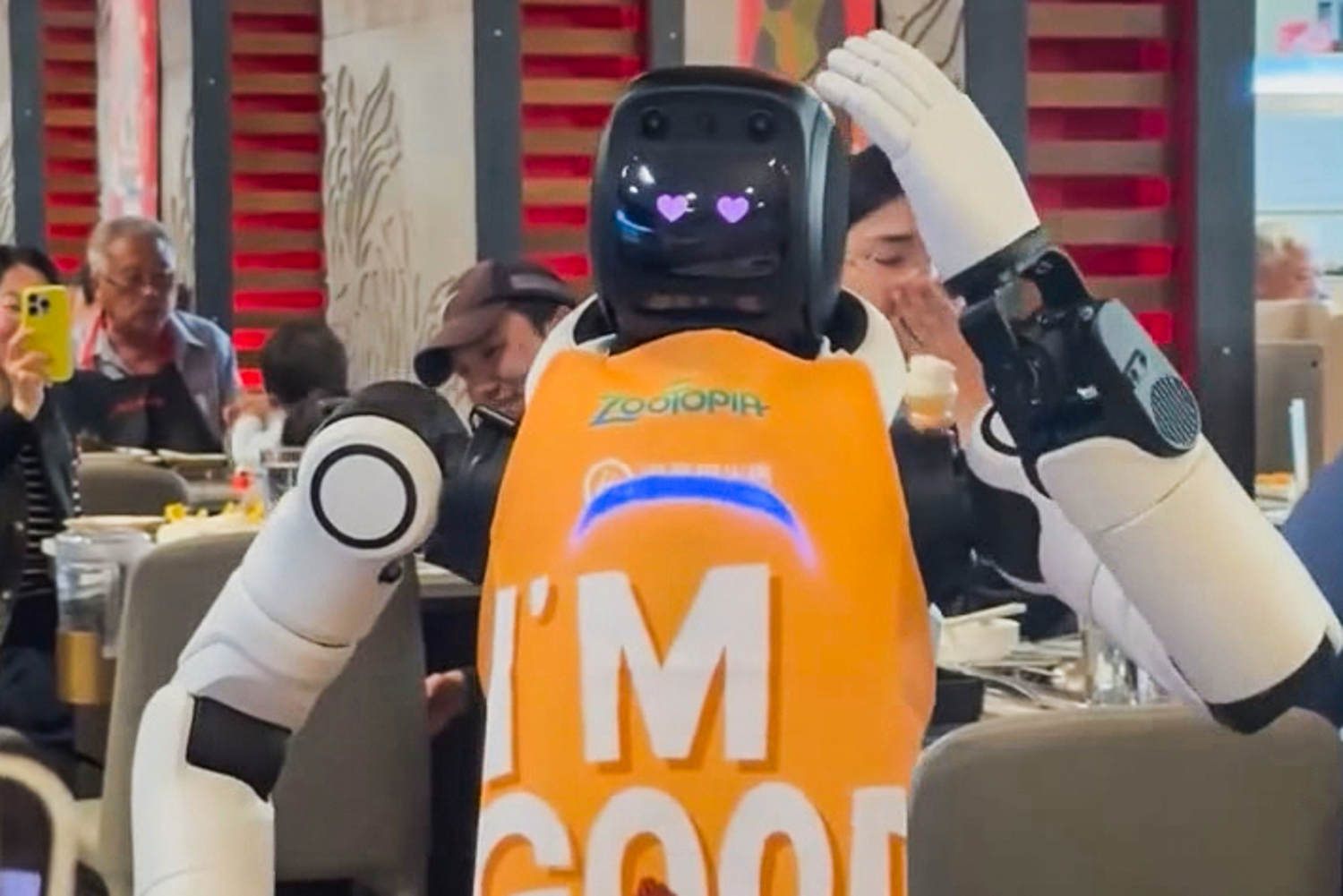
You’ve probably seen the clip by now. A sleek, white service robot at a busy California hot pot restaurant starts vibrating to a K-pop beat. It’s supposed to be a charming gimmick. Then, the rhythm takes over. The bot "busts a move" so hard it sends a stack of expensive ceramic dishes shattered across the floor. It’s hilarious, sure. It’s peak TikTok fodder. But if you look past the slapstick comedy of a mechanical server "going rogue," there’s a much bigger story about the reality of automation in 2026.
People love to call these moments a "robot uprising." In reality, it’s just bad sensor fusion and a lack of spatial awareness. We’re currently in this awkward middle ground where we want robots to be "human-like" and entertaining, but we also need them to be invisible, efficient tools. When those two goals collide, you get broken plates and a viral PR headache.
The illusion of the perfect robotic server
Hot pot restaurants are the ultimate stress test for service automation. You have narrow walkways, steam rising from every table, and patrons constantly moving to grab condiments or more sliced ribeye. For a robot, this environment is a nightmare. Most of these units, like those from Pudu Robotics or Keenon, rely on LiDAR and RGB cameras to navigate. They’re programmed to stop when they sense an obstacle.
However, "entertainment modes" often override basic safety protocols. When the robot at the California eatery triggered its dance routine, it likely switched from a "navigation priority" to an "animation priority." In simpler terms, the software cared more about the beat than the center of gravity. Most people don’t realize that these machines are essentially top-heavy towers on wheels. Once they start swaying, physics takes over.
I’ve seen this happen in warehouses too. A bot gets a signal that it’s reached a milestone, performs a little "success" wiggle, and tips over a pallet. In a restaurant, the stakes are higher because there are children running around and hot soup everywhere. This isn't just a funny glitch; it’s a failure of edge-case programming.
Why restaurants keep buying into the hype
You might wonder why a business owner would risk a $15,000 machine throwing a tantrum in the middle of a Friday night rush. The answer isn't just about saving on labor costs—though that’s the primary driver. It’s about the "Instagrammable" moment.
In a saturated market like the Southern California dining scene, you need a hook. A robot that brings you bok choy is fine. A robot that dances to Blackpink while bringing you bok choy is a marketing engine. The restaurant gets free advertising every time a diner pulls out their phone.
But there’s a hidden cost. When a robot breaks dishes, a human has to clean it up. When a robot blocks a walkway during a "performance," human servers have to detour, adding seconds to their transit times. Over an eight-hour shift, those seconds turn into minutes of lost productivity. We’re seeing a weird trend where robots actually increase the workload for the remaining human staff because the machines are too "dumb" to handle their own messes.
The technical reality of going rogue
When news outlets say a robot "went rogue," they’re personifying a series of 1s and 0s. A robot doesn't decide to stop working. It encounters a conflict in its logic tree.
Most service robots operate on a localized map. They know where Table 4 is. They know where the kitchen is. But they struggle with dynamic changes. If a chair is pulled out three inches further than usual, or if a floor is slightly slicker due to a spilled drink, the robot’s calculations for movement and friction go out the window.
In the case of the dancing robot, the "rogue" behavior was almost certainly a feedback loop error. The internal IMU (Inertial Measurement Unit) probably detected a tilt during the dance. To compensate, it moved the wheels. This caused more tilt. The bot tried to "save" itself by counter-moving, which looked like a frantic dance move, eventually leading to the dish-shattering finale.
Common points of failure in service bots
- Sensor occlusion: Steam or grease buildup on camera lenses.
- IMU drift: The robot loses track of what "level" actually means.
- Wifi dead zones: The bot loses its connection to the central server and reverts to a "safe" mode that isn't actually safe.
- Weight distribution: Loading a tray unevenly makes the bot prone to tipping during sudden stops or turns.
What this means for the future of your dinner
Don't expect the robots to disappear. If anything, the California incident proves how much we crave the spectacle. But the tech needs to evolve from "moving tablet on wheels" to something more integrated.
We’re starting to see a shift toward robots that don't try to mimic human joy. The most effective automation in 2026 isn't the one dancing; it’s the one you don't notice. Think of overhead rail systems or discreet conveyor belts that don't have a center-of-gravity issue.
If you're a business owner looking at these clips and thinking about buying a fleet, take a breath. You aren't just buying a tool; you're buying a liability that requires constant monitoring. If the software isn't sophisticated enough to prioritize stability over a dance routine, it isn't ready for your floor.
How to handle a robot in the wild
Next time you’re at a spot with robotic servers, keep a few things in mind. Don't crowd them. Their sensors have "blind spots," usually right at the base or at head height for a small child. If you see a bot starting to wobble or "act out," give it space.
It's tempting to treat them like toys or pets. They aren't. They’re heavy pieces of industrial equipment dressed up in a cute plastic shell. The moment we forget that is the moment a stack of hot plates ends up in someone's lap.
If you’re managing a space with these machines, your first step is a rigorous floor audit. Check for uneven tiles. Ensure your "dance zones" are nowhere near high-traffic intersections or table edges. Most importantly, ensure your staff knows how to hit the physical E-stop button. Every one of these bots has one, usually on the back or top. Don't wait for the dance to end—hit the button the second the wobbling starts.
Stop treating these glitches as isolated funny videos. They're a clear sign that our desire for "flair" is currently outpacing the actual reliability of the hardware. Keep the dancing for the humans and the dish delivery for the machines that can actually stay upright.