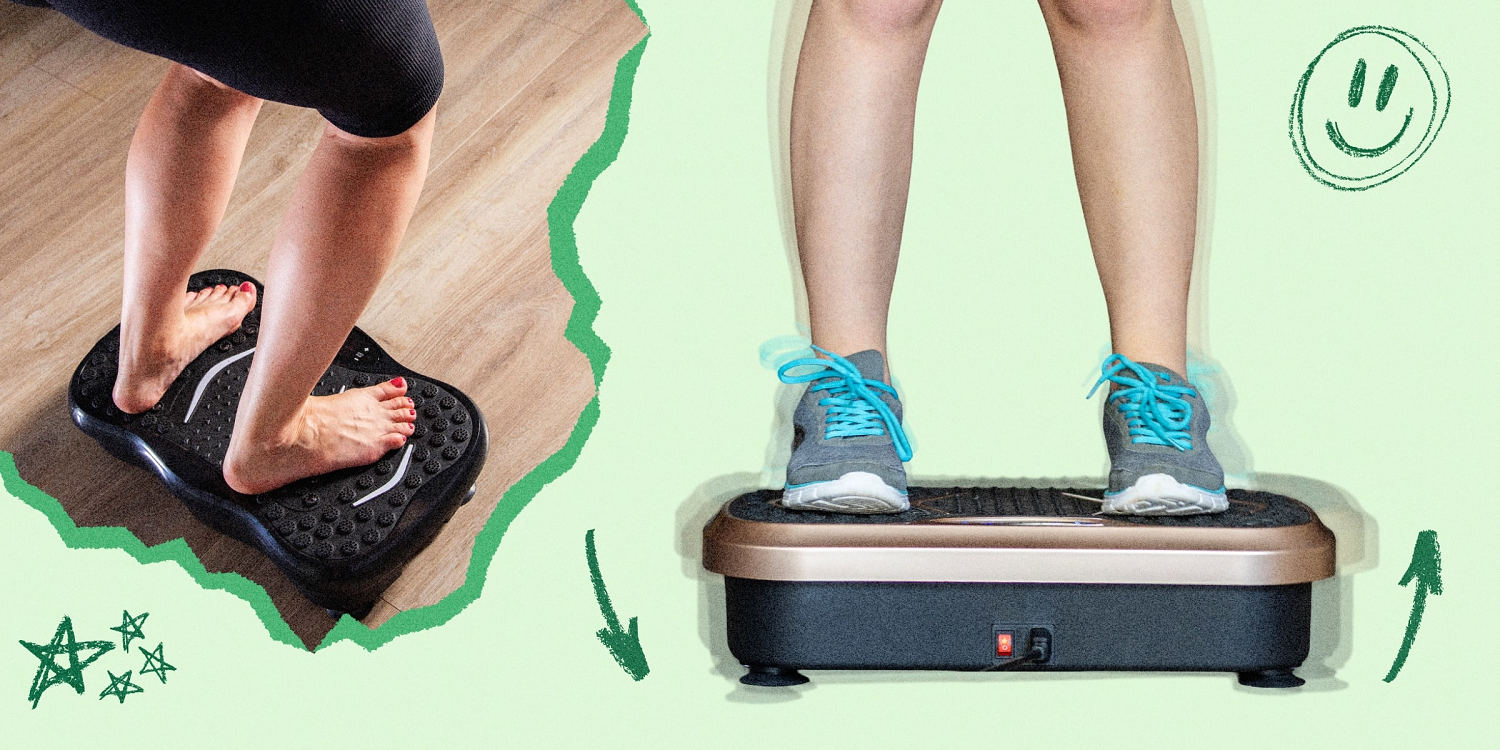
Every six months, the fitness industrial complex finds a new way to monetize laziness. Right now, it is the vibration plate. You have seen the ads. Someone stands on a violently shaking metal platform, staring blankly at a television screen, while an infomercial voice claims that ten minutes of standing still equals a grueling hour at the squat rack. They talk about whole body vibration. They whisper about lymphatic drainage, bone density miracles, and effortless fat loss.
It is a brilliantly marketed fantasy. It is also absolute nonsense.
Let us look at the lazy consensus saturating the wellness internet. The standard buyer's guide tells you that vibration plates are a clever shortcut. They claim the rapid oscillations force your muscles to contract dozens of times per second, tricking your nervous system into a high-intensity workout without the heavy lifting. They suggest you can stand on it while reading emails, do a few pushups with your hands on the vibrating deck, and watch your core tighten up.
I have watched people blow thousands of dollars on these machines, hauling heavy steel plates into living rooms only to use them as glorified clothes racks within three months. I have tested the clinical literature. I have looked at the actual physics of mechanical loading.
Here is the truth nobody wants to print. Whole body vibration has a legitimate clinical lineage in very specific, narrow contexts. It was originally studied for bedridden osteoporosis patients, astronauts fighting bone atrophy in zero gravity, and severe neuromuscular rehabilitation. If your neuromuscular system is completely compromised, shaking you like a paint mixer creates passive muscle activation that is better than lying in a coma.
You are not an immobilized astronaut. You are a functioning human being looking for a shortcut. And physics does not care about your marketing brochure.
The Physics Problem Your Influencer Ignored
Let us talk about mechanical load. Muscle hypertrophy and bone density remodeling do not happen because your tissue feels a slight tickle at thirty hertz. They happen in response to heavy mechanical tension and progressive overload.
When you squat with a barbell, gravity pulls a heavy mass down, your skeletal system absorbs that force, and your muscle fibers recruit high-threshold motor units to push the weight back up. That is internal force generation coupled with external resistance.
A vibration plate does the opposite. It provides passive vibration. The motor shakes the plate, the plate shakes your feet, and some of that energy travels up your legs. The acceleration forces involved are a tiny fraction of what happens when you simply step off a curb or jog down the street. Your muscles do experience reflexive contractions to stabilize your joints, but the magnitude of those contractions is trivial. It is the equivalent of trying to build a chest by shivering in a cold room.
The calorie burn claims are even more laughable. Studies measuring energy expenditure during whole body vibration show a metabolic rate roughly equivalent to a slow, casual walk. Standing on a vibrating box does not torch stubborn belly fat. It does not replace cardiovascular conditioning. If you sweat while using one, it is either because the ambient temperature in your room is warm or because you are holding a static squat on top of a vibrating surface—at which point the squat is doing one hundred percent of the work, and the vibration is just making your joints feel unstable for no functional reason.
Dismantling the PAA Fallogy
Let us address the common questions people type into search engines late at night when they are trying to justify dropping five hundred bucks on a vibrating piece of steel.
Can a vibration plate burn belly fat?
No. Spot reduction is a myth, and passive vibration has zero localized lipolytic effect. You lose fat through a sustained caloric deficit, period. Shaking your adipose tissue does not magically melt it away. If local vibration melted fat, riding a dirt bike would make you lean.
Does it actually improve bone density?
In clinical settings with geriatric populations under strict supervision using high-amplitude, high-frequency specialized medical devices? There is minor, marginal evidence of slowed bone mineral density loss. But the consumer-grade garbage sold online? The amplitude is too low and inconsistent to trigger osteogenesis. If you want to build bone mineral density, you need impact forces and heavy axial loading. Deadlifts. Heavy carries. Running. Not standing on a vibrating plastic disc.
Can it damage your joints?
Ah, here is the downside of my contrarian approach. Most fitness gurus pretend these machines are completely harmless. They are not. Chronic exposure to high-frequency whole body vibration without proper stabilization can wreak havoc on your lower back, knees, and inner ear. Occupational health studies on industrial workers using jackhammers and vibrating platforms for extended periods show severe risks of hand-arm vibration syndrome, lower back pain, and joint wear. Posing on a high-frequency plate with locked knees is a fantastic way to rattle your spine into an early retirement.
The Real Problem Is the Mindset
The real danger of the vibration plate is not the machine itself. It is the psychological trap it reinforces.
It preys on the desperate hope that fitness is just a life hack away. It whispers that you can bypass the friction, the discomfort, and the heavy lifting required to actually transform your body. It sells you the illusion of efficiency.
Real health requires friction. It requires tension. It requires you to pick up heavy things, put your lungs under metabolic stress, and push your physical limits against actual resistance. There are no shortcuts. Every time you buy into a passive wellness gadget, you are paying a tax on your own avoidance of hard work.
Sell the plate. Cancel the infomercial order. Go buy a pair of kettlebells, learn how to hinge at the hips, and start moving real weight through a full range of motion.
Stop looking for a machine to shake the fat off your bones. Put in the actual work.