The ground didn't just shake in Venezuela. It ruptured twice in less than a minute, ripping through the northern coast and leaving a trail of absolute devastation.
Right now, the official count stands at 235 dead and over 4,300 injured. But if you talk to anyone on the ground in La Guaira or Caracas, they'll tell you those figures don't even scratch the surface. With tens of thousands of people currently unaccounted for, the reality of this disaster is changing by the hour.
This wasn't a standard tremor. Seismologists are calling it a seismic doublet, a rare and brutal phenomenon where two massive tectonic events strike almost simultaneously. First came a magnitude 7.2 foreshock near San Felipe. Just 39 seconds later, a massive 7.5 mainshock hit southeast of Yumare.
Because both quakes were incredibly shallow, occurring at a depth of just 10 kilometers, the energy didn't dissipate underground. It exploded directly upward into some of the most densely populated cities in the country.
The Destruction of La Guaira and Caracas
Acting President Delcy Rodriguez quickly declared a state of emergency, pointing to the coastal state of La Guaira as the absolute epicenter of the tragedy. It makes sense. La Guaira is the maritime and aerial gateway to the country, and right now, it's essentially cut off from the world.
The Simon Bolivar International Airport in Maiquetia sustained massive structural damage and is closed indefinitely. Imagine trying to coordinate a massive international rescue effort when your primary airport looks like a war zone. It's a logistical nightmare.
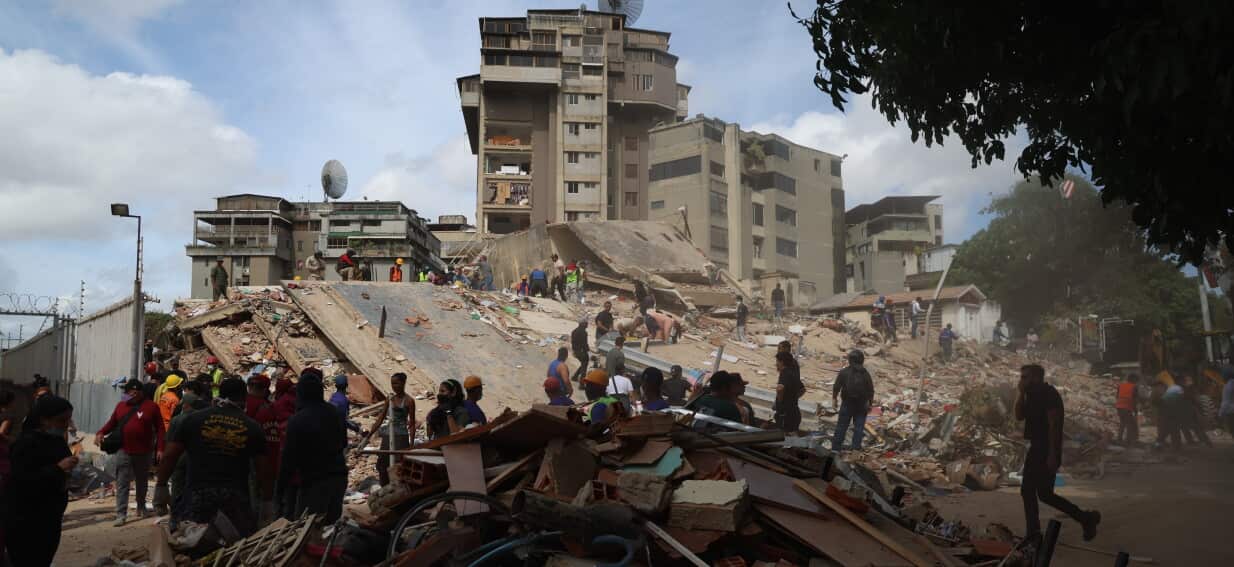
In Caracas, high-rise apartment buildings in southeastern neighborhoods completely pancaked. In Chacao, Mayor Gustavo Duque reported multiple building collapses with residents buried alive. The same nightmare played out in Baruta and Pinto Salinas.
Entire apartment blocks have been reduced to concrete skeletons. People are standing in the streets, staring at what used to be their living rooms, with furniture completely exposed to the open air. Dust columns are still hanging over neighborhoods that were bustling with activity just days ago.
Why the Crisis Is Spiraling Out of Control
The initial tremors were only the beginning. The National Assembly has already logged well over 138 aftershocks, which are actively destabilizing structures that managed to survive the first hits.
Honestly, the rescue effort is a race against an ticking clock, and the local authorities were caught completely unprepared. Survivors describe watching neighbors dig through concrete blocks with their bare hands because the police arrived without heavy lifting machinery or specialized tools.
To make matters worse, structural failures hit eight regional hospitals, forcing medical staff to evacuate critical patients into the streets during active aftershocks. The public health system is totally overwhelmed. Health Minister Carlos Alvarado noted that a huge portion of the 235 fatalities were people who either arrived at clinics with no vital signs or died during transport because traffic was snarled and ambulances couldn't navigate cracked roads.
The basic infrastructure is broken. Power grids are down, communication lines are severed, and clean water is non-existent in the hardest-hit zones. Locals are actually risking their lives by running back into unstable, tilting buildings just to grab food, water, and medicine because nearby supermarkets completely ran out of stock.
A Massive International Rescue Push
The scale of this disaster has forced a sudden pause in regional geopolitics. Nations are putting aside long-standing diplomatic arguments to get boots on the ground.
The United States Southern Command deployed C-17 Globemaster and C-130 Hercules transport aircraft to launch a massive humanitarian airlift operation. Neighboring Colombia activated its armed forces and risk-management units for immediate cross-border deployment. Brazil sent a military cargo plane packed with 36 specialized search-and-rescue firefighters, while Mexico and Chile dispatched elite seismic disaster response teams.
Even with this sudden influx of global aid, the immediate burden has fallen on ordinary citizens. In Vargas state, hundreds of local motorcycle riders have organized themselves into makeshift supply chains. They're loading up their bikes with water, non-perishable food, and basic medical supplies, navigating ruined highways to reach communities that international aid groups haven't even found yet.
What Needs to Happen Next
If you want to support the ongoing relief efforts or are trying to track down information regarding missing relatives, focus your energy on these specific, actionable steps right now.
First, utilize verified digital missing persons databases rather than relying on chaotic social media feeds. Tracking sites have currently flagged thousands of unconfirmed missing cases in La Guaira alone, and centralized digital registries are the most accurate way to cross-reference names as field hospitals update their admission logs.
Second, if you're donating to relief funds, direct your capital toward organizations with active logistics networks on the ground in Colombia and Brazil. Because the Simon Bolivar International Airport is closed, physical aid must be trucked in across the Colombian border or flown into secondary regional hubs, making large-scale logistical experience more valuable than good intentions.
Finally, keep a close watch on regional structural assessments if you have property or family in northern Venezuela. Local engineers warn that secondary collapses from ongoing aftershocks pose the single greatest threat over the next 72 hours, meaning any building showing visible wall fractures must be completely evacuated immediately.