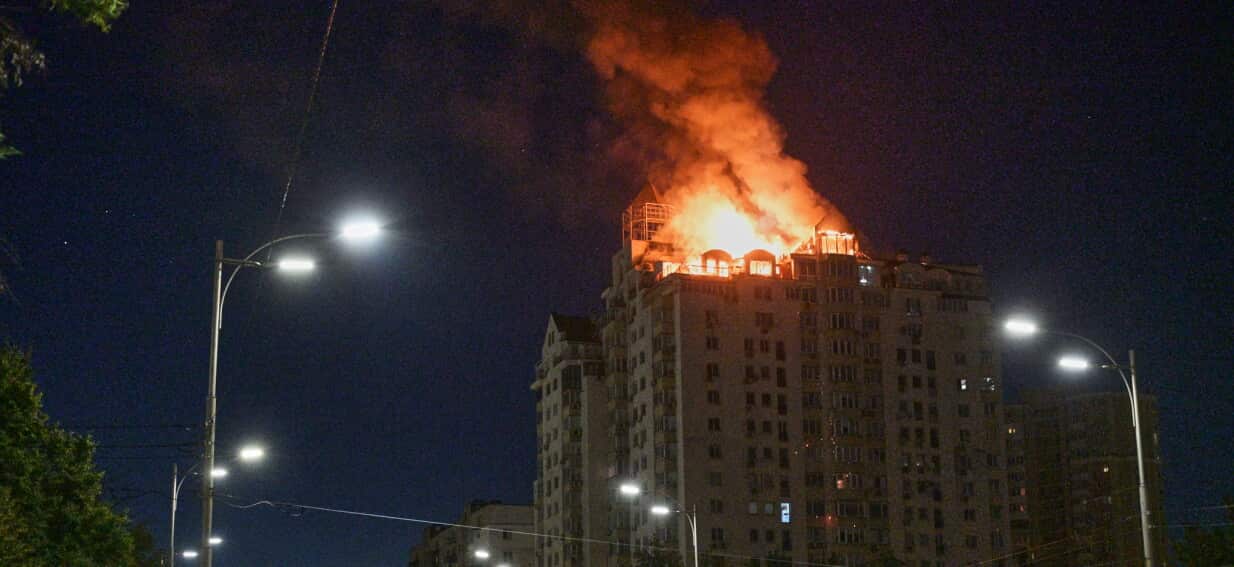
People in Venezuela panicked recently when the sky turned an eerie, deep crimson. Social media flooded with videos of the crimson horizon, and the timing could not have been worse. It happened just days after a series of noticeable earthquakes rattled the region. Naturally, the internet did what it always does. Doom-scryers and viral threads immediately pointed to the Book of Revelation, claiming the end times had arrived.
It makes for a great clickbait headline. But it is flat wrong.
When you see the sky change color dramatically right after a natural disaster, your brain naturally wants to link the two events. Humans are wired to find patterns, even where they do not exist. The truth behind the blood-red skies over Venezuela has nothing to do with ancient prophecies or impending doomsday. It comes down to basic atmospheric physics and a perfectly timed meteorological phenomenon.
Understanding why this happens can save you from a lot of unnecessary anxiety the next time a strange color hits the horizon.
The Physics of Scattering That Earthquakes Cannot Change
To understand why the sky turned red, we have to look up, not down. Earthquakes happen miles beneath the crust. They release massive amounts of energy through seismic waves, shaking buildings and cracking pavement. What they do not do is pump hundreds of tons of specific light-filtering particles into the upper atmosphere.
The color of our sky is dictated by a process called Rayleigh scattering. Sunlight looks white, but it actually contains all the colors of the rainbow. Each color travels in waves, but their wavelengths are different. Blue and violet light travel in short, choppy waves. Red and orange light travel in much longer wavelengths.
Normally, the nitrogen and oxygen in our atmosphere scatter the short blue waves in every direction. That is why the sky looks blue on a standard afternoon.
When the sun sets or rises, that light has to travel through a much thicker layer of the atmosphere to reach your eyes. By the time it gets to you, most of the blue light has been scattered away completely. Only the longer red and orange wavelengths make it through the haze.
Why the Red Was So Extreme in Venezuela
If Rayleigh scattering happens every day, why did Venezuela look like a scene from an apocalyptic movie? The answer lies in atmospheric aerosols.
When the air contains an unusually high concentration of tiny particles like dust, smoke, volcanic ash, or even salt spray, it triggers Mie scattering. Unlike Rayleigh scattering, Mie scattering occurs when the particles in the air are roughly the same size as the wavelengths of the light itself. This process scatters longer wavelengths much more efficiently, turning a standard orange sunset into a deep, blinding crimson.
Local weather reports and satellite tracking from the period show a heavy concentration of Saharan dust plumes blowing across the Atlantic, mixed with localized agricultural burning smoke. This exact cocktail of particles creates the perfect filter for sunlight. The shaking from the recent earthquakes did not cause the red sky. The timing was entirely coincidental.
Real Post Earthquake Sky Phenomenon Is Very Different
Earthquakes can actually cause optical illusions, but they look nothing like a blanket of red clouds. Scientists call these phenomena Earthquake Lights (EQL).
Earthquake lights are incredibly rare and highly debated in the scientific community. When they do happen, they do not turn the entire sky red for hours. Instead, they appear as brief, localized flashes of blue, white, or green light shooting up from the ground during or immediately before the shaking.
Researchers from Rutgers University suggested that these flashes happen because of the immense stress built up in the rocks. When certain types of rocks, like basalt or dacite, are subjected to extreme pressure right before a fault line slips, the chemical bonds break apart. This creates holes of positive electrical charge. These charges rush toward the surface, ionizing the air molecules and creating localized sparks or glowing auras.
- Duration: Earthquake lights last for fractions of a second or a few minutes, not the entire evening.
- Color: They are predominantly blue, white, or violet, rarely a deep red.
- Scale: They are visible only near the epicenter, not across an entire country.
What happened in Venezuela was an atmospheric sunset enhanced by particulates, completely separate from the tectonic shifts occurring underground.
How to Spot the Difference Yourself
The next time the sky shifts into an unusual color palette after a natural disaster, you do not need to panic. You can analyze the situation rationally by looking for a few specific indicators.
Check the clock first. If the deep red coloration occurs strictly around dawn or dusk, you are looking at standard atmospheric scattering enhanced by dust or smoke. True anomalous events like earthquake lights or chemical flares do not care about the position of the sun.
Look at the cloud cover. A uniform red sky means the light is bouncing off the bottom of existing cloud layers from a sun that has already dipped below the horizon. If the light appears as a localized beam or a sudden flash during total darkness, then you are looking at something worth investigating, usually power transformers exploding due to the earthquake or localized atmospheric electrical discharge.
Stop relying on viral social media videos for scientific explanations. When a crisis hits, misinformation spreads faster than seismic waves. Look up local meteorological data and check for dust storms, wildfire smoke, or high humidity levels. Ninety-nine percent of the time, the environment has a perfectly logical explanation that has nothing to do with ancient omens.