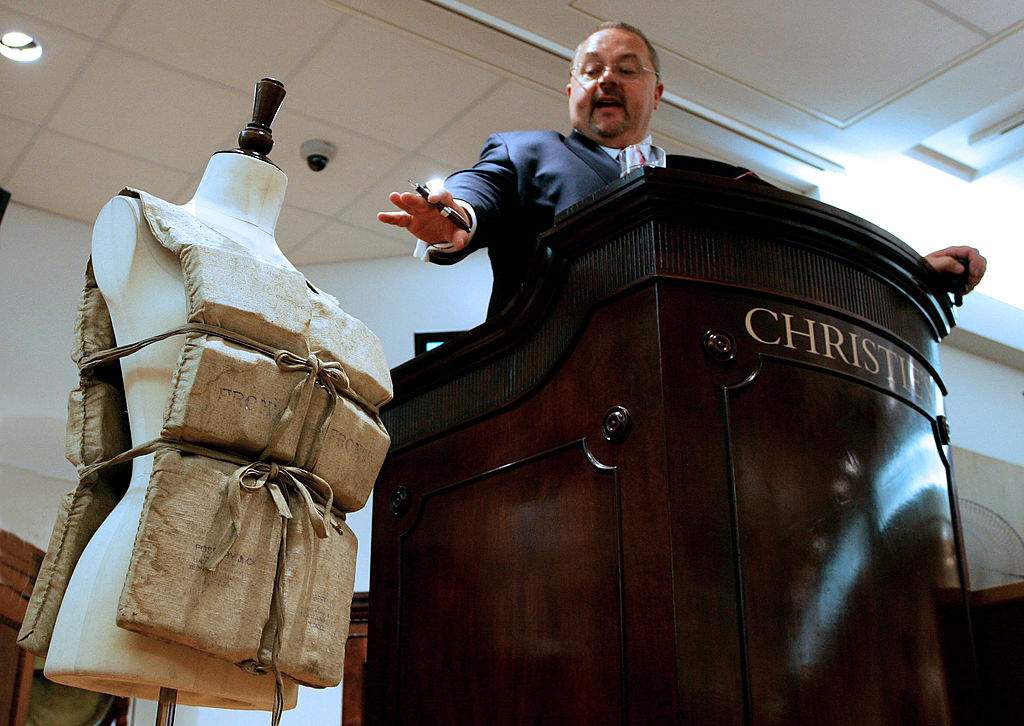
The projected $648,000 sale of a life-jacket recovered from the RMS Titanic is not merely a transaction for a piece of cork and canvas; it is a clinical exercise in the pricing of extreme rarity and historical finality. In the high-stakes auction market, the value of an artifact is inversely proportional to its survival rate and directly proportional to its proximity to a definitive historical inflection point. For the Titanic, that point is the two-hour-and-forty-minute window between the iceberg collision and the final submersion. This specific life-jacket represents one of fewer than 10 known extant examples from the approximately 3,500 originally onboard, placing it in a category of scarcity that triggers unique economic behaviors among ultra-high-net-worth collectors.
The Mechanics of Premium Artifact Valuation
The valuation of historical assets of this magnitude relies on a three-factor framework: Provenanced Proximity, Material Integrity, and Narrative Finality. If you enjoyed this piece, you might want to check out: this related article.
Provenanced Proximity refers to the physical distance between the object and the core of the tragedy at the moment of impact or resolution. A menu from the Titanic’s first-class dining room carries value, but it does not possess the same survival-critical weight as a life-jacket. The jacket was a functional tool in a life-or-death struggle, making it a primary witness to the event. This proximity creates a "secular relic" status, where the object transcends its material components to become a physical proxy for the event itself.
Material Integrity presents a significant bottleneck for Titanic-era textiles. Saltwater saturation, bacterial consumption at depth, and over a century of atmospheric exposure usually lead to total structural failure. The survival of this specific jacket, particularly the linen casing and the internal cork blocks, indicates a preservation environment that resisted the typical decay cycle. For collectors, the lack of extensive restoration is a value multiplier; an original, degraded state is more financially viable than a "repaired" object that has lost its authentic fiber density. For another perspective on this development, check out the latest update from Financial Times.
Narrative Finality is the psychological driver of the price ceiling. The sinking of the Titanic is a closed system. No more artifacts will be created, and the wreck site itself is protected by international treaties and a natural process of iron-eating bacteria ($Halomonas\ titanicae$) that ensures the ship will eventually disappear. The market recognizes a "terminal inventory" state. When supply is fixed and the source is undergoing geological-scale erasure, the price floor for existing assets moves upward regardless of broader economic volatility.
The Collector’s Yield and Risk Profile
Investing in catastrophic artifacts differs from traditional art or real estate due to the ethical and legal friction involved. Analysts must account for the Sovereignty Risk. Governments and heritage organizations frequently challenge the private sale of maritime disaster artifacts, citing the 2001 UNESCO Convention on the Protection of the Underwater Cultural Heritage. While this specific jacket likely bypasses these hurdles because it was recovered shortly after the sinking rather than salvaged from the seabed decades later, the shadow of potential repatriation creates a complex liquidity profile.
The buyer of this artifact is likely not seeking a yield-bearing asset in the traditional sense. Instead, they are engaging in Capital Preservation through Cultural Moats. In periods of high inflation or currency instability, hard assets with singular historical significance serve as a hedge. Unlike gold or Bitcoin, a Titanic life-jacket cannot be mined, minted, or replicated. Its value is tied to a specific, unrepeatable human tragedy that remains fixed in global consciousness.
Comparative Market Analysis: The Titanic Premium
To understand the $648,000 estimate, one must examine the price elasticity of Titanic memorabilia compared to other maritime disasters. The "Lusitania" or the "Empress of Ireland" share similar tragic scales, yet their artifacts rarely command 10% of the Titanic’s market price. This discrepancy is the Titanic Premium, driven by:
- Class Structure Crystallization: The Titanic serves as a frozen-in-time laboratory of the Edwardian social hierarchy. The life-jacket is a symbol of the failure of that hierarchy, as safety equipment was distributed with lethal inequality.
- Technological Hubris: The artifact represents the exact moment when the "unsinkable" narrative failed. This makes the object a memento mori for the industrial age, an intellectual value that appeals to Silicon Valley and tech-wealth collectors who manage similar risks of systemic failure.
The expected sale price reflects a 25% increase over similar sales from a decade ago. This appreciation is not linear; it is lumpy, occurring in spikes around anniversaries or major cinematic/cultural re-evaluations of the event. The current valuation suggests that the market has moved past the "morbid curiosity" phase into the "institutional-grade asset" phase.
Structural Deterioration and the End of Private Ownership
The second limitation on the long-term value of the life-jacket is the Biological Clock. Organic materials like linen and cork have a finite lifespan outside of highly controlled, oxygen-deprived environments. Private collectors often lack the nitrogen-purged display cases and precise UV-filtering required to halt cellular breakdown. This creates a paradox: the more the artifact is "owned" and displayed in private settings, the faster its value-driving material integrity vanishes.
This reality often forces a transition from private hands to institutional holdings. Many high-level collectors eventually donate such items to museums to secure tax advantages and ensure the artifact’s survival. The $648,000 price tag may be the last time this specific item enters the private market before it is absorbed into a permanent collection, further tightening the remaining supply of "circulating" Titanic relics.
Quantifying the Ethical Discount
There exists a segment of the market that avoids "tragedy-based" assets entirely, viewing the monetization of a death site as a reputational risk. This creates an Ethical Discount in the potential buyer pool. To mitigate this, auction houses frame the sale as "historical preservation." They emphasize the provenance—tracking the item from the recovery ship, the CS Mackay-Bennett, through generations of documented ownership. This rigorous chain of custody transforms the object from a "looted" item into a "stewarded" historical document. Without this documentation, the jacket would be untradable in professional circles, losing nearly 90% of its estimated value.
The Mackay-Bennett connection is the gold standard of Titanic provenance. As the primary recovery vessel tasked with retrieving bodies, any item linked to its crew carries an unimpeachable record of being present at the coordinates of the disaster. This removes the "authenticity tax" that plagues less-documented Titanic items, such as post-sinking postcards or coal fragments.
Strategic Capital Allocation in Historical Assets
For the strategic investor, the acquisition of the Titanic life-jacket should be viewed through the lens of Portfolio Diversification into Non-Correlated Assets. The value of this jacket will not fluctuate with the S&P 500 or interest rate hikes. It is tied to the enduring nature of a specific cultural mythos.
The primary move for the winner of this auction is the immediate implementation of a Conservation-First Management Strategy. This involves:
- Atmospheric Stabilization: Maintaining a constant 18°C and 45% relative humidity to prevent the cork from becoming brittle and the linen from shattering.
- Legal Hardening: Securing comprehensive insurance that accounts for the "unique-loss" status, where the replacement cost is infinite because the asset is irreplaceable.
- Documentation of the "Grave-Site" Status: Ensuring the item is handled with the decorum of a funerary object to avoid the "ghoul" stigma that can depress resale value in more sensitive future markets.
The artifact’s worth is capped only by the limits of human fascination with the Titanic. As the physical wreck on the ocean floor collapses into a rust-heap over the next 20 to 50 years, these surface-borne artifacts will become the only remaining physical links to the event. The current auction price is a floor, not a ceiling, for the last tangible remains of the 20th century's most potent metaphor for systemic collapse.