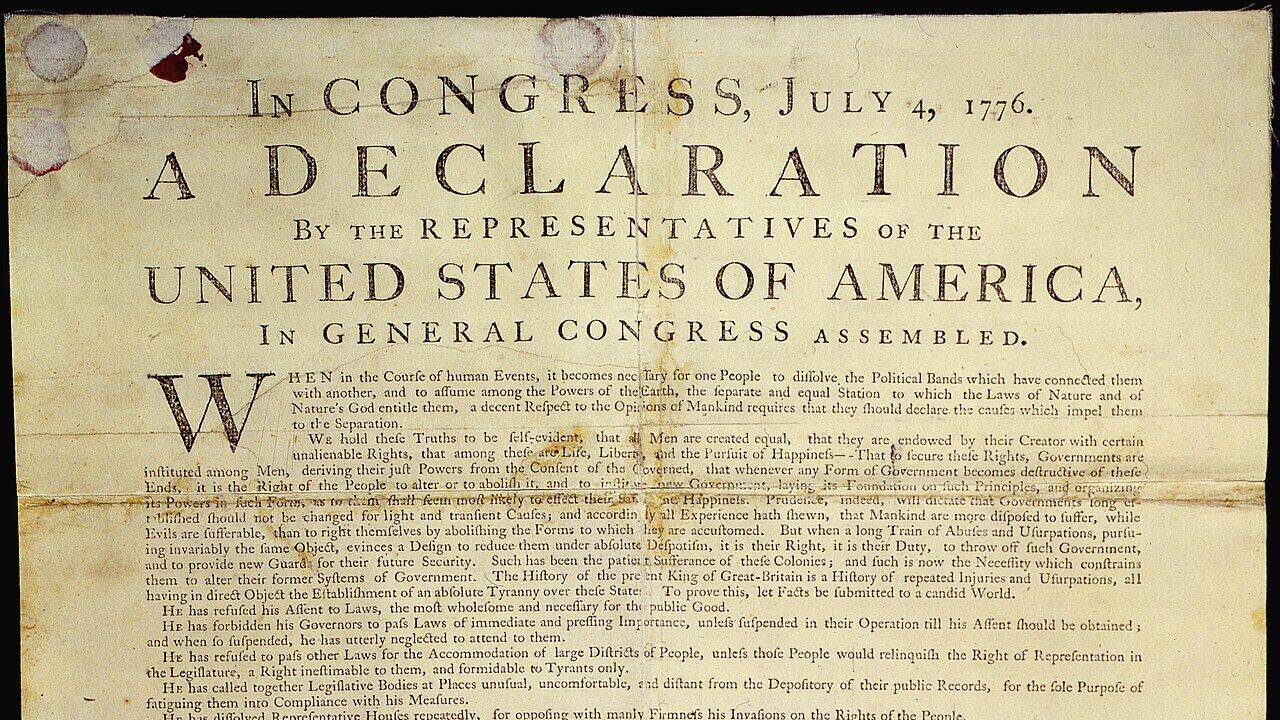
An ordinary flea market purchase resulting in an eight-million-dollar asset liquidation represents an extreme instance of valuation arbitrage. When a Pennsylvania buyer acquired a framed painting for four dollars and subsequently realized the backing board concealed an original printing of the 1776 Declaration of Independence, the transaction exposed a profound pricing inefficiency in the secondary art and manuscript market. This event is frequently categorized as mere luck, yet a rigorous examination reveals a distinct set of market frictions, institutional blind spots, and verification failures that allow high-value historical instruments to trade at scrap value.
Deconstructing this financial anomaly requires moving past the narrative of serendipity and analyzing the structural mechanics that govern asset discovery, authentication risk, and liquidity channels for rare historical documents.
The Information Asymmetry Matrix
The primary driver of the four-dollar acquisition price is information asymmetry between the uninitiated holder and institutional experts. In standard liquid markets, price discovery relies on transparent order books and continuous trading. In the market for historical ephemera, price discovery is fragmented, asymmetric, and dependent on localized provenance tracking.
The transaction breaks down into three distinct operational failures within the traditional valuation pipeline:
- Provenance Decay: As physical assets change hands across generations, contextual documentation is routinely lost. The physical object is decoupled from its historical pedigree, reducing its perceived utility to mere aesthetic decoration.
- Inspection Friction: Institutional gatekeepers, such as estate liquidators and thrift store curators, operate under severe throughput constraints. They optimize for inventory velocity rather than deep historical authentication, creating a systematic blind spot for rare document identification.
- Verification Cost: The capital and time required to authenticate a rare document exceed the operating budget of casual sellers. Without an economic incentive to run specialized chemical, typographic, and paper-mold analyses, sellers default to pricing based on immediate physical utility rather than historical scarcity.
When these three factors intersect, mispricing is inevitable. The market assigns a value close to zero because the transaction cost of extracting true value is higher than the perceived upside for an untrained vendor.
Typographic Verification and Supply Scarcity
The valuation ceiling of eight million dollars for a single document copy is rooted in hard supply constraints and verified historical production runs. In July 1776, the Continental Congress ordered the printing of the Declaration of Independence by John Dunlap. Out of an estimated initial print run of approximately 200 broadsides, only 26 copies are known to survive today.
Scarcity alone, however, does not dictate an eight-figure valuation. The price realization depends on strict forensic verification criteria:
- Paper Composition: Dunlap broadsides utilized specific rag paper stocks containing identifiable watermarks consistent with late-eighteenth-century papermaking techniques in Philadelphia.
- Typographic Signatures: Authentic first printings contain specific compositional errors, line breaks, and spelling variations introduced during the rapid typesetting process before formal congressional revisions were finalized.
- Ink Analysis: Spectroscopic examination confirms iron gall ink formulations matching the period, distinguishing original broadsides from nineteenth-century facsimile reproductions produced for the centennial celebrations.
The Pennsylvania buyer did not merely purchase old paper; they acquired a scarce verification-ready instrument with a restricted circulating supply. The eight-million-dollar auction outcome reflects the resolution of authentication risk. Prior to professional grading and pedigree confirmation, the asset traded as an unverified commodity. Post-authentication, the asset transitioned into a museum-grade institutional holding, unlocking access to elite liquidity channels such as Sotheby's or Christie's.
The Structural Mechanics of Secondary Market Liquidity
Moving an asset from a four-dollar flea market find to an eight-million-dollar hammer price requires navigating a highly illiquid, relationship-driven market structure. Unlike equities or commodities, historical manuscripts lack centralized exchanges. Liquidity is episodic and dependent on high-net-worth collector demand or institutional acquisition budgets.
The liquidation path follows a strict operational sequence:
- Non-Destructive Forensic Audit: High-resolution digital scanning, UV fluorescence testing, and fiber analysis are deployed to eliminate forgery risk. In this phase, the asset undergoes baseline risk mitigation.
- Pedigree Reconstruction: Archivists trace the chain of custody to rule out stolen property claims and establish historical continuity, which directly influences institutional buyer confidence.
- Targeted Auction Placement: Rather than utilizing open-market retail channels, the asset is routed through specialized manuscript auctions where institutional buyers, sovereign wealth funds, and billionaire collectors compete in a concentrated liquidity window.
The enormous spread between acquisition cost and final sale price is the market's compensation for bearing the extreme search and verification costs inherent in fragmented asset classes.
Strategic Allocation of Discovery Capital
The recurrence of multi-million-dollar manuscript discoveries in domestic environments indicates that household capital assets frequently harbor mispriced historical debt and equity instruments, currency variants, and state documents. Traditional financial planning treats physical households as consumption units, ignoring the latent portfolio value of uncatalogued paper assets.
To capture asymmetrical upside in historical asset markets, participants must operate with institutional rigor. This involves treating physical estate liquidation not as a cleanup task, but as a systematic search for mispriced long-duration assets. The bottleneck is rarely a lack of valuable artifacts in circulation; the bottleneck is the high cost of human attention required to filter noise from signal in unindexed environments.
The market for historical documents remains fundamentally inefficient because the cost of inspection outweighs the expected value for casual holders. Until automated computer-vision authentication and decentralized provenance tracking reduce verification friction, high-variance arbitrage opportunities will continue to surface in unlikely locations.