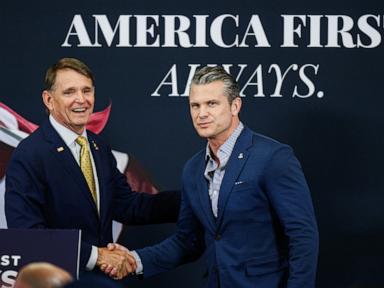
The air inside the high school gymnasium in Ohio smelled exactly like every political rally over the last forty years. Popcorn, damp winter coats, and the faint, sweet tang of floor wax. On stage, the flags were crisp. The music boomed through slightly distorted speakers, vibrating the metal bleachers where local families sat shoulder-to-shoulder.
In the center of it all stood the Secretary of War, smiling, shaking hands, and delivering a stump speech that moved with the polished rhythm of a seasoned campaigner. To the casual observer, it was a standard slice of American political theater.
But if you looked closely at the edges of the room, the theater dissolved.
Near the side exits, men in dark suits did not watch the crowd. They watched their secure mobile devices. Every few minutes, a quiet murmur would pass between the security detail, a subtle shifting of weight, a glance toward the ceiling. Two thousand miles away, across an ocean and a vast expanse of desert, American naval destroyers were actively trading missile fire with Iranian coastal batteries in the narrow, choked waters of the Strait of Hormuz.
This is the reality of the unseen split screen. It is a moment in modern history where the highest official responsible for prosecuting a sudden, unapproved war chooses to step off the command deck and onto the campaign trail.
To understand how jarring this is, we have to look past the political noise. Traditionally, when American forces enter a major conflict, the Pentagon becomes a fortress of singular focus. The Secretary stays tethered to the National Military Command Center. The optics demand total concentration on the lives of the service members in harm's way.
Yet, here was the man overseeing Operation Epic Fury, standing under basketball hoops, telling a crowd that the nation's adversaries were already beaten.
The disconnect is not just visual. It is deeply personal for those caught in the gears of both worlds.
Consider a hypothetical family sitting in the third row of that Ohio gym. Let us call them the Millers. Their twenty-one-year-old son is an operations specialist aboard an American cruiser currently stationed in the Gulf of Oman. For the Millers, the war is not a talking point or a strategic victory to be cheered. It is a text message that reads "Going dark for a bit, love you," followed by days of deafening silence. They came to the rally looking for reassurance. They wanted to see the man who holds their son’s fate in his hands looking serious, burdened, and entirely focused on bringing those sailors home.
Instead, they watched a celebration.
The Secretary spoke with absolute confidence. He painted a picture of a conflict that was essentially won, using sharp, defiant language to dismiss anyone who questioned the strategy or the timeline. To the crowd, it sounded like strength. But to those watching the actual data from the region, the narrative felt increasingly detached from the muddy reality on the water.
The conflict had begun weeks earlier with promises of a swift, decisive campaign to eliminate threats and secure the region. The initial strikes were massive, spectacular, and dominant. Airspace was seized. Targets were destroyed. The administration declared that the opposition was broken.
But wars have a stubborn habit of refusing to follow a script.
Despite the overwhelming display of force, the waters of the Middle East did not clear. Instead, the critical chokepoint of global energy trade became a shooting gallery. Commercial vessels found themselves trapped or targeted. The administration was forced to launch a secondary, temporary tracking operation just to shepherd merchant ships through the chaos. Every day the strait remained contested, the economic shockwaves traveled backward, moving from the oil terminals of the Gulf directly to the digital signs at gas stations in Ohio, Pennsylvania, and Iowa.
The price of fuel climbed. The public’s patience thinned. The legal sixty-day window for military action without explicit congressional approval began to tick down toward its expiration.
That clock is the real reason the Secretary left Washington.
When a military campaign faces an unexpected impasse abroad, the battle shifts home. It becomes a war of perception. The administration needed to convince the public—and a skeptical, restless Congress—that the stalemate was actually a victory, that the rising prices were a small price to pay, and that the critics were merely defeatists.
So, the architect of the strategy took to the trail. He transformed a complex, grinding geopolitical crisis into a simple binary choice between strength and weakness. He argued that a fragile truce meant the legal clock had paused, a piece of statutory interpretation that left constitutional scholars and lawmakers scratching their heads in disbelief.
But constitutional law does not play well in a noisy gymnasium. Applause lines do.
The tragedy of this approach is that it obscures the true cost of the conflict. When we talk about military operations in terms of political wins or losses, we lose sight of the human weight. We forget about the thirteen flag-draped coffins that have already returned. We forget about the four hundred wounded service members adjusting to altered lives in military hospitals. We forget that behind every boast of uncontested airspace, there is a pilot sitting in a cockpit, staring into the dark, wondering if this is the night the luck runs out.
By treating the war as a successful campaign milestone, the leadership risks alienating the very people who bear the burden of their decisions. The policy becomes a abstraction, a tool used to rally the base rather than a solemn duty to be executed with humility.
As the rally in Ohio drew to a close, the music swelled once more. The Secretary waved, dropped the microphone, and stepped off the stage, surrounded by a phalanx of security and aides pushing through the flashing cameras.
Outside, the evening air was cold and quiet. The campaign bus sat idling, its glossy wrap reflecting the streetlights. Somewhere inside that bus, a secure phone was ringing. A staffer would hand it over, and the transition would happen in an instant. The politician would fade. The overseer of operations would return. He would listen to the latest coordinates of missile strikes, the casualty reports, the shifting positions of the fleet, and the status of the fragile ceasefire.
The split screen would merge, if only for an hour, in the quiet back seat of a bus speeding down a dark midwestern highway, leaving the cheering crowd behind to reckon with the reality of a war that is far from over.