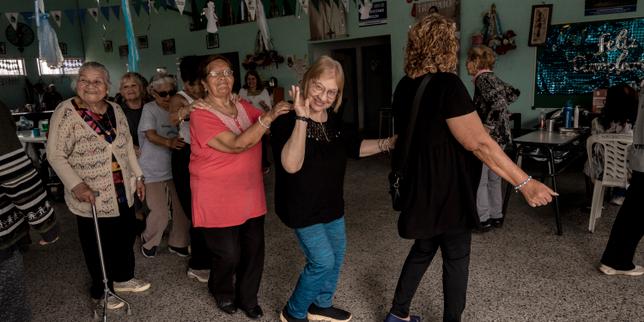
The rain in Buenos Aires does not fall; it settles into your bones like a memory you cannot shake. On a Tuesday morning in Villa Lugano, a sprawling working-class neighborhood on the southern edge of the Argentine capital, the smell of wet concrete mixes with the sharp, metallic tang of burning scrap wire.
Inside a cramped parish hall, Elena—a hypothetical composite of the thousands of community organizers keeping Argentina’s poorest neighborhoods afloat—stirs a massive aluminum pot of guiso, a thick stew of lentils, rice, and whatever vegetables the local market vendors couldn't sell the day before. Her hands are red from cold water. Her ledger, a spiral-bound notebook with frayed corners, tells a story that no macroeconomic chart in the Casa Rosada can capture. Six months ago, she fed eighty families. Today, the line snakes past the rusted iron gate and down the muddy sidewalk, two hundred people deep. For a different perspective, check out: this related article.
Wait.
Listen to the silence in that line. It is not the silence of apathy. It is the silence of people doing mental arithmetic on empty stomachs, trying to figure out how a country that feeds half the world can no longer afford to feed its own children. Related analysis on this trend has been published by NBC News.
Across town, in the gilded halls of the presidential palace, another kind of arithmetic is taking place. President Javier Milei, the self-described anarcho-capitalist with the rock-star hair and the prophetic certainty of an Austrian School economist, sees that same ledger and reads a completely different gospel. To him, Elena’s soup kitchen is a symptom of a decades-old disease—a bloated, paternalistic state that stole Argentina’s future by printing money and handing out favors. His cure is shock therapy: slash public spending, dismantle subsidies, let the invisible hand of the market clear away the rot, and endure the pain until the currency stabilizes and capital returns.
Now, into this volatile, deeply divided country steps Pope Leo XIV.
For years, Argentines waited in vain for their native son, Pope Francis, to come home. He never did, caught in the gravitational pull of domestic politics where every gesture he made was weaponized by one faction or another. Now, his successor, Leo XIV—a pontiff forged in the missionary trenches of Latin America, carrying the Augustinian tradition of radical community and the social doctrine of his predecessor—is preparing to walk onto Argentine soil. He is arriving in a nation torn between two incompatible visions of human dignity, where the Catholic Church stands at the exact antipodes of Javier Milei’s libertarian revolution.
The Theology of the Chainsaw
To understand why this papal visit feels less like a diplomatic courtesy and more like a collision of tectonic plates, you have to understand the sheer ideological ferocity of the moment.
When Javier Milei took office in late 2023, wielding a literal chainsaw at campaign rallies to symbolize the cutting of the state, he wasn't just proposing a budget cut. He was proposing a moral inversion. In Milei’s worldview, the state is not a protector of the vulnerable; it is a criminal enterprise that extracts wealth from productive individuals through taxation. Social justice—a phrase deeply woven into both Argentine Peronism and Catholic teaching—was branded by Milei as an aberration, a theft disguised as charity.
I remember standing near the Plaza de Mayo during the first winter of his administration, watching pensioners hold cardboard signs in the biting wind. Their monthly stipends had been gutted by inflation that had soared past two hundred percent before Milei’s austerity began to wrestle it down. The macro numbers eventually started to look impressive to Wall Street analysts: a fiscal surplus, a slowing of monthly price hikes, a stabilization of the peso. Yet, on the street, the poverty rate surged past fifty percent before gradually receding, leaving millions stranded in a brutal economic purgatory.
Think of the Argentine economy like a house with a rotted foundation. Milei walked in with a sledgehammer, knocked down the load-bearing walls to stop the ceiling from collapsing, and told the family living inside to sleep in the snow until the concrete dries. Economists argue about whether the foundation will hold. The Church, meanwhile, is looking at the family freezing in the yard.
For the Argentine Episcopal Conference, this is not an abstract policy debate. The Catholic Church in Argentina is not merely a collection of Sunday worshippers; it is the country’s largest, most deeply embedded social safety net. Through Caritas, its charitable arm, and through the curas villeros—the slum priests who live in the corrugated-iron shantytowns of Buenos Aires and Rosario—the Church operates thousands of soup kitchens, addiction recovery centers, and schools.
When the Milei administration froze food deliveries to community kitchens in early 2024, alleging widespread corruption among the political intermediaries who distributed them, the Church pushed back with rare, unified fury. Priests stood before cameras holding empty pots, reminding the government that children cannot eat audits.
A Pope Who Knows the Dust of the Periphery
This is the terrain Pope Leo XIV is walking into. Unlike a European diplomat who might view Latin American poverty through the lens of white papers and Vatican statistics, Leo XIV knows the texture of this struggle firsthand. Having spent decades as a missionary and bishop in Peru before rising through the Roman Curia, he understands that in Latin America, politics and theology bleed into one another like ink on wet paper.
Why does his arrival matter so much right now? Because Leo XIV represents a direct, institutional challenge to the central premise of Milei’s project.
While Milei preaches the sovereignty of the autonomous individual—the idea that society is merely a collection of voluntary contracts between self-interested actors—Leo XIV carries the banner of Catholic social teaching, which insists that human beings only exist in relation to one another. In this view, the market is a useful tool, never a sovereign god. When the pursuit of fiscal equilibrium requires sacrificing the weakest members of the community, the Church calls it idolatry.
Consider what happens next when a pontiff with that worldview steps off the plane at Ezeiza International Airport.
Every word he utters will be dissected. Every handshake will be weighed on a political scale. If he visits a shantytown in the conurbano—the vast, impoverished urban ring surrounding Buenos Aires—the images of him embracing mothers who cannot afford milk will broadcast a silent, devastating critique of Milei’s austerity to the entire world. Conversely, when he sits across from Milei in the Casa Rosada, the cameras will capture a fascinating psychological standoff: a president who has increasingly leaned into religious mysticism and Old Testament metaphors to justify his economic crusade, facing a pope whose entire authority rests on the New Testament command to feed the hungry and clothe the naked.
The Invisible War for the Argentine Soul
There is a deeper current running beneath this clash, one that outsiders often miss. Argentina is experiencing an identity crisis that goes far beyond inflation rates or bond yields.
For nearly eighty years, the country was defined by Peronism—a populist movement that promised workers dignity, state protection, and upward mobility, even as its economic mismanagement repeatedly drove the nation into bankruptcy. Milei’s rise was a visceral rejection of that failure. Young men working gig-economy delivery jobs on battered motorcycles voted for him in droves, tired of watching their earnings evaporate while political elites lived in luxury. To them, the old system was a lie, and the Church, with its constant calls for solidarity and state intervention, often looked complicit in maintaining a status quo that kept everyone poor.
Let’s be honest about this: the Church’s position is not without its own painful contradictions. For years, many Argentine bishops maintained cozy relationships with Peronist politicians who weaponized welfare programs to buy votes while doing nothing to create real jobs. When Milei’s supporters accuse the clergy of defending a failed model that trapped millions in dependency, they are touching a raw, undeniable nerve.
Yet, stripping away the safety net without building a bridge to the other side creates a different kind of trap.
In neighborhoods like Villa Lugano, the vacuum left by the retreating state is not being filled by dynamic entrepreneurs and foreign investors. It is being filled by narcos. When a teenager drops out of school because his family needs him to earn money, and there are no state-funded workshops or community centers left to catch him, the local drug gang offers him a gun, a pair of sneakers, and a sense of belonging. The curas villeros have been screaming this warning into the wind for two years: fiscal austerity without social protection does not create a free market; it creates a cartel state.
The Weight of a Papal Footstep
Imagine, for a moment, the choreography of the upcoming visit.
In the days leading up to Leo XIV’s arrival, the government will scrub the avenues leading from the airport. Banners will go up. Milei, ever the master of political theater, will likely emphasize their shared ground—perhaps pointing to the Church’s traditional stance on family values or the defense of life from conception, attempting to frame the Pope as a moral ally against cultural progressivism while quietly sidestepping the economy.
Leo XIV will not take the bait. His predecessors—from Leo XIII, whose 1891 encyclical Rerum Novarum laid the foundation for modern Catholic social thought by condemning both unchecked capitalism and state socialism, to Francis, who famously called unbridled capitalism the "dung of the devil"—built a doctrinal fortress that cannot be co-opted by libertarian economics.
By taking the name Leo XIV, the Pope deliberately tethered his pontificate to that exact legacy. He is signaling that in an era of artificial intelligence, hyper-financialization, and radical market deregulation, the Church will once again plant its flag on the side of the worker and the marginalized.
When he speaks at a massive open-air Mass in Buenos Aires, millions will listen—not just devout Catholics, but secular Argentines, union leaders, disillusioned voters, and desperate families looking for someone with global moral authority to validate their pain. He does not need to mention Javier Milei by name to dismantle the moral architecture of Milei’s government. All he has to do is read the Beatitudes in a country where fifty percent of the population is struggling to buy bread.
The Ledger and the Altar
Back in Villa Lugano, the rain finally stops, leaving the puddles reflecting a pale, bruised sky.
Elena wipes down the long wooden tables in the parish hall. The pot of guiso is empty, scraped clean down to the scorched lentils at the bottom. Tomorrow, she will wake up at five in the morning to beg the wholesale market for bruised potatoes and chicken backs, hoping it will be enough to stretch through Friday.
She does not read Austrian economics, and she does not follow the internal politics of the Vatican. When asked what she expects from Pope Leo XIV’s visit, she pauses, her fingers tracing the spine of her frayed notebook. She doesn't ask for a miracle, and she doesn't ask for the Pope to topple a president. She simply hopes that when the cameras follow the man in white through the mud of her neighborhood, the people in power will finally be forced to look at the faces behind the numbers.
Argentina stands at a crossroads where two absolute certainties refuse to yield. One believes that freedom requires the cold, uncompromising discipline of the market, no matter how many fall along the way. The other insists that a society is judged solely by how it treats the least of its brothers and sisters.
Soon, the bells of the Metropolitan Cathedral in Buenos Aires will ring out across the Plaza de Mayo, echoing against the pink walls of the presidential palace. And in the space between the altar and the state, an entire nation will hold its breath, waiting to see which gospel will claim its future.


