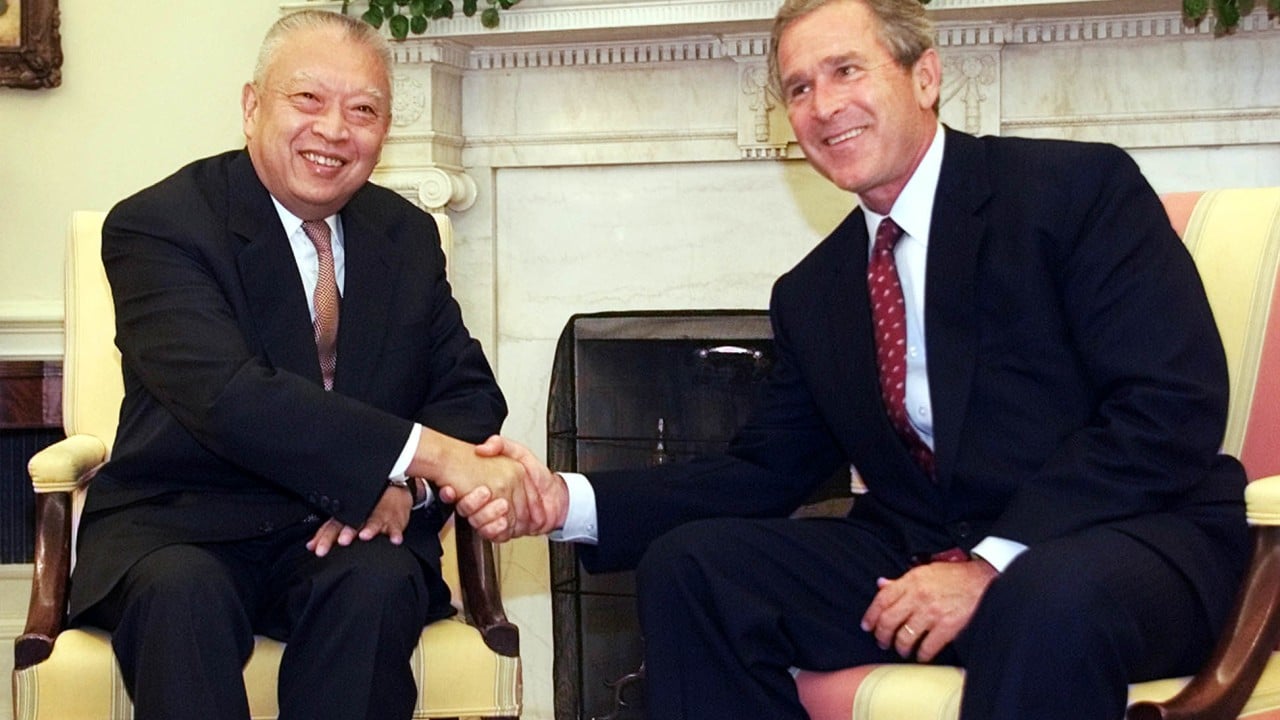
Tung Chee-hwa, Hong Kong’s inaugural chief executive who navigated the fragile fault lines of Beijing and Washington following the 1997 handover, left behind an intricate political footprint that defies simple hagiography. His passing at age 89 brings renewed focus to a career defined by high-stakes international positioning, maritime commerce, and backdoor diplomatic channels between superpowers. Mainstream accounts routinely hail him as a visionary bridge-builder, yet a rigorous inspection of his years in power reveals a more complicated operational reality. He operated as a corporate patriarch thrust into a geopolitical tempest, attempting to harmonize two fundamentally incompatible economic and political systems while global tensions steadily mounted.
The Shipping Magnate in the Crosshairs
Before taking the reins of the newly established Hong Kong Special Administrative Region, Tung managed his family’s massive container shipping enterprise, Orient Overseas Container Line. That background shaped his administrative philosophy entirely. He approached governance through the prism of corporate hierarchy, stability, and consensus among elite stakeholders rather than public-facing democratic competition. When Beijing selected him to lead the city, he inherited a jurisdiction pregnant with anxieties. The 1997 handover was not merely a ceremonial lowering of the Union Jack; it was an unprecedented constitutional experiment known as one country, two systems.
Tung’s early tenure coincided with the brutal shockwaves of the 1997 Asian financial crisis. Property values plummeted. Public anxiety spiked. Instead of retreating, Tung deployed massive market interventions, most notably defending the Hong Kong dollar peg through aggressive government stock purchases. Critics decried the move as state capitalism interfering with free-market sanctity. Supporters argued it saved the local economy from total collapse. This crisis management style became his hallmark: insular, top-down, and heavily reliant on personal relationships with mainland leadership and wealthy tycoons.
Constructing the Track-Two Apparatus
The narrative of Tung as an architect of US-China relations crystallized most visibly after his resignation from the chief executive post in 2005. Unburdened by formal executive responsibilities, he stepped onto the global stage as a high-level intermediary. In 2008, he established the China-United States Exchange Foundation (CUSEF), an organization explicitly designed to foster dialogue between American politicians, academics, and their Chinese counterparts.
Track-two diplomacy serves a very specific purpose in international relations. When official state channels freeze or degenerate into bureaucratic hostility, private foundations step in to keep communication lines open. Tung possessed a unique toolkit for this role. Having lived, studied, and worked in the United States for nearly a decade—including stints in Massachusetts and New York—he understood American political psychology. Simultaneously, his immense standing within Beijing's political architecture, culminating in an 18-year run as vice-chairman of the Chinese People's Political Consultative Conference, gave him rare access to the inner sanctum of Chinese policymaking.
Yet, this dual identity subjected him to intense scrutiny. In Washington, think tanks and congressional committees grew increasingly wary of foreign influence operations. Foundations like CUSEF faced persistent questions regarding their funding sources and operational transparency. Tung insisted his sole motivation was preventing destructive misunderstandings between the world's two largest economies. The reality on the ground was far more nuanced. He was trying to preserve a framework of commercial and cultural engagement that was already buckling under structural geopolitical competition.
The Structural Limits of Conciliation
History judges leaders by the durability of the systems they leave behind. By the time health issues forced Tung to step back from public life, the foundational premises of his bridge-building efforts were fraying. The era of uncritical economic engagement between Washington and Beijing had ended, replaced by strategic rivalry, technological decoupling, and escalating trade barriers.
Consider a hypothetical trade negotiation between two rival corporate giants. If the leadership of both firms fundamentally agrees on market expansion, a mediator can easily smooth over minor friction. However, if one firm decides its primary objective is absolute market dominance and national security protection, a mediator's charm and historical ties become entirely ornamental. Tung's brand of elite, quiet diplomacy assumed that shared economic interests would always override political divergence. That assumption proved fatal as ideology reasserted its dominance over global trade.
Hong Kong itself became the primary casualty of this shifting global tectonic plate. The social unrest of 2003, triggered by his administration's attempt to pass national security legislation, foreshadowed the much deeper societal convulsions that erupted decades later. Tung had consistently underestimated the deep-seated skepticism ordinary citizens held toward authoritarian legal mechanisms, viewing dissent primarily as a management problem rather than a fundamental clash of political values.
Assessing the True Impact
Evaluating Tung Chee-hwa requires stripping away both the uncritical praise of state media and the knee-jerk condemnation of hostile foreign commentators. He was a transitional figure, a man shaped by the golden age of globalized shipping who tried to apply corporate logistics to the messy art of statecraft.
His efforts with CUSEF and various local think tanks did maintain vital intellectual exchanges during periods of acute bilateral frostiness. American diplomats regularly met with Chinese counterparts under the umbrella of his initiatives, preventing total communication breakdowns. At the same time, his inability to foresee or mitigate the structural drift between Washington and Beijing exposed the inherent limitations of personal diplomacy in an era of great power competition.
He stayed in the arena long after his physical health began to wane, driven by an unwavering belief in his personal mandate to keep the peace between East and West. Whether that persistence altered the course of history or merely delayed an inevitable collision remains the central debate surrounding his legacy. The architecture he helped build has not collapsed entirely, but the storm it was designed to withstand has grown far too fierce for any single mediator to control.