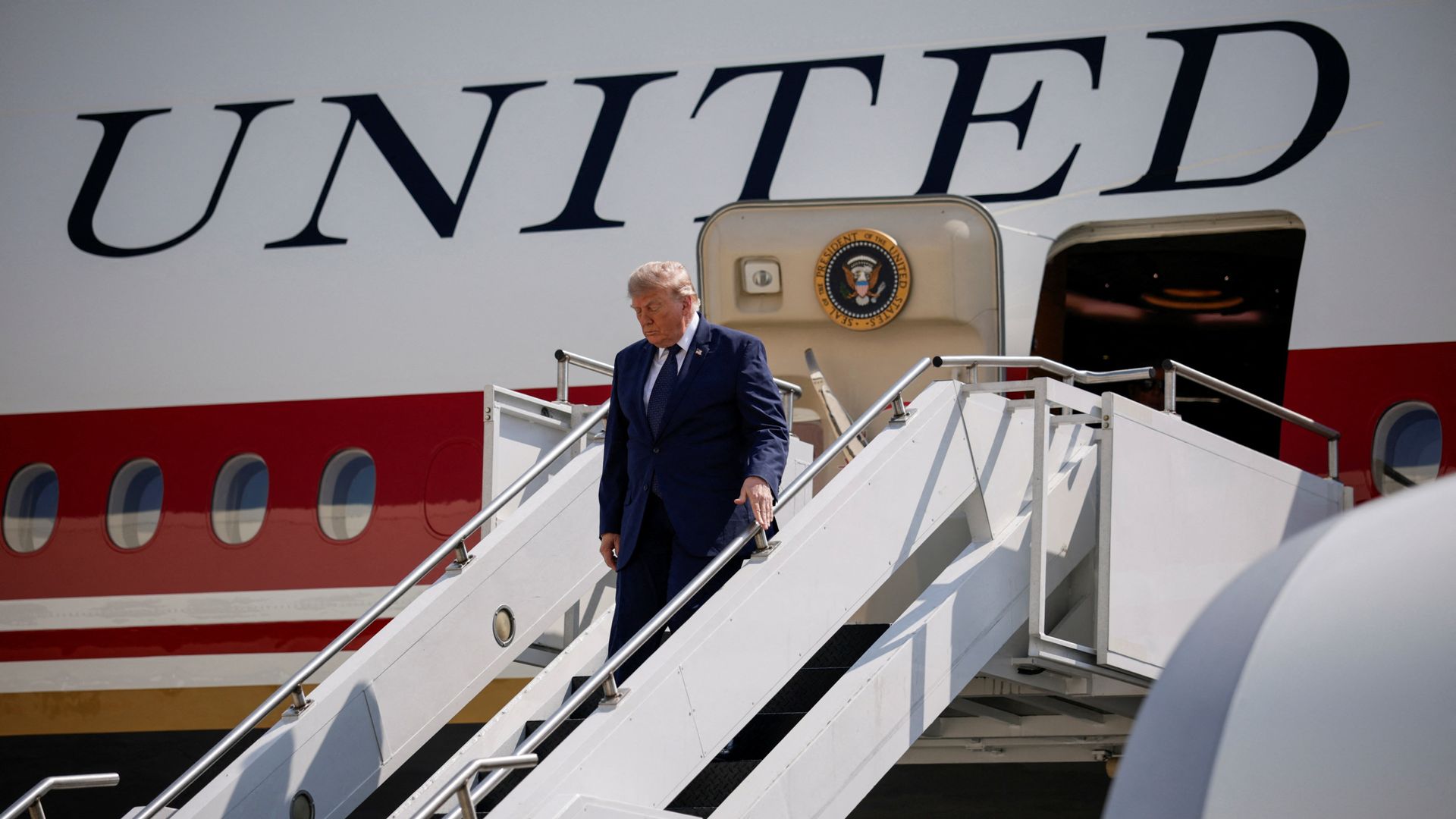
Flying a president around the globe isn't just about plush leather seats, customized gold trim, or a shiny paint job. It requires a flying fortress capable of surviving missile attacks and directing nuclear strikes mid-flight. When President Donald Trump stepped aboard his newly minted Boeing 747-8—a $400 million gift from Qatar's royal family—on July 1, it looked like a major victory for speed over government bureaucracy.
That honeymoon lasted barely three weeks. Meanwhile, you can find related developments here: Inside the High-Stakes FBI Moscow Diplomacy Crisis.
Trump announced that the custom-painted jet is being grounded for about a month to get "maxed out" with defense upgrades. Behind that casual phrasing lies a stark reality. Rushing a luxury airliner into service as Air Force One left critical security gaps that military planners simply couldn't ignore, especially during international flashpoints.
The Reality of Rushing a Flying Fortress into Service
When Qatar transferred the 14-year-old Boeing 747-8 to the Pentagon last year, the White House saw a chance to bypass years of defense acquisition delays. Boeing's official program to build two purpose-built VC-25B Air Force One replacements under a $3.9 billion contract signed back in 2018 has suffered massive cost overruns and delays. Those official planes aren't expected until at least 2028. To see the bigger picture, we recommend the recent report by Reuters.
Defense contractor L3Harris Technologies took on the task of rapidly modifying the Qatari jumbo jet. They repainted the hull in Trump's preferred navy blue, red, and gold scheme, keeping the interior opulent with cream-and-tan leather seating, wood paneling, and presidential seals.
It looked ready for prime time. But flying into active conflict zones requires far more than aesthetic flair.
The first major red flag popped up on July 8 during a presidential trip from Turkey to the United Kingdom. With geopolitical tensions flaring with Iran, Secret Service advisors reportedly stepped in. Rather than flying the high-visibility Qatari jet across Europe, Trump switched back to one of the 35-year-old legacy VC-25A planes for the leg to London.
Trump publicly shrugged off the swap as a choice made "for old time's sake." Yet reporters on board noted crew members instructing media passengers to pull down window shades during departure from Ankara. Security concerns were clearly driving the decision behind closed doors.
What the Qatari Jet Is Actually Missing Up High
Standard Air Force One aircraft are built from the ground up to operate as airborne command posts in the middle of a national catastrophe. They aren't just commercial airliners with fancy bedrooms. They are hardened military hardware.
The Qatari jet, despite its $400 million original price tag as a royal transport, lacked several fundamental systems required for presidential operations:
- Infrared Countermeasures: Standard presidential jets feature directional infrared countermeasure pods that detect incoming heat-seeking missiles and blind their guidance systems with lasers.
- Electromagnetic Pulse Hardening: True presidential aircraft carry miles of heavily shielded wiring designed to survive the electro-magnetic pulse of a high-altitude nuclear detonation, keeping onboard flight systems and electronics alive.
- Advanced Communications Suits: To act as the National Command Authority in a crisis, the president needs secure, unhackable satellite feeds and encrypted links directly to the Pentagon and strategic nuclear forces.
- In-Flight Refueling Capability: Standard VC-25A aircraft can stay airborne almost indefinitely with aerial refueling, a feature missing on commercial variants.
When questioned after landing at Joint Base Andrews following a trip to the FIFA World Cup final in New Jersey, Trump admitted the plane needed work. He insisted the jet already possessed significant capability, but acknowledged that defense teams need a month to install the missing systems. White House Press Secretary Karoline Leavitt later confirmed the plane will be sidelined in the fall while Trump returns to flying on the legacy presidential fleet.
Leaks Subpoenas and standard Boeing Delays
The security vulnerabilities on the donated aircraft weren't supposed to be public knowledge. After news outlets reported on the specific defensive hardware missing from the plane, the situation escalated into a full-blown federal leak investigation.
Federal agents issued grand jury subpoenas to several journalists who covered the story. Intelligence officials argued that revealing specific defensive gaps on a presidential transport compromised national security. Press freedom groups pushed back, pointing out that public oversight of a foreign-gifted presidential aircraft is essential.
This operational headache traces back to Boeing's ongoing struggles with the primary Air Force One replacement contract.
In 2018, Boeing signed a fixed-price deal to deliver two modified 747-8s to replace the aging fleet built during the Reagan administration. That fixed-price structure meant Boeing had to absorb any costs exceeding the original $3.9 billion budget.
Manufacturing snarls, supply chain bottlenecks, and engineering setbacks have driven program overruns past $2 billion, all of which Boeing has had to write off. The delays forced the administration to look for an immediate bridge aircraft, leading directly to the Qatari gift.
Modifying a commercial jet for presidential duty usually takes four to five years. Trying to compress that timeline into less than a year left defense technicians scrambling to install basic hardware while delaying the installation of heavy defensive suites.
How the Presidential Fleet Moves Forward From Here
Upgrading a Boeing 747 with high-grade military hardware in 30 days is an aggressive timeline. Defense contractors will need to work around the clock to integrate missile protection sensors, secure communications hardware, and defensive jammer pods into the existing airframe.
If you track aviation news or follow national security policy, keep an eye on these key factors over the coming months:
- Watch the Flight Tail Numbers: Pay attention to Air Force flight logs when presidential trips resume in the autumn. If Trump continues flying the legacy VC-25A past the one-month mark, it signals that the retrofitting process hit technical hurdles.
- Track Congressional Oversight Hearings: Expect House and Senate Armed Services Committees to press the Air Force on total modification costs. The original retrofit budget was estimated under $400 million, but additional defense phases could drive that bill higher.
- Monitor the Formal VC-25B Program: Check the Government Accountability Office reports on Boeing's progress. Until the primary VC-25B aircraft are delivered in 2028, the military will have to keep juggling legacy airframes and temporary solutions to keep the commander-in-chief secure.