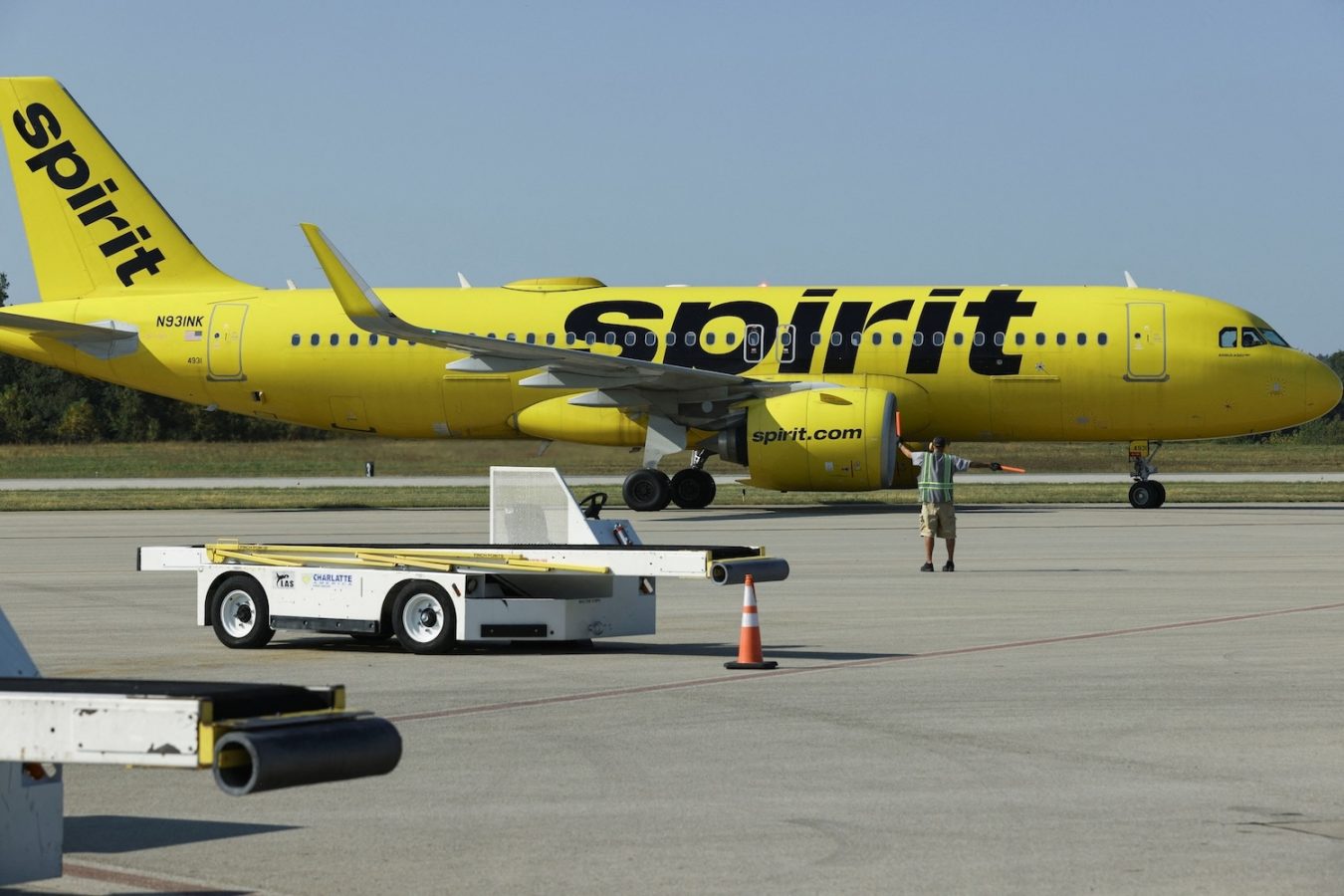
The media is currently salivating over the prospect of a government-led rescue of Spirit Airlines, fueled by Donald Trump’s characteristic rhetorical flourishes about protecting American brands. They see a "champion of the people" stepping in to stop the "big bad" legacy carriers from monopolizing the skies. They are dead wrong.
Saving Spirit Airlines as it currently exists isn't populist—it’s corporate welfare for a broken business model that has been failing since well before the Department of Justice blocked the JetBlue merger. Everyone focuses on the $3.3 billion in debt or the grounded Pratt & Whitney engines. Those are symptoms. The disease is a fundamental shift in how Americans travel, and no amount of executive-order posturing can fix a product that consumers have collectively outgrown.
The Myth of the Low Cost Savior
The "lazy consensus" dictates that if Spirit dies, ticket prices for the average family of four will double overnight. This assumes a static market where Spirit’s presence is the only thing keeping United or Delta honest. It ignores the reality of Yield Management.
Legacy carriers didn't beat Spirit by being "better" in the traditional sense; they beat Spirit by inventing the Basic Economy tier. They weaponized Spirit’s own model against it. When a traveler sees a $90 fare on Spirit and a $110 fare on Delta that includes a "real" seat and a reliable app, the math has changed. The $20 gap is no longer wide enough to justify the Spirit "experience."
If the government intervenes to prop up Spirit, they aren't saving competition. They are subsidizing an inefficient operator that is bleeding cash because it lost its competitive advantage. In a true capitalist ecosystem, inefficient players must be allowed to fail so their assets—planes, pilots, and most importantly, gate slots—can be redistributed to someone who knows how to turn a profit.
The Merger Mania Fallacy
The narrative often suggests that Trump would simply "allow" a merger that the Biden administration blocked. This is a shallow read of antitrust law and airline economics.
When the DOJ blocked the JetBlue-Spirit merger, the argument was that it would eliminate the "Spirit Effect"—the downward pressure on prices. The contrarian truth? The Spirit Effect was already dead. Spirit's operating margins have been negative for years. You cannot provide a "downward pressure on prices" when you are literally losing money on every seat you fly. That isn't a business; it’s a charity funded by bondholders.
Even if a second Trump administration greenlit a merger tomorrow, who is buying?
- JetBlue? They’ve moved on, scarred by the legal fees and the realization that Spirit’s fleet is a maintenance nightmare.
- Frontier? They are struggling with the same ULCC (Ultra-Low-Cost Carrier) headwinds.
- Legacy Carriers? They don't want the headache of integrating a toxic culture and a different fleet type (A320neo engine issues) just to get some extra gates they could probably pick up in a bankruptcy auction anyway.
The Ghost of the 1978 Deregulation Act
We need to talk about what "competition" actually means in the 2020s. Since the Airline Deregulation Act of 1978, the industry has cycled through booms and busts. The irony of conservatives or populists calling for a government intervention is that it flies in the face of the very deregulation that allowed Spirit to exist in the first place.
I’ve seen companies blow millions trying to "save" brands that have lost their "Why." Spirit’s "Why" was: "We are the cheapest, and it’s going to suck, but you’ll save $50."
But travelers have become more sophisticated. They value their time and their sanity. When you factor in the "Spirit Tax"—the $65 carry-on bag, the $25 seat selection, the $5 water—Spirit is often more expensive than Southwest or a legacy carrier’s basic economy. The government stepping in to save this model is like the government stepping in to save the horse and buggy because it kept the price of hay low.
The Debt Trap Nobody is Discussing
Spirit is staring down a massive wall of debt maturing in 2025 and 2026. Specifically, their loyalty program-backed loyalty bonds.
Imagine a scenario where the US government provides a "bridge loan" or uses the Treasury to guarantee Spirit’s debt. You are essentially using taxpayer-backed credibility to bail out sophisticated institutional investors who knew the risks of buying high-yield airline debt. This isn't "saving jobs"; it’s a transfer of wealth from the public to the bondholders.
If Spirit goes through a Chapter 11 restructuring, those bondholders take the "haircut" they deserve for a bad bet. The airline continues to fly, the pilots keep their jobs, but the equity is wiped out and the debt is rationalized. A "bailout" or a "Trump-save" prevents this necessary cleansing of the balance sheet.
The Engine Crisis is the Final Nail
We cannot ignore the technical catastrophe that is the Pratt & Whitney GTF (Geared Turbofan) engine. Spirit has dozens of planes grounded because the engines are literally falling apart.
$$Operating_Loss = (Fixed_Costs + Debt_Service) - (Decreased_Capacity \times Revenue_Per_Seat)$$
The math is brutal. Spirit is paying for planes that cannot fly. No amount of "unleashing the economy" or "cutting red tape" fixes a metallurgical defect in a turbine blade. If the government "saves" Spirit, are we also going to subsidize Pratt & Whitney’s repair schedule? Where does the intervention end?
What People Also Ask (and Why They Are Wrong)
"Won't ticket prices go up if Spirit disappears?"
In the short term, on specific routes (like Fort Lauderdale to Atlantic City), yes. But in the long term, new entrants like Avelo or Breeze—who have much lower cost structures and more modern point-to-point strategies—will fill that vacuum. Markets abhor a vacuum. They also abhor a zombie airline that only exists because of political optics.
"What about the thousands of employees?"
In a Chapter 11 or even a Chapter 7 liquidation, pilots and flight attendants are the most valuable assets. With the current global pilot shortage, these professionals would be absorbed by United, Delta, and American within weeks. The "saving jobs" argument is a political shield used to protect executive bonuses and shareholder value.
The Brutal Reality of the "Premium" Shift
The biggest reason to stop trying to fix Spirit is that the market has moved toward "premiumization." Even the budget-conscious traveler now wants Wi-Fi, power outlets, and the assurance that they won't be stranded for three days if one flight cancels.
Spirit’s infrastructure isn't built for reliability; it’s built for high utilization. When that utilization breaks, the system collapses. We are seeing a "K-shaped" recovery in travel where the people who can afford to fly are willing to pay for the "Premium Economy" or "Business Lite" experience. Spirit is a retail store trying to sell 8-track tapes in a Spotify world.
Stop Trying to Save the Unsaveable
If the US government intervenes in Spirit, it signals that no airline is ever allowed to fail. That is the death of innovation. If you can’t fail, you don't have to be good. You just have to be "important enough" or "loud enough" on social media to get a mention in a campaign speech.
The most "pro-consumer" thing that could happen is for the market to take its course. Let Spirit restructure through the courts, not through the Oval Office. Let the bloated debt be burned away. Let the planes go to carriers that can actually fly them.
Supporting a bailout isn't being a "fan of the little guy." It’s being a fan of a ghost.
Stop looking for a political savior for a business that forgot how to provide value.
The sky won't fall if the yellow planes disappear. It will just get a little more efficient.