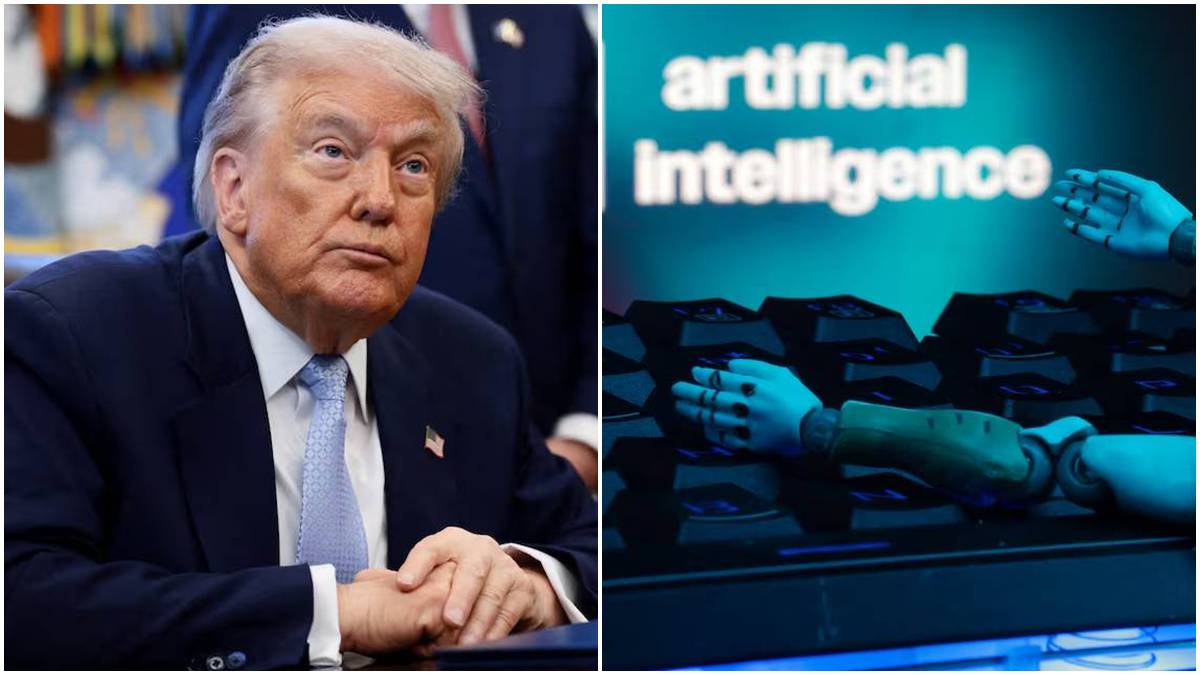
When the White House labels existential warnings about machine intelligence a complete fabrication, the shockwaves hit Silicon Valley immediately. Donald Trump recently dismissed artificial intelligence safety anxieties as a hoax, rejecting calls from prominent researchers and tech executives for heavy government guardrails.
This stance is a direct continuation of an administration strategy that prioritizes unbridled technological acceleration over precautionary bureaucracy. Back when he returned to office, Trump swiftly rescinded prior federal directives on artificial intelligence governance, arguing that strict oversight handcuffs American companies while adversaries surge ahead.
The Geopolitical Race Against Beijing
At the heart of this deregulation push is a raw geopolitical calculation. The administration's position rests on a single driving principle: whoever wins the race for advanced computing dominates the global economy.
Critics inside top-tier labs like Anthropic and OpenAI argue that rolling out massive foundational models without rigorous safety evaluations invites catastrophe. They point to risks ranging from automated cyber warfare to autonomous biological threats.
Yet, the administration views these warnings through a different lens. Officials argue that exaggerated threat narratives are often used by legacy incumbents to pull up the drawbridge, locking in monopolies by making compliance too expensive for startups. Furthermore, political leaders have explicitly stated that over-regulation benefits international competitors—most notably China—who won't slow down their own research cycles just to appease Western compliance officers.
Inside the Silicon Valley Divide
The tech sector itself is deeply fractured over this issue. On one side, companies advocating for deceleration argue that self-regulation is failing and that independent federal monitoring is the only way to prevent a runaway disaster. Figures within these labs contend that codebases of a certain size possess unpredictable emergent properties that demand strict containment protocols.
On the other side, open-source advocates and free-market venture capitalists argue that open weights and rapid deployment are essential for democratic innovation. They believe that locking down models behind corporate or state-sanctioned walls creates dangerous choke points.
Trump's outright rejection of safety panics aligns tightly with the deregulatory wing of the tech industry. By framing extreme compliance demands as a conspiracy against American energy grids and data center expansion, the White House has made it clear that massive infrastructure builds and unfiltered compute growth take priority. Power-hungry data centers are getting fast-tracked, and federal hurdles are being systematically dismantled.
What This Means for the Future of Tech
Without a heavy federal mandate forcing labs to pump the brakes, the industry is entering an era of hyper-competition. Companies will race to scale models larger and faster, betting that market forces and internal corporate policies are enough to manage risk.
You'll see state-level regulations face intense federal pushback as the executive branch attempts to impose a unified, minimally burdensome standard nationwide. For software developers and enterprises, this means navigating a chaotic landscape where innovation speed trumps precautionary bureaucracy.
The debate won't quiet down anytime soon. As models grow more capable, the friction between accelerationists and safety advocates will only intensify. Ultimately, the administration's bet is simple: winning the technological race leaves no room for hesitation.