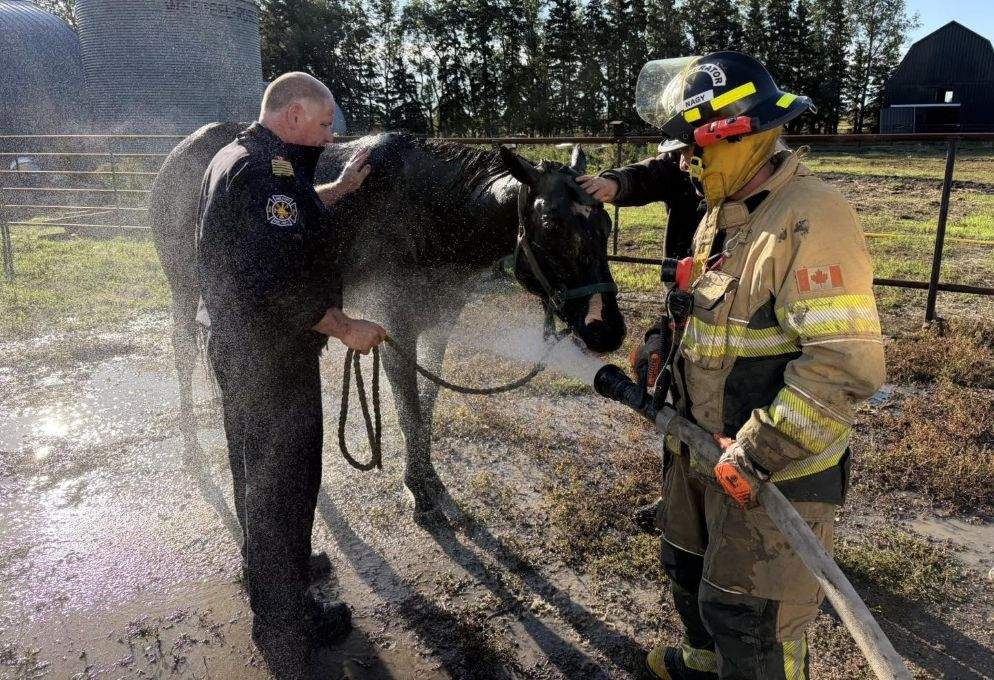
The morning air across the open plains of Saskatchewan carried the sharp, familiar bite of early spring thaw. Beneath that crisp surface, however, lay an invisible hazard that has claimed more rural working animals than most municipal emergency responders care to admit. When local emergency crews pulled a completely exhausted horse from a sucking, deceptive mud pit in rural Saskatchewan, the rescue made standard regional news. It played out as a feel-good dispatch of firefighters, animal handlers, and heavy straps hauling an animal back to dry ground.
Behind the flash photography and the sigh of relief lies a darker, systemic hazard facing livestock owners across the Canadian prairies. Mud pits are not merely inconvenient puddles. They are high-density sediment traps born of rapid seasonal melt, poor drainage, and shifting subsoil composition. When an animal steps into these saturated hollows, physics turns malicious. The vacuum effect of dense clay and silt locks around the lower limbs, while the animal's panic accelerates exhaustion. Every struggle drives the hooves deeper, turning a simple extraction into a race against hypothermia, shock, and organ failure.
Understanding how these agricultural emergencies unfold requires looking past the surface water. When winter frost leaves the ground frozen solid underneath an upper layer of rapidly thawing topsoil, moisture has nowhere to escape. It pools in natural depressions, mixing with heavy clay to form a dense slurry. To a grazing horse, these areas often look identical to dry pasture or shallow standing water. The weight distribution of a thousand-pound animal breaches the semi-solid crust instantly.
Emergency responders in rural districts face immense tactical hurdles during these incidents. Standard tow trucks cannot navigate waterlogged terrain without getting stuck themselves, rendering heavy mechanical recovery risky and slow. Rescuers frequently rely on specialized webbing, manual digging in freezing water, and sometimes local agricultural machinery equipped with long booms. Veterinarians must remain on standby to administer sedatives. A panicked horse fighting its rescuers can break limbs or inflict severe trauma on the very people trying to save its life.
The immediate rescue is only the first hurdle in a long recovery process. Once an animal is freed from deep suction mud, systemic crisis often sets in. Vets call this condition capture myopathy or exhaustion syndrome. When muscles work beyond their limit without adequate oxygen, toxins flood the bloodstream. Kidney failure can occur hours after the animal is standing safely in a warm barn. Livestock owners often celebrate a successful pull from the ditch, only to lose the animal forty-eight hours later to internal complications.
Preventative infrastructure in rural farming regions remains dangerously outdated. Drainage ditches dug decades ago have silted up, and changing weather patterns bring heavier, faster spring thaws than previous generations managed. Farmers and acreage owners find themselves fighting a reactive battle every single year. Fencing off low-lying areas requires capital and constant maintenance, luxuries that margin-pressed agricultural operations struggle to prioritize until disaster strikes.
Local fire departments are increasingly bearing the brunt of these agricultural rescues, despite operating on volunteer budgets and limited technical rescue gear. Specialized animal rescue glides and low-pressure lifting bags are standard equipment in urban centers, but rare in rural volunteer halls. When a horse goes down in a remote pasture three miles from the nearest paved road, responders often improvise with whatever rope and timber is rattling around the back of a pickup truck.
The reality of rural animal rescue demands a shift from reactive heroism to aggressive landscape management. Property owners must identify high-risk saturation zones before the spring thaw sets in, utilizing temporary fencing and improved run-off channels. Municipalities need to recognize that rural economic stability is tied directly to the safety of working animals and livestock. Until local infrastructure catches up with shifting environmental extremes, emergency services will continue pulling exhausted animals from the mud, one desperate rescue at a time.