The blue glow didn't just illuminate the living room. It swallowed it.
Imagine a Tuesday evening in 1960. A family sits around a wooden console television, their faces bathed in the flickering light of a monochrome broadcast. For the first time in human history, millions of people are watching the exact same moving image at the exact same second. They are laughing at the same jokes, gasping at the same news bulletins, and buying the same dish soap.
This was the birth of a new kind of consciousness. Before the screens arrived, American identity was regional, fractured, and slow-moving. It lived in local newspapers and porch conversations. But the television set changed the physics of American life. It became a national mirror, reflecting a carefully curated version of who we were supposed to be.
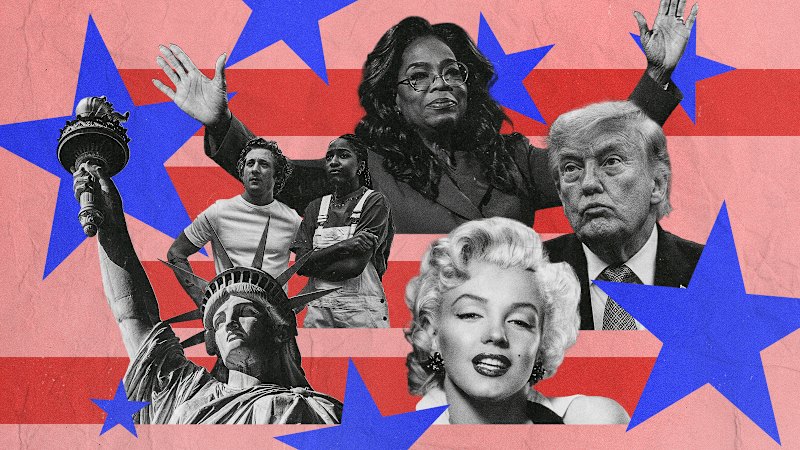
As the nation marks its 250th anniversary, that mirror has fractured into billions of digital shards. Yet, to understand how we arrived at this strange, hyper-connected milestone, we have to look at three forces that collided to shape the modern mind: the hypnotic power of television, the relentless ambition of New York City, and the rise of a real estate mogul turned president who mastered them both.
The Great Screen Takeover
Television was never just an entertainment device. It was an architecture of attention.
In the early days, the power held by network executives was absolute. Three major channels decided what constituted reality for the entire country. If a story didn't make the evening broadcast, for all practical purposes, it never happened. This created a profound sense of shared experience, but it also created an illusion of total consensus.
Consider the sheer weight of that influence. When Walter Cronkite adjusted his glasses and spoke to the camera, an entire superpower adjusted its worldview.
Then came cable. The monoculture began to splinter. Suddenly, viewers weren't just consumers of a single national narrative; they could choose their own reality. The introduction of 24-hour news cycles meant that information had to be fed into an insatiable furnace that never slept. Drama replaced documentation. Conflict became the primary product because conflict kept eyes glued to the glass.
We grew hooked on the rhythm of the transmission. The quiet spaces of American life—the moments of silence on the porch, the unstructured hours of thought—were systematically filled with broadcast signals. We became a nation defined by what we watched.
The Concrete Stage
While the airwaves were being colonized, a physical space was busy manufacturing the imagery that filled them. New York City.
Manhattan has always functioned as America’s psychic capital. It is a city built on vertical ambition, a dense grid of steel and stone where the sheer proximity of millions of people creates a unique kind of social pressure. In New York, identity is something you perform. The sidewalks are stages, the skyscrapers are backdrops, and the currency is visibility.
During the fiscal crisis of the 1970s, the city was teetering on the edge of bankruptcy. The streets were dangerous, the subways were covered in graffiti, and the national media painted the Big Apple as a dystopian cautionary tale. It was a dark time, but it set the stage for a massive reinvention.
New York didn't just rebuild its economy; it rebuilt its mythology. It transformed itself into the ultimate luxury brand. Through hit sitcoms, glittering advertising campaigns, and Wall Street triumphalism, the city beamed a new American dream across the globe. It was a dream of glitz, power, and unapologetic wealth. If you could make it there, you could make it anywhere. The world watched, fascinated, and took notes.
The Man in the Frame
In the center of this neon-lit intersection stood a young developer who understood the mechanics of the new era better than almost anyone else. Donald Trump.
Long before he entered politics, he was a creature of the New York tabloids and the television screen. He recognized a fundamental truth about the modern age: in a world crowded with noise, attention is the ultimate form of leverage. It didn't matter if the press was positive or negative, as long as it spelled the name correctly and kept the camera pointed in his direction.
He built towers that gleamed with gold leaf, but his truest construction was his public persona. He became the living embodiment of the New York success story that television had been selling to the heartland.
When The Apprentice debuted in the early 2000s, it synthesized decades of cultural evolution into a single, highly polished hour of prime-time entertainment. The boardroom became a mythical space where economic destiny was decided with a catchphrase. For millions of viewers sitting in living rooms across the country, the line between reality and television dissolved entirely.
The performance was so convincing that it eventually rewrote the rules of American politics. The techniques perfected in the gossip columns of Manhattan and the editing bays of Hollywood proved to be more powerful than traditional political machines. The screen had finally conquered the state.
The Unseen Inheritance
Now, we stand at the 250-year mark of the American experiment.
It is easy to look at the current state of public discourse and feel a sense of profound vertigo. We argue about facts, we retreat into digital echo chambers, and we view our fellow citizens through lenses of deep suspicion. But this isn't an accidental detour. It is the logical conclusion of a century spent staring into the glass.
We have become a society of producers and consumers, constantly broadcasting our own lives while judging the performances of others. The hunger for visibility that once belonged exclusively to New York starlets and billionaire developers has been democratized. Everyone has a camera. Everyone has an audience. Everyone is hunting for clicks.
The invisible stakes of this transformation are immense. When attention becomes the primary metric of human value, the quiet virtues—nuance, patience, empathy—tend to evaporate. We forget how to listen because we are too busy preparing our next monologue.
The challenge of the next era isn't about policy or economics. It is about reclaiming our attention. It is about remembering that reality doesn't end where the screen begins, and that the true story of a nation is written not in the headlines, but in the quiet, unbroadcast moments between us.