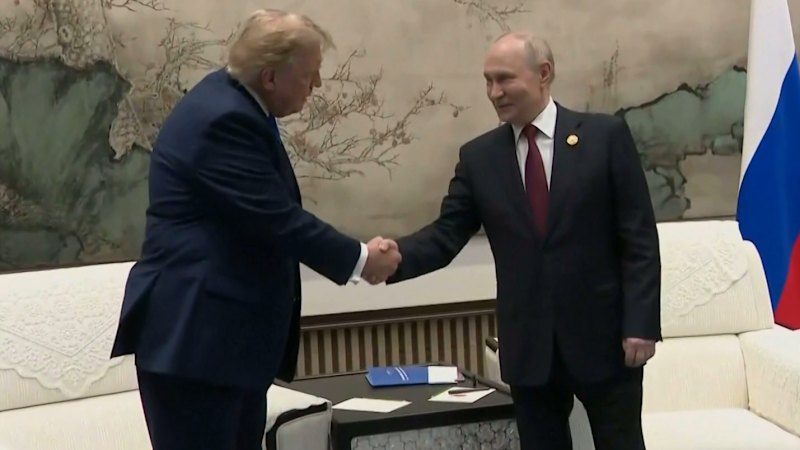
Cold.
That is the first thing you notice about the air inside a diplomatic convention hall—a relentless, humming chill pumped through ceiling vents to keep hundreds of sweating journalists, nervous translators, and men in dark wool suits from overheating under television lights. I have spent enough autumn weeks standing behind velvet ropes in cities like Lima, Danang, and San Francisco to know that the real temperature of the world is never measured by the thermostat on the wall. It is measured in the stiffness of a handshake. It is measured in the exact millimeter of distance two world leaders keep between their shoes when they pause for the cameras.
When Donald Trump, Xi Jinping, and Vladimir Putin converge at the Asia-Pacific Economic Cooperation summit, the headlines always treat it like a heavyweight prize fight. You know the drill. Pundits dissect the body language. Anchors speculate on who blinked first. Maps light up with arrows showing naval chokepoints and tariff walls, turning twenty-one diverse economies into a monochrome chessboard.
It makes for great television. It also misses the entire point.
To understand what actually happens when these three men share a stage at APEC, you have to leave the press riser. You have to follow the invisible thread that connects a microphone in a convention center to a pallet of electronics sitting on a dock in Long Beach, or a family-run machine shop in Ohio, or a soybean farm in Mato Grosso. Because while the cameras focus on the theatrics of three towering egos, the quiet reality of APEC is much simpler and infinitely more personal. It is the annual stress test of the fragile, interconnected machine that keeps modern life affordable.
The Architecture of an Invisible Bargain
To see how this works, consider a hypothetical character—let us call her Elena. Elena owns a mid-sized company in Seattle that designs and assembles specialized medical sensors. She does not follow diplomatic cables. She does not care about the historical grievances of the South China Sea or the nuances of Eurasian energy pipelines. What Elena cares about is her Tuesday morning invoice.
Her sensors require rare-earth magnets processed in China, microcontrollers fabricated in Taiwan, aluminum housings stamped in Vietnam, and specialized testing software written by engineers in Eastern Europe. For thirty years, Elena’s business existed because of an unspoken global consensus—a consensus that APEC was literally built to protect. Founded in 1989 as the Cold War thawed, the forum operates on a deceptively simple premise: if nations trade together, they grow together, and they stop shooting at each other.
APEC represents nearly forty percent of the world’s population and well over half of global economic output. Unlike the World Trade Organization, its agreements are non-binding. There are no binding treaties signed in blood here. Instead, it is a pressure valve. It is the one room where the architects of the global economy are forced to sit across from one another and confront the physical consequences of their rhetoric.
Now watch what happens to Elena’s Tuesday invoice when Trump, Xi, and Putin enter that room.
Each of these men arrives carrying a fundamentally different worldview, and none of those worldviews prioritize Elena’s supply chain. According to decades of trade policy analysis from institutions like the Peterson Institute for International Economics, the post-Cold War era of frictionless globalization has steadily fractured into competing spheres of influence. When Trump steps to the podium, he brings the blunt, transactional logic of economic nationalism—the belief that decades of multilateral trade deals hollowed out American manufacturing and that tariffs are not a last resort, but a primary instrument of statecraft.
Across the table sits Xi Jinping, presiding over an export powerhouse grappling with domestic real estate debt and demographic headwinds, determined to prove that China is the indispensable engine of Asian growth and technological self-reliance. And in the wings—or directly across the aisle—stands Vladimir Putin, operating under sweeping Western sanctions, viewing the Pacific Rim not as a marketplace of rules, but as a geopolitical lifeline to bypass European isolation and bind Russian energy to Asian demand.
When those three agendas collide in a single summit, the air in the room changes. You can feel it in the corridors. Trade ministers who spent months drafting polite, consensus-driven communiqués suddenly find their sentences gutted over a single word—protectionism, sovereignty, security.
The Illusion of the Decoupled World
There is a comforting myth that circulates in Washington, Beijing, and Moscow alike: the idea that the world’s great powers can cleanly untangle themselves from one another. Politicians call it de-risking or decoupling or import substitution. On a campaign stage, it sounds clean, decisive, and patriotic.
In reality, it is like trying to unbake a cake.
I remember standing on a container terminal in Busan a few years back, watching automated cranes lift steel boxes off a vessel the size of four football fields. A logistics director standing beside me pointed to a single forty-foot container dangling fifty feet in the air. "Inside that box," he told me, "there are sub-assemblies that have already crossed the Pacific twice before anyone even puts a brand logo on them."
That is the truth that diplomatic posturing tries to obscure. Modern manufacturing is not a straight line from point A to point B; it is a dense web of specialized dependencies. When Trump threatens sweeping universal tariffs, or when Beijing restricts the export of gallium and germanium—minerals essential for semiconductors and defense optics—or when Russian energy reroutes through shadow fleets into Asian refineries, the shockwaves do not stop at national borders.
They land on Elena’s desk.
Suddenly, the Vietnamese factory stamping her aluminum housings faces a component shortage because its raw ingots came from a sanctioned smelter. Her shipping insurance spikes because naval tensions in the Taiwan Strait have underwriters nervous. Her bank holds up a routine cross-border payment for three weeks to run compliance checks against new export controls. Elena hasn't changed a single thing about how she runs her business, yet her margins have just evaporated.
And she passes that cost on to the hospital buying her sensors. Who passes it on to your insurance company. Who passes it on to you.
Why the Stage Matters More Than the Script
If APEC produces no binding laws, and if these three leaders are locked in deep structural rivalry, a fair question hangs over the entire spectacle: why bother showing up at all? Why spend millions of dollars on motorcades, security perimeters, and gala dinners if the communiqués are watered down to platitudes?
I used to wonder that myself. Early in my career covering international summits, I viewed the whole circus with a healthy dose of cynicism. It felt like theater designed to distract from stalemate.
I changed my mind during a late-night briefing in a hotel lobby after a particularly tense bilateral meeting between American and Chinese officials. An exhausted veteran diplomat—a man who had spent thirty years negotiating trade disputes—sat nursing a lukewarm coffee and explained what happens when leaders stop meeting.
"When you don't have a scheduled room," he said, "every misunderstanding becomes a crisis. If a naval vessel veers off course, or a central bank makes a sudden currency move, and you haven't looked the other guy in the eye in two years, your intelligence agencies immediately assume the worst-case scenario. The room doesn't solve the rivalry. It just keeps the rivalry from turning into an accident."
Think of APEC as a circuit breaker in an overloaded house. You do not install a circuit breaker because you expect it to generate electricity; you install it so that when too much current surges through the wires at once, the whole building doesn't burn down.
When Trump, Xi, and Putin appear at the same summit, the bilateral pull-asides—those brief, tightly choreographed meetings in side rooms away from the plenary hall—carry more weight than the formal speeches. A forty-five-minute conversation between Washington and Beijing on the margins of APEC can re-establish military-to-military communication channels that had gone dark for months. A brief exchange in a hallway can signal whether a threatened tariff hike is an opening bid for negotiation or an immovable wall. Even Putin’s presence forces Asian middle powers—nations like South Korea, Japan, Indonesia, and Vietnam—to perform a delicate balancing act in public, revealing where their true economic loyalties lie when forced to choose between Western security guarantees and Eurasian commodity flows.
The Middle Powers Refuse to Choose
Here is the detail that gets buried beneath the obsession with the Big Three: the other eighteen economies in the room are no longer passive bystanders.
For decades, Asia-Pacific diplomacy operated on an unspoken rule: the United States provided the security umbrella, China provided the manufacturing workshop, and everyone else enjoyed the ride. That arrangement is dead.
Today, leaders from Singapore, Jakarta, Tokyo, and Canberra arrive at APEC with their own leverage and a growing impatience with being treated as collateral damage in a three-way tug-of-war. During the 2022 and 2023 summit cycles, officials from Southeast Asian nations repeatedly warned in public remarks and regional forums—including the Shangri-La Dialogue and ASEAN-linked briefings—that forcing the region to pick a side would shatter decades of hard-won poverty reduction.
Consider what happens next in the supply chain. As tariffs and geopolitical friction have risen between Washington and Beijing, investment has not simply flooded back into the American Midwest. Instead, massive amounts of capital have flowed into connector economies—countries like Vietnam, Mexico, Malaysia, and India. Factories are built in Hai Phong or Monterrey, often using Chinese machinery and intermediate parts, before shipping finished goods to American consumers.
At APEC, these middle powers are fighting to keep the rules of trade predictable enough that this new, messy geometry can survive. They push for digital trade standards, green energy supply chain agreements, and customs modernization—unsexy, technical work that rarely makes the evening news in New York or Moscow, yet determines whether global commerce keeps moving or grinds into gridlock.
The Human Ledger
It is easy to feel powerless watching three men command the attention of the world’s cameras while the rest of us wait to see what our groceries, cars, and mortgages will cost next year. Geopolitics has a way of making ordinary people feel like spectators in a stadium where they didn't buy a ticket, watching a game whose rules keep changing mid-play.
I admit, there are moments covering these summits when the sheer scale of the contradictions feels overwhelming. You watch leaders toast to "shared prosperity" and "open markets" under crystal chandeliers, knowing full well that their trade ministries are drafting new export blacklists before the dessert plates are cleared. It is confusing. Sometimes it is genuinely frightening. You wonder whether the system we built over the last eighty years is bending so it won't break, or bending right before it snaps.
Yet history offers a sobering perspective. The world has navigated periods of intense great-power friction before—from the mercantilist clashes of the nineteenth century to the oil shocks and stagflation of the 1970s. What separates periods of managed competition from catastrophic collapse is rarely a sudden burst of goodwill among rival leaders. It is the stubborn, pragmatic realization that economic ruin respects no border.
China cannot export its way out of stagnation if its largest consumer markets lock their doors. The United States cannot re-industrialize overnight without access to global mineral processing and allied manufacturing networks. Russia cannot sustain a wartime economy indefinitely without Asian buyers and technological inputs. Every single man on that APEC stage is tethered, whether he admits it at the podium or not, to the same global arithmetic.
The Morning After the Cameras Leave
Eventually, the motorcades pull away from the convention center. The television trucks coil their cables. The flags of the twenty-one member economies are folded and packed into crates until next autumn, when the whole traveling circus will reassemble in another Pacific Rim city.
Back in Seattle, Elena opens her laptop on a rainy morning and checks the overnight freight rates out of Shenzhen and Busan. Back in a port city in southern China, a factory manager checks the order book for the coming quarter, calculating whether he can afford to keep his night shift running. Back in a grocery store in any suburb from Melbourne to Minneapolis, a shopper reaches for a bag of coffee beans, glances at the price sticker, and pauses for half a second before dropping it into the cart.
None of them were invited to the summit. None of them stood under the flags for the family photo. Yet every word spoken in those cold, brightly lit rooms—every tariff threatened, every channel reopened, every silent calculation made across a polished mahogany table—lives quietly inside that half-second pause at the grocery shelf.