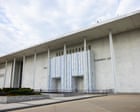
The headlines are predictable. Commentators clutch their pearls over executive threats to tear down the John F. Kennedy Center for the Performing Arts if a massive, quarter-billion-dollar facelift falls short. The lazy consensus says this is just another political stunt, a crude exercise in architectural vandalism meant to shock polite society in Washington.
They have it completely backwards.
I have spent two decades watching public arts institutions turn into bloated, bureaucratic mausoleums. We pump endless taxpayer cash into preserving concrete slabs that nobody visits, treating aging brutalist structures like sacred texts when they are actually operational anchors dragging down urban revitalization.
Threatening the wrecking ball is not an act of destruction. It is the only shock therapy left for a district addicted to subsidized irrelevance.
The Myth of the Untouchable Monument
Let us strip away the sentimentality. Built in 1971, the Kennedy Center sits on prime Potomac real estate as an architectural fortress designed to keep the city out, not invite it in. Edward Durell Stone gave Washington a marble mausoleum surrounded by a moat of concrete highways. It is an urban planning disaster disguised as a cultural temple.
When politicians demand a two-hundred-and-fifty-million-dollar cash injection under the threat of demolition, the institutional establishment screams about heritage. But heritage without utility is just real estate waste.
I have watched civic leaders throw good money after bad for decades, pouring fortunes into structural band-aids for buildings that fundamentally fail the modern public. We treat these structures as permanent because changing them requires courage. A wrecking ball clears the throat. It forces a conversation we refuse to have about what a performing arts center should actually achieve in the twenty-first century.
"A monument that requires constant legislative hostage-taking to maintain its roof is not a cultural asset. It is a real estate trap."
Why the Current Renovation Model is Broken
The standard playbook for failing public venues goes like this: commission a study, beg Congress for an appropriation, hire a starchitect to add a glass atrium that nobody asked for, and pat yourself on the back while ticket sales flatline.
This approach ignores basic market realities. Physical attendance habits shifted permanently over the last several years. Giant, monolithic halls built for mid-century symphonic performances sit empty for sixty percent of the week. Pouring a quarter billion dollars into updating backstage rigging or upgrading carpet while ignoring the underlying business model is corporate malpractice funded by taxpayers.
If a private enterprise operated with the occupancy rates and financial efficiency of many national performing arts venues, the board would be fired before lunch. Yet, when an outsider threatens to wipe the slate clean, the establishment treats it as an existential threat to high culture.
Culture does not live in marble blocks. It lives where people actually want to gather.
The Economics of Creative Destruction
Economists love to talk about creative destruction, but only when it happens to someone else's industry. We watched retail, media, and transportation get ripped apart and rebuilt for the modern era through ruthless optimization. Why should federal cultural real estate be exempt from the laws of economic gravity?
Imagine a scenario where the Kennedy Center is actually leveled and the site is opened up to a mixed-use master plan. You could replace a brutalist monolith with a dynamic, permeable waterfront district that integrates outdoor performance spaces, high-density residential zones, and flexible, modular venues that pay for themselves.
The fear of demolition comes from a profound lack of imagination. Critics assume that if you tear down a monument, culture disappears. History proves the exact opposite. Every time a stagnant, monolithic institution gets challenged by the threat of eradication, it is forced to innovate, downsize, or reinvent its value proposition.
Dismantling the Elite Subsidy Machine
Let us address the elephant in the room: who actually benefits from these massive capital expenditures?
The millions funneled into these renovations rarely trickle down to experimental artists, local community programs, or affordable ticket prices. They go to mega-contractors, architectural vanity projects, and administrative bloat. The system is rigged to protect the overhead, not the art.
When a threat is made to demolish the physical plant unless performance metrics or financial targets are met, it introduces accountability into a sector that has operated like a protected monopoly for half a century.
I am not naive. A threat of demolition is often used as a blunt instrument of political leverage rather than a calculated urban planning thesis. But we can take the underlying logic and run with it. If the choice is between bleeding public funds into a crumbling concrete fortress or forcing a complete rethinking of how Washington houses its arts, let the wrecking ball swing.
Stop treating buildings as sacred objects. Start treating them as tools that must earn their keep. If the Kennedy Center cannot survive on its merits, its adaptability, and its connection to a modern audience, then let it fall. Something far better will rise in its place.


