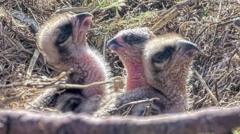
High up in the Scots pine canopy of the Abernethy Forest, a high-stakes survival drama is playing out on camera. The legendary Loch Garten Nature Centre, managed by RSPB Scotland, just welcomed its newest residents. Two tiny, bobble-headed osprey chicks have officially hatched, breaking through their shells into a world that is as perilous as it is beautiful.
If you have been watching the live nest camera feed, you know it is impossible to look away. But what looks like a cozy family scene is actually a grueling, non-stop race against time. The first few days of new chicks hatched at osprey centre locations like Loch Garten are brutal. Many people assume that once the eggs hatch, the hard part is over. It is not. The real struggle for survival starts right now. Don't miss our previous article on this related article.
Here is what is actually happening behind the scenes on that nest platform, why these initial 72 hours dictate everything, and how these apex predators beat the staggering odds stacked against them from day one.
The Brutal Reality of the First Three Days
When an osprey chick emerges from its mottled brown shell, it looks less like a majestic bird of prey and more like a wet, exhausted tennis ball. It cannot regulate its own body temperature. It cannot see clearly. It can barely hold up its own oversized head. If you want more about the history here, Al Jazeera provides an excellent breakdown.
That is why the immediate behavior of the breeding pair, currently captured on the high-definition RSPB webcam, is so disciplined. For the first few days, the mother osprey rarely leaves the nest cup. This is called brooding. She uses her own body heat to keep the chicks at a steady temperature, sheltering them from the erratic Scottish weather.
Rain is the biggest enemy right now. A chilled chick is a dead chick. If water penetrates that initial downy fluff before their true feathers develop, hypothermia sets in fast. The father's job is equally relentless. He must hunt for two adults and a growing brood, scanning nearby lochs for trout and pike.
The Feeding Order and Why Siblings Fight
Osprey eggs do not hatch all at once. They hatch asynchronously, usually one to two days apart. This creates an immediate, intentional hierarchy in the nest.
The first chick to break out gets a massive head start. It gets the first meals, grows stronger, and quickly becomes significantly larger than its younger sibling. When the male bird drops a fresh fish into the nest, the female tears off tiny, easily digestible strips of raw flesh.
She offers these pieces to the chicks one by one. Check out the dynamics on the live feed and you will notice something harsh but necessary:
- The oldest, strongest chick dominates the front of the queue.
- The younger chick must wait its turn until the first is full.
- If food is scarce, the older sibling will actively peck and bully the smaller one to secure its meals.
This looks cruel to human eyes. It is easy to feel sorry for the underdog. But from an evolutionary standpoint, it makes perfect sense. If fish are hard to find, it is better for one strong chick to survive than for two weak chicks to starve. Luckily, the current Loch Garten pair are experienced providers, and both chicks are getting their share of daylight meals.
How Modern Camera Tech Changed Raptor Conservation
We take high-definition live streams for granted now. But the history of the Loch Garten osprey centre is deeply intertwined with the history of wildlife surveillance.
Ospreys went completely extinct in the UK during the early 20th century due to heavy persecution and egg collecting. When a single pair naturally returned to breed at Loch Garten in the 1950s, the RSPB set up a 24-hour guard camp to protect them from thieves.
Early monitoring involved literal bunkers, binoculars, and basic forward-facing mirrors. Today, low-light, high-definition cameras mounted above the nest send crystal-clear footage directly to the visitor centre and online streams.
This is not just for public entertainment. This data helps ornithologists track exact feeding frequencies, identify the specific fish species being brought back, and monitor how environmental shifts or local climate patterns affect chick growth rates. It turns out that observing these first few days gives scientists a highly accurate prediction of whether the brood will successfully fledge later in the summer.
What to Watch for on the Live Feed This Week
If you are tuning in over the next few days, skip the casual glancing and look for specific developmental milestones. The transformation happens incredibly fast.
First, watch their coordination. Right now, the chicks wobble constantly. Their necks look too weak for their heads. Within a week, their core strength will skyrocket, and they will sit up purposefully during feeding times.
Second, look at their coats. That initial pale, smoky grey down will soon give way to a darker, thicker second coat of down. This temporary layer provides much better insulation before their dark brown flight feathers start pinning through.
Finally, keep an eye on the nest rim. As the chicks get stronger, they will instinctively crawl to the edge of the nest cup to poop outward, keeping their immediate living space clean. It is a tiny, hilarious, yet vital behavior that shows their instincts are kicking in perfectly.
The next critical phase is the three-week mark, when their rapid bone growth peaks. For now, the focus remains entirely on steady feeding, staying dry, and surviving the volatile Scottish spring.
If you want to support these conservation efforts, you can track the nest progress directly through the RSPB Loch Garten project updates or visit the Abernethy reserve in person to see the team monitoring these remarkable birds in real-time.


