The coffee in the standard Parisian bistro has a specific weight to it. It is bitter, served in a thick porcelain cup that has survived a thousand dishwashers, and it arrives with a small, wrapped square of dark chocolate that nobody ever seems to eat. On a Tuesday morning in April, the steam rising from these cups across the capital carried something heavier than caffeine. It carried the familiarity of a recurring storm.
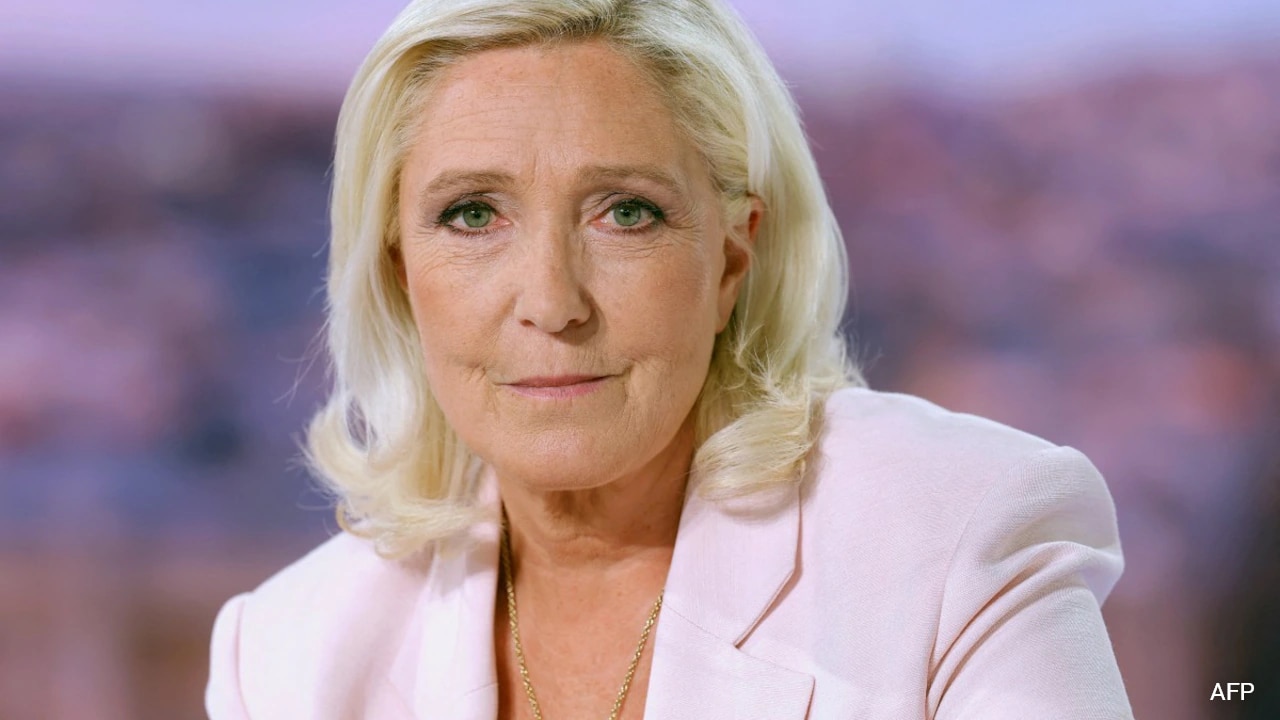
Marine Le Pen is running for president. Again.
To those who watch global politics from the safe, clipped lawns of international cable news, this announcement might feel like a rerun. We have seen this footage before. The sharp blonde bob, the practiced, husky cadence of a voice built on decades of political tobacco and campaign-trail shouting, the family name that has haunted the French republic for half a century. But familiarity breeds a dangerous kind of blindness. To look at this announcement as merely another campaign cycle is to miss the profound shift in the ground beneath Europe’s feet.
This is not a rerun. It is a culmination.
Consider a hypothetical voter named Thomas. He is forty-two, lives in a small town three hours south of Paris where the main factory transitioned to a logistics hub five years ago, and he drives a diesel Peugeot that costs ten euros more to fill up every single month. Thomas does not read radical manifestos. He does not wave historical flags. When he looks at the television screen and sees Le Pen announcing her 2027 candidacy, he does not see the fringe agitator that his father warned him about thirty years ago. He sees a permanent fixture of the architecture. He sees an alternative that has ceased to feel alternative.
That is the true victory of the National Rally. Long before the first ballot is cast, they have won the battle for normalcy.
The Architecture of Acceptance
The human brain is remarkably adept at normalizing the extraordinary. When Jean-Marie Le Pen, Marine’s father, shocked the world by making it to the second round of the presidential election in 2002, the reaction was a collective, national trauma. Millions of people took to the streets. The political left and right joined hands in a desperate, panicked coalition to block him, treating his candidacy like a sudden biohazard inside the democratic machine. It was a fever. It had to be broken.
When his daughter achieved the same milestone years later, the streets were quieter. The shock had decayed into a grim calculation. By the time she did it again, it was treated as an inevitability.
The strategy was never about a sudden, violent coup. It was about erosion. Marine Le Pen spent a decade executing what French analysts call dédiabolisation—un-demonizing the brand. She purged the overt anti-Semites from the party ranks, famously including her own father. She traded the leather jackets and combat boots of the party’s old guard for tailored navy blazers and soft pastel scarves. She stopped talking about leaving the European Union or abandoning the euro currency, realizing that voters feared economic chaos more than they disliked Brussels bureaucrats.
Instead, she shifted the argument to protection. Protection of the French wallet, protection of the secular street, protection of the identity that many felt was slipping away through the fingers of a globalized elite.
The numbers tell the story of this slow-motion conquest. In the 2017 runoff, she captured thirty-three percent of the vote. In 2022, that number climbed to over forty-one percent. In the legislative elections that followed, her party secured a massive, unprecedented bloc of seats in the National Assembly. They became legislators. They wore suits. They sat on committees. They stopped throwing rocks at the institution because they had successfully moved inside it.
The Cafe and the Factory Floor
To understand why this announcement lands differently now, one must leave the grand boulevards of Paris and look at the places where the national fabric has worn thin.
In the old industrial basins of the north and the forgotten villages of the rural south, the debate is no longer about ideology. It is about a feeling of deep, systemic abandonment. The current political establishment has long spoken the language of metrics, GDP growth, and green transitions. But metrics do not fix a broken tooth when the nearest dentist is forty kilometers away.
Let us look at another reality. The cost of living has become an intimate, daily friction. It is the teacher who packs her own lunch because the school cafeteria prices went up. It is the farmer who watches the price of fertilizer double while his milk sells for pennies. Le Pen’s narrative directly targets this friction. Her platform frames every economic hardship not as a complex global phenomenon, but as a direct result of a government that cares more about international prestige than domestic survival.
It is a deeply persuasive story. It simplifies a chaotic world.
The traditional parties have struggled to counter this because they are trapped in an old vocabulary. They still use the language of the mid-twentieth century, warning of historical ghosts and the danger to democratic norms. But to a young person entering a job market where permanent contracts are a rarity and housing costs consume half of a paycheck, those historical warnings feel abstract. They sound like the elite protecting their own comfort.
The danger of the far-right is no longer that it looks terrifying. The danger is that it looks exhausted by the same things the voters are exhausted by.
The Long March Through the State
There is a specific kind of arrogance that belongs to centrist politics. It is the belief that history moves in a straight line toward progress, and that any deviation is merely a temporary glitch in the system. For years, the French establishment treated Le Pen as a predictable foil—a useful adversary to be brought out during election season to frighten the electorate into voting for the status quo, then safely tucked away for another five years.
That strategy has run out of road.
The political center in France has become hollowed out. The old socialist party and the traditional gaullist conservative party, which took turns governing the country for generations, have essentially collapsed into electoral irrelevance. The current governance relies heavily on a fragile, personalized coalition that lacks deep roots in the provinces. When that coalition dissolves, there is no traditional alternative left standing. There is only Le Pen, waiting on the doorstep with twenty years of campaign experience and an organization that has grown stronger with every defeat.
Her early announcement for the next election cycle is a deliberate tactical move. It is designed to project total confidence while her opponents are still mired in internal squabbles and legislative gridlock. It signals to the financial markets, the civil service, and the international community that they need to start preparing for a different kind of France.
The civil service is an essential part of this equation. For decades, the high-level bureaucrats who actually run the French state viewed the National Rally with open hostility. They believed a far-right victory would lead to administrative chaos. But as the party has institutionalized, that resistance has begun to soften. Career officials are quietly looking at the polling data. They are realizing that their future superiors might very well be wearing the National Rally badge. The invisible infrastructure of the state is adjusting to the possibility.
The Weight of the Choice
This upcoming campaign will not be fought over policy papers or white-paper economic projections. It will be fought over the definition of French identity in a world that feels increasingly hostile and unpredictable.
On one side is the vision of a country integrated into a grand, European project—open, technologically advanced, but often perceived as cold and indifferent to those who cannot keep up with its pace. On the other side is Le Pen’s vision: a return to the protective shell of the nation-state, a hardening of borders, and a promise that the traditional citizen will always come first, regardless of the broader global consequences.
It is easy to condemn the latter vision from a distance. It is much harder to address the genuine pain and dislocation that makes that vision appealing to millions of decent, hard-working people who feel they have become strangers in their own land.
The next year will see an avalanche of commentary, polling data, and television debates. The noise will be deafening. But the true story of this election will be written in the quiet moments—the silent calculations made by voters at kitchen tables, the subtle shifts in conversation among colleagues, the gradual acceptance that what was once unthinkable has become ordinary.
The porcelain cups in the Parisian bistros will continue to be washed and served. The trains will run. The seasons will change. But the republic is approaching a crossroad where the old maps no longer apply, and the woman who has spent her life trying to redraw them is already standing at the intersection, waiting.