Every November, the horizon in northern India simply vanishes.
It does not fade gently. It chokes. A heavy, acrid, yellow-gray smog settles over New Delhi, creeping through window cracks, stinging eyes, and scraping the back of every throat. For the millions of people living beneath this suffocating canopy, autumn does not bring crisp air. It brings a survival crisis.
Consider a farmer named Rajesh. He is a hypothetical composite of the thousands of farmers in the states of Punjab and Haryana, but his dilemma is entirely real. Every year, Rajesh faces a brutal clock. After harvesting his rice crop, he has a mere twenty-day window to clear his fields and plant his winter wheat. He cannot plow the stubborn, silica-rich rice stubble back into the soil; it takes too long to decompose and destroys his machinery. He cannot afford to haul millions of tons of agricultural waste away.
So, he strikes a match.
Multiply Rajesh by millions. The resulting smoke creates an environmental nightmare visible from space. But recently, researchers looked at those blazing fields and saw something else entirely. They saw a fuel depot.
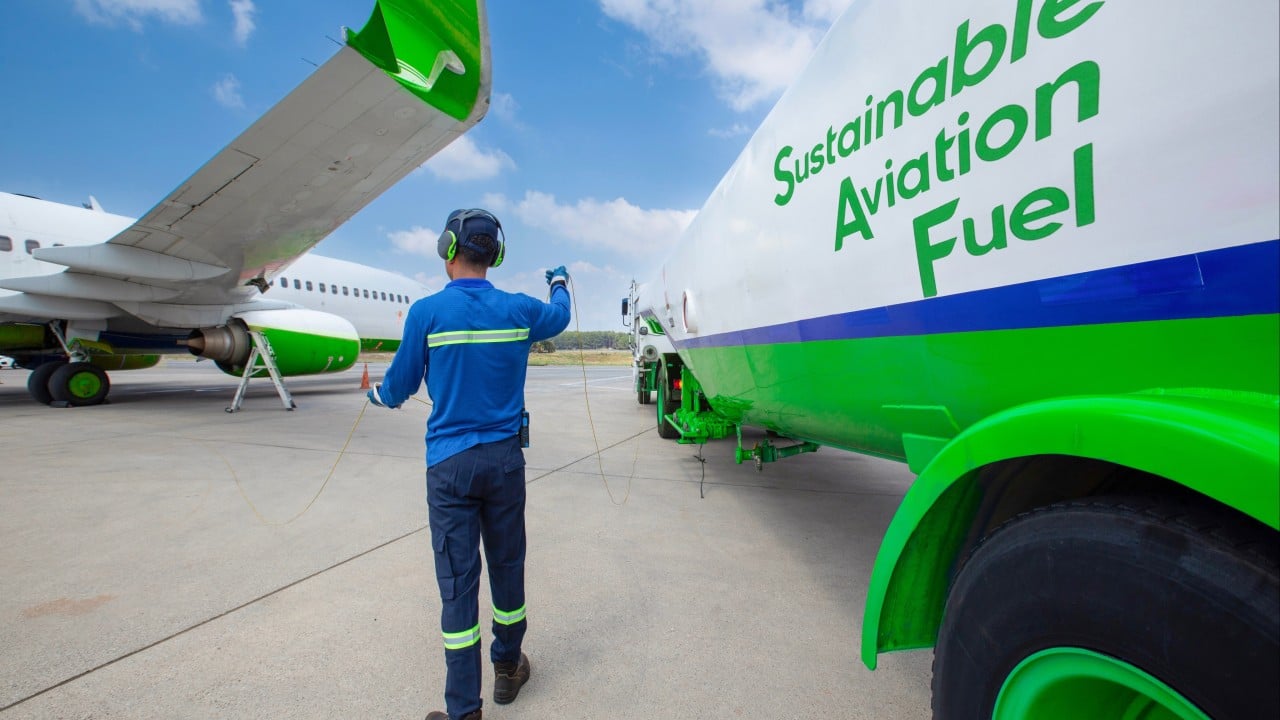
A landmark study has revealed that the very crop residue causing India’s seasonal air crisis could be transformed into Sustainable Aviation Fuel (SAF). The toxic waste that grounds flights due to poor visibility could, ironically, power the global aviation industry.
It sounds like alchemy. Burning fields turned into jet fuel. To understand how this works, we have to look at the sheer scale of the waste and the desperate search for a cleaner way to fly.
The Trillion-Ton Problem at Thirty-Thousand Feet
Aviation has a massive carbon problem, and the industry knows it. Airplanes contribute roughly 2.5% of global carbon dioxide emissions. If you add the high-altitude contrails and other non-$CO_2$ warming effects, the actual climate impact is significantly higher.
The aviation sector has pledged to achieve net-zero carbon emissions by 2050. But you cannot plug a commercial Boeing 777 into a wall outlet. Battery technology is nowhere near dense enough to lift a 300-ton metal tube across the Atlantic Ocean. Hydrogen fuel cells are decades away from commercial viability at scale. For the foreseeable future, airplanes must burn liquid fuel.
This is where Sustainable Aviation Fuel comes in. SAF is chemically identical to conventional jet kerosene. It can be dropped straight into existing aircraft engines and airport fueling systems without a single modification. The beauty of SAF lies in its lifecycle. Instead of drilling into the earth to extract fossilized carbon that has been locked away for millennia, SAF uses carbon that is already circulating in our atmosphere—trapped inside living plants.
When an airplane burns SAF, it still releases carbon. But that carbon was pulled out of the air by the plant just a few months prior. It is a closed loop. In theory, pure SAF can reduce lifecycle greenhouse gas emissions by up to 80% compared to conventional jet fuel.
The catch? We barely make any of it. Right now, SAF accounts for less than 1% of global aviation fuel consumption. The main roadblock is feedstock. We simply do not have enough organic material to turn into fuel without destroying forests or hijacking land needed to grow food for a hungry planet.
And that brings us back to the burning fields of northern India.
From Agricultural Waste to Aviation Kerosene
The recent study quantified exactly how much agricultural residue India produces. The numbers are staggering. Every year, Indian farmers burn an estimated 100 million to 150 million tons of crop waste.
If scientists and engineers can successfully intercept that waste before the match is struck, the yield would be revolutionary. The data suggests that utilizing India’s excess agricultural residue could fulfill a massive chunk of the global aviation industry’s SAF targets. We are talking about billions of liters of clean-burning fuel extracted from material that is currently treated as hazardous garbage.
The transformation process relies on a technology known as alcohol-to-jet (ATJ) or gasification coupled with Fischer-Tropsch synthesis. To put it simply, the agricultural waste—primarily rice straw and wheat stalks—is broken down. In the alcohol-to-jet pathway, the biomass is converted into cellulosic ethanol. Through a series of chemical reactions involving dehydration, oligomerization, and hydrogenation, that ethanol is re-engineered into complex hydrocarbon chains identical to those found in fossil-derived jet A-1 fuel.
The science is proven. The chemical equations balance perfectly. But the real challenge is not happening in a pristine laboratory. It is happening on the ground, in the dirt, amid the chaotic logistics of rural India.
The Friction of Reality
It is easy to look at a data point on a spreadsheet and see a solution. It is much harder to implement it when human survival is on the line.
To turn Rajesh’s crop waste into aviation fuel, an entire supply chain must be built from scratch. Someone has to go to his farm with a baling machine. The straw must be compressed, loaded onto trucks, and transported to a regional processing facility. It must be stored in a way that prevents rot and spontaneous combustion.
All of this must happen within that same frantic twenty-day window between harvest and planting. If the trucks are late, or if the price offered to Rajesh for his stubble does not cover the labor of gathering it, he will use the match. A box of matches costs a few rupees. A logistical supply chain costs billions.
Furthermore, processing rice straw is notoriously difficult. Rice plants absorb high amounts of silica from the soil. When processed, this silica acts like fine glass, grinding down mechanical components and fouling chemical catalysts. It is an engineering headache that requires specialized, robust pre-treatment systems to wash and prepare the biomass before it ever sees a refinery.
There is also an emotional hurdle. Convincing millions of independent farmers to alter a generational practice requires immense trust. They are not thinking about global aviation targets or the carbon footprint of a flight from London to New York. They are thinking about their immediate yield, their families, and the impending winter. The solution cannot just be green; it must be profitable for the person holding the match.
The Invisible Stakes
If this transition succeeds, the benefits ripple far beyond the aviation sector.
The health implications for northern India are profound. During the burning season, hospital wards in Delhi fill with children and the elderly suffering from severe respiratory distress. The air quality index routinely sails past 400—a level deemed hazardous to healthy adults, let alone vulnerable populations. Living in the city during these months is statistically equivalent to smoking roughly twenty cigarettes a day.
By creating a commercial market for crop residue, we fundamentally change the economics of pollution. Waste becomes a cash crop. Instead of an environmental liability, the stubble becomes an additional source of income for rural communities that desperately need it.
The geopolitical implications are equally vast. India currently imports more than 80% of its crude oil. Developing a domestic SAF industry utilizing local agricultural waste would bolster energy security, create thousands of green jobs in rural areas, and position the country as a primary exporter of clean fuel to an aviation industry starved for feedstocks.
A Quiet Dusk over Haryana
Picture a November evening a few years from now.
The air is cool and sharp, carrying the scent of damp earth rather than the sting of acrid smoke. Rajesh stands at the edge of his field. The ground is clear, the rice stubble neatly baled and stacked by a local cooperative, waiting for transport to a nearby biorefinery. His winter wheat is already sown.
Above him, high in the darkening sky, the distant blinking lights of an international flight catch the last rays of the sun. The passengers inside are reading, sleeping, or watching movies, blissfully unaware that the energy pushing them through the stratosphere was harvested from the very dirt beneath Rajesh’s feet.