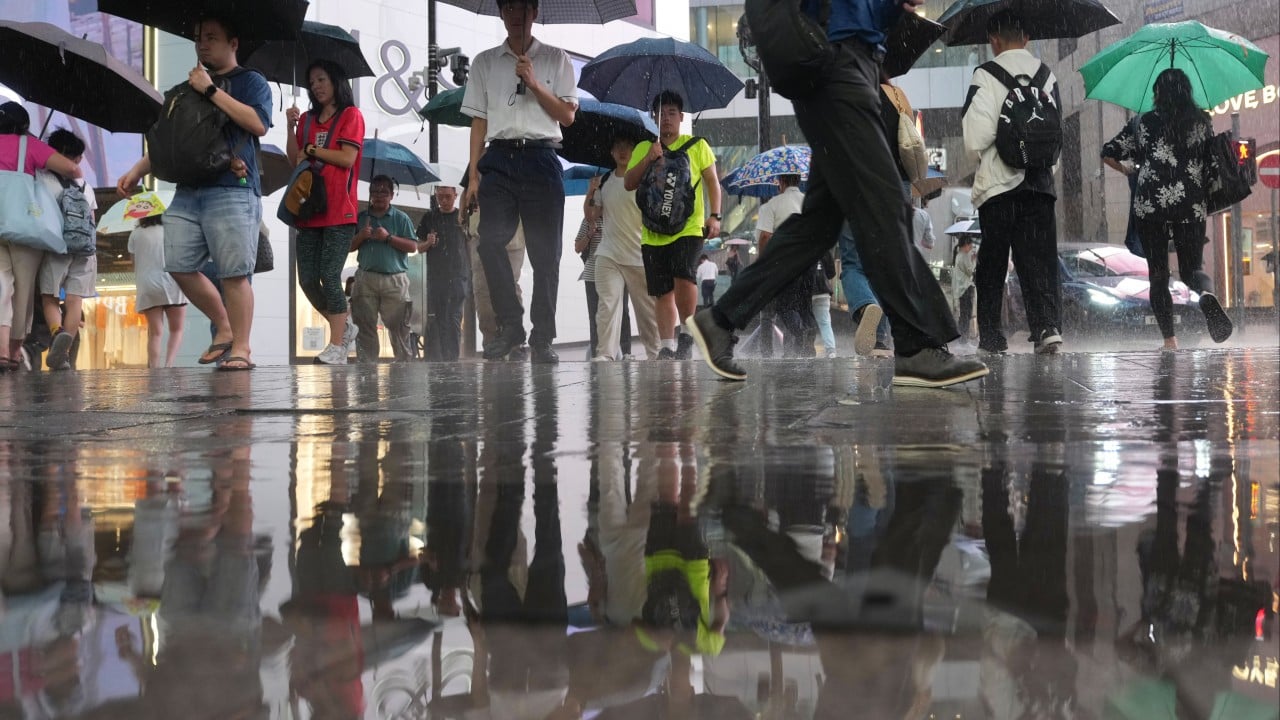
A prolonged thermal peak spanning nine consecutive days of extreme heat in Hong Kong created a atmospheric pressure anomaly that culminated instantly in an amber rainstorm warning. When urban microclimates experience sustained high temperatures without nocturnal cooling, the thermodynamic profile of the lower troposphere undergoes a structural shift. The boundary layer accumulates massive latent heat, increasing the atmospheric moisture holding capacity exponentially.
Surface energy balance equations dictate that urban infrastructure absorbs incoming shortwave radiation during protracted dry spells and converts it into sensible heat flux. This stored energy alters local wind patterns, drawing marine air masses inland where they encounter a stationary thermal dome. When a marginal synoptic disturbance disrupts this stable state, the discharge mechanism is severe.
Urban precipitation events following extreme heat anomalies do not distribute evenly across geographic sectors. Topographic relief forces localized convection, transforming broad frontal systems into high-intensity, short-duration convective cells. The transition from an extended heat wave to a sudden precipitation warning exposes fundamental vulnerabilities in municipal engineering throughput.
The Thermodynamic Mechanics of Heat-to-Rain Transitions
Understanding the rapid transition from blistering temperatures to flash precipitation requires examining the local moisture convergence zone. During the nine-day heat wave, regional evaporation rates over the surrounding South China Sea accelerated, pumping high-enthalpy vapor into the lower atmosphere. The urban canopy layer acted as a thermal battery, maintaining high surface temperatures that prevented standard nocturnal inversion layers from stabilizing the air mass.
The physical sequence operates through three distinct phases:
- Enthalpy Accumulation: Extended solar radiation increases both surface temperatures and boundary layer humidity, raising the wet-bulb temperature across the urban core.
- Convective Inhibition Decay: The continuous buildup of sensible heat erodes the capping inversion that normally suppresses vertical cloud growth, creating an unstable thermodynamic column.
- Rapid Precipitation Discharge: The introduction of cooler upper-air dynamics forces sudden condensation, releasing latent heat and triggering torrential downpours that overwhelm surface drainage coefficients.
This sequence highlights why standard meteorological forecasts frequently struggle with the exact timing of post-heatstorm events. The trigger is not a gradual change in regional pressure gradients, but a localized tipping point where atmospheric buoyancy overcomes structural suppression.
Drainage Infrastructure Capacity and Runoff Economics
Municipal drainage networks operate under deterministic hydraulic constraints. Engineers design urban drainage systems using Intensity-Duration-Frequency curves derived from historical rainfall probabilities. When an amber rainstorm warning triggers, rainfall rates typically exceed thirty millimeters per hour, pushing conduit velocities to their maximum design limits.
The economic cost of these events manifests as a friction coefficient against urban productivity. Transportation networks experience immediate throughput bottlenecks as low-lying arterial roads flood, disrupting logistics supply chains across the territory. The financial exposure is a function of system recovery time rather than total water volume.
Drainage systems in dense vertical cities like Hong Kong face a dual challenge: subterranean space constraints limit pipe diameters, while expansive concrete surfaces eliminate natural groundwater infiltration. Every square meter of non-permeable pavement shifts the hydrological response from a prolonged absorption curve to an instantaneous spike discharge.
Hydraulic Response Variables
- Time of Concentration: The duration required for runoff to travel from the most hydraulically remote point in the catchment to the primary drainage outlet. In urbanized topography, this metric compresses sharply, causing flash surges.
- Infiltration Excess: The condition where precipitation rate exceeds the soil or surface absorption capacity, converting 100 percent of rainfall into direct surface runoff.
- Tailwater Submergence: The backwater effect occurring when marine storm surges or elevated coastal water levels prevent coastal outfalls from discharging freely, backing up water into municipal conduits.
Strategic Urban Adaptation Frameworks
Mitigating the systemic risk of alternating extreme heat and sudden precipitation demands a multi-variable operational framework. Traditional civil engineering approaches focused exclusively on increasing pipe diameter are economically inefficient and physically constrained by dense underground utilities.
Modern metropolitan resilience requires decoupling surface water management from subterranean pipe capacity. Water-sensitive urban design principles prioritize decentralized retention, utilizing building rooftops, vertical green walls, and sub-surface detention basins to slow the velocity of runoff before it reaches primary municipal channels.
Microclimate modeling must replace historical weather averages as the baseline for infrastructure maintenance schedules. By treating the urban environment as an active thermodynamic system, municipal operators can deploy dynamic traffic diversion protocols and automated retention gate adjustments the moment boundary layer instability indicators cross critical thresholds.
The financial allocation for climate adaptation must shift from reactive disaster response to predictive thermal management. Cool-pavement technologies and reflective roofing materials reduce the baseline sensible heat flux during multi-day heat waves, lowering the thermal energy available to fuel subsequent convective storms.
Deploy sensor arrays across primary catchment basins to measure real-time hydraulic pressure gradients, replacing static hourly monitoring with continuous high-frequency data feeds that inform automated flood control infrastructure.