The Cheap Buzzing Nightmare
Put yourself on a dirt road outside a forward operating base. The dust smells like burnt diesel and baked copper.
You hear it before you see it. For another view, see: this related article.
It does not sound like a war machine. It sounds like a lawnmower stuck in a tree. A high-pitched, whirring whine that drills straight into your teeth. You look up, squinting against the glare, searching the empty sky. Nothing. Then, a dark speck hovering six hundred feet up.
It cost four hundred dollars on the internet. It weighs less than a stray cat. Taped to its underbelly is a commercial plastic tube packed with high explosives and metal ball bearings. Similar insight on this trend has been provided by MIT Technology Review.
Then it stops hovering. It tilts its nose down and dives.
For decades, military doctrine relied on a simple equation: expensive, sophisticated weapons defeat cheap, primitive threats. But in modern conflict zones, that math has shattered. A two-million-dollar Patriot missile or a hundred-thousand-dollar air-defense round is a magnificent feat of engineering. Using one to shoot down a quadcopter built from off-the-shelf plastic and mail-order rotors is financial suicide. You run out of million-dollar missiles long before the adversary runs out of five-hundred-dollar drones.
The United States Marine Corps found itself staring at this exact balance-sheet tragedy. The sky was suddenly full of cheap death, and traditional air defense was too heavy, too slow, and far too expensive to stop it.
Something had to change. Fast.
The Problem with Human Reflexes
To understand why a cheap drone is so hard to kill, you have to understand human biology.
Picture a Marine standing behind a heavy machine gun mounted on a tactical vehicle. The vehicle is bouncing over rutted dirt. The target in the sky is the size of a dinner plate, moving erratically at forty miles an hour, changing altitude every fraction of a second.
The Marine takes a breath. Her eyes track the target. Her brain calculates distance, wind velocity, target vector, and bullet drop. She squeezes the trigger.
Panic sets in. The lead is wrong. The bullets chew through empty clouds hundreds of yards behind the target. By the time her brain adjusts, the drone has already completed its dive.
Humans are brilliant at strategy, adaptability, and moral judgment. We are remarkably terrible at performing real-time, multi-variable vector calculus while being shot at.
Historically, military engineers solved this by pouring more metal into the air. If you fire three thousand rounds a minute, probability dictates a few will hit. But modern infantry units traveling light cannot haul tens of thousands of pounds of spare ammunition across rugged terrain just to spray the sky every time a commercial drone buzzes overhead.
The math remained broken. The Marines needed surgical precision, but they needed it at the speed of light.
Teaching a Machine to See the Sky
Enter the integration of computer vision and automated fire control.
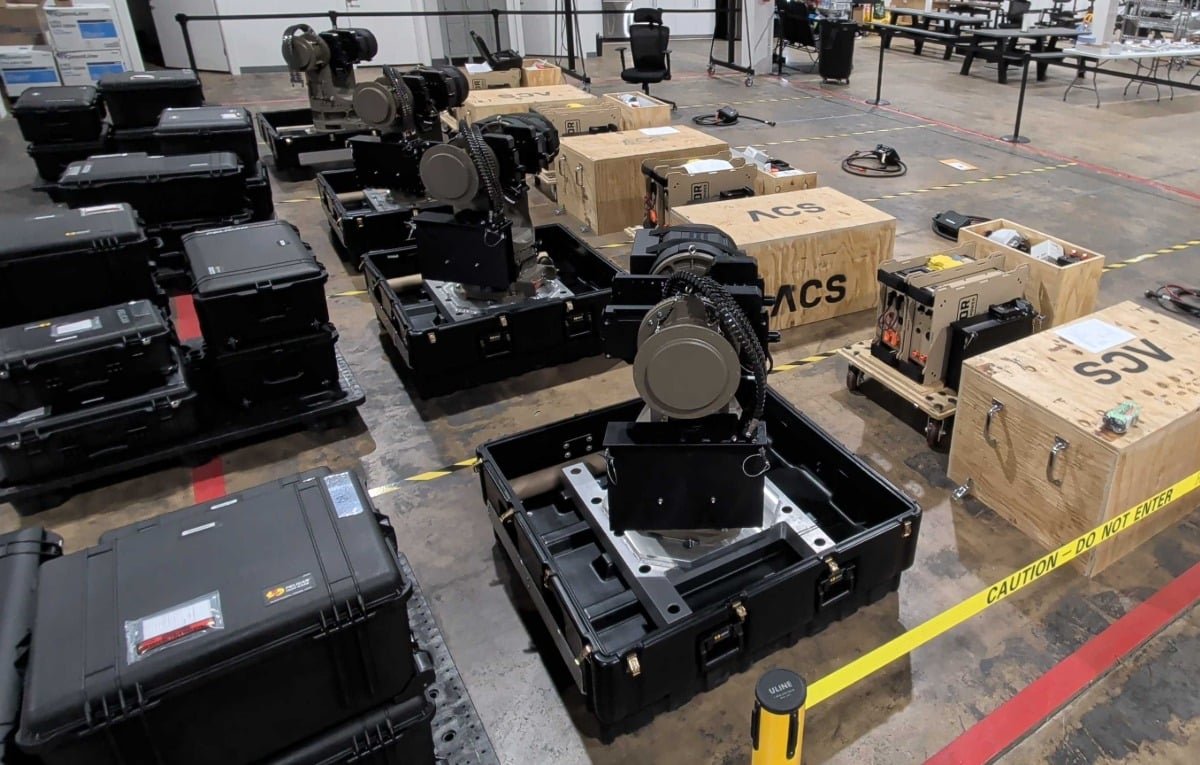
Instead of replacing the weapon, engineers decided to replace the flawed interface between the weapon and the human eye. They took standard infantry heavy weapons, like the M2 .50-caliber machine gun or automatic grenade launchers, and mounted them onto stabilized optical platforms driven by artificial intelligence.
Think of it as giving a blind heavy-barrel machine gun the visual acuity of an eagle and the reaction speed of a microchip.
When a drone enters the airspace, the system's high-definition thermal and visual sensors pick up the motion instantly. The human operator does not have to hunt through the clouds. A box appears on a digital screen, highlighting the threat.
Here is where the magic—and the math—happens.
The AI calculates the drone’s precise trajectory in milliseconds. It factors in atmospheric pressure, wind velocity, the exact angle of the barrel, and the flight time of the bullet. It compensates for the movement of the Marine's own vehicle.
The barrel twitches. It moves with a terrifying, smooth precision that no human wrist could ever replicate. It leads the drone, tracking its exact path like an invisible string pulling the weapon along.
Crucially, the system does not pull the trigger on its own. The human operator stays in the loop. The Marine looks at the screen, verifies the target is indeed an enemy threat and not a friendly reconnaissance unit or a civilian object, and holds down the trigger authorization.
The gun waits until the exact millisecond the target crosses the mathematical path of the bullets. Then, it fires.
Not a fifty-round burst of wasted lead. Three rounds.
Thump. Thump. Thump.
A mile away, a plastic quadcopter turns into a brief puff of black smoke and a shower of plastic confetti. Total cost of ammunition used: a few dollars.
The Invisible Stakes of Automated Warfare
It is easy to get caught up in the technical elegance of an automated tracking mount. It sounds like science fiction made real. But step back from the glowing optics and consider what this shift actually represents.
We are witnessing the quiet death of the asymmetrical advantage.
For ten years, non-state actors and low-budget militaries held a terrifying upper hand. They realized they could paralyze advanced military units using consumer technology bought with a credit card. They turned the sky into an invisible minefield, forcing high-tech forces to bleed resources just to keep their heads down.
By merging artificial intelligence with existing, low-cost kinetic weapons, that leverage vanishes. The five-hundred-dollar drone is no longer a asymmetric superweapon; it is once again just a fragile piece of plastic hovering in a lethal sky.
Yet, this shift brings its own quiet anxieties.
As weapons systems become faster, the window for human decision-making shrinks from seconds to milliseconds. Right now, policy dictates that a human must make the final call to pull the trigger. But as swarms of twenty, fifty, or a hundred drones attack simultaneously, the human bottleneck becomes a vulnerability again.
How long can the human stay in the loop when the loop moves faster than human nerve impulses?
It is a question that military strategists, ethicists, and frontline troops are wrestling with in real time. We are stepping across an invisible threshold where the machinery of defense must operate at speeds that leave human cognition behind.
The Quiet Sky
Imagine that same dirt road again.
The heat rises off the hood of the vehicle in shimmering waves. Somewhere in the distance, a small engine whines to life. A dark spot rises over the ridge line, creeping forward with deadly intent.
Inside the vehicle, the Marine does not panic. She does not scramble to point a heavy barrel into the glare of the sun.
She watches a crisp display screen. A green box snaps around the distant speck. The optic system hums quietly as the motorized mount adjusts a fraction of a millimeter to the left.
She presses a button on a joystick, giving the system authorization to engage.
A brief, sharp burst echoes across the valley. The sky clears. The drone is gone before its pilot even realizes it was tracked.
The Marine takes a slow breath, sweeps her eyes across the horizon, and waits for the dust to settle.


:max_bytes(150000):strip_icc():focal(749x0:751x2)/Arnold-Schwarzenegger-Joseph-Baena-032926-a90f8d3315fc44a6aebc6d7bb44bda01.jpg)