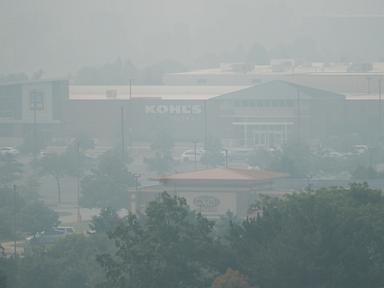
The sky turns an apocalyptic shade of orange, the air smells like a campfire gone wrong, and the push notifications start screaming.
"Air Quality Index has reached hazardous levels. Stay inside. Seal your windows. Run your air conditioning."
It is the same copy-paste playbook every single time Canadian wildfire smoke drifts across the US Midwest. Public health officials, legacy news outlets, and well-meaning local meteorologists line up to deliver the exact same advice.
It is incredibly neat. It is highly intuitive. And it is fundamentally wrong.
The lazy consensus tells us that our homes are impenetrable fortresses capable of keeping the nasty, microscopic PM2.5 particles at bay. The reality? For millions of Americans, telling them to "stay inside" is not just useless advice—it is actively harmful. It breeds a false sense of security while people sit in living rooms that are slowly filling with the exact same toxins they think they are escaping, only without the benefit of ventilation.
We need to stop treating "indoors" as a magical shield. It is time to look at the physics of air exchange, the economics of housing, and the brutal reality of what actually happens when the continent catches fire.
The Fortress Myth: Your Living Room is Not a Cleanroom
Let us dismantle the core premise of the "stay inside" directive.
When an official tells you to seek shelter indoors, they are operating under the assumption that your home is a sealed, climate-controlled vault. If you live in a multi-million dollar, recently constructed smart home with a commercial-grade HVAC system and MERV 16 filtration, sure. You can ignore this.
But for the rest of the country, your house breathes. In fact, it inhales.
The Reality of Air Exchange Rates
Every building undergoes a process called infiltration. This is the unintentional flow of outdoor air into a building through cracks, gaps, and porous building materials.
The metric that matters here is Air Changes per Hour (ACH).
- A modern, energy-efficient home might have an ACH of 0.2 to 0.5, meaning it takes several hours for the indoor air to fully replace itself with outdoor air.
- An older home—the kind that populates the vast majority of Midwest suburbs and urban centers—often has an ACH of 1.0 to 2.0 or even higher.
If your home has an ACH of 1.5, the hazardous air outside is completely replacing the air inside your living room every 40 minutes.
Simply shutting your windows does not stop PM2.5 (fine particulate matter that is less than 2.5 micrometers in diameter). These particles are so small they make a mockery of standard window seals, door sweeps, and cheap fiberglass furnace filters.
I have spent years analyzing indoor environmental quality data. I have watched homeowners sit comfortably on their couches, watching news reports about the "toxic soup outside," completely oblivious to the fact that the laser particle counter on their coffee table is reading levels nearly identical to the backyard. They are breathing the fire. They just cannot see it because the smoke has been diffused through their drywall.
The Air Conditioning Trap
"Run your AC on recirculate," the experts chime in.
This advice assumes two things that are frequently false: that everyone has central air conditioning, and that central air conditioning actually cleans the air.
Most residential AC units do not clean your air. They cool it.
[Outdoor Smoke] ---> [Cracks/Gaps in House] ---> [Indoor Living Space]
                                                          |
                                                          v
                                               [Standard HVAC Filter]
                                            (Catches dust bunnies, passes PM2.5)
The standard filter sitting in your furnace grate is likely a MERV 8 or lower. These are designed to protect the mechanical equipment from large dust bunnies and pet hair; they do absolutely nothing to stop microscopic wildfire smoke.
Worse, running a window AC unit—a staple in older Midwestern apartments—can actually create negative pressure in a room, actively drawing more outdoor smoke through the gaps in your window frames.
By telling people to simply "stay indoors" without explaining the mechanics of filtration, public health messaging creates a deadly compliance trap. People stay inside, seal their windows, turn on their ineffective fans, and marinate in a concentrated soup of carbon monoxide, volatile organic compounds (VOCs), and fine particulates.
The Socioeconomic Blindspot of Public Health
The "stay inside" directive is classist.
It works beautifully for tech workers who can transition to remote work, order grocery delivery, and crank up their high-end HVAC systems. It is a disaster for everyone else.
The HVAC Divide
If you are renting an older apartment in Chicago, Detroit, or Cleveland, you do not have control over your building's filtration. You cannot force your landlord to upgrade the building's air handling units to MERV 13.
The Blue-Collar Reality
Millions of workers do not have the luxury of "staying inside." Construction crews, delivery drivers, agricultural workers, and municipal employees still have to work. Telling them to stay indoors is a useless platitude that abdicates systemic responsibility. It shifts the burden of safety onto the individual, while offering them zero practical tools to survive the workday.
The Counter-Intuitive Playbook for Wildfire Smoke
If "stay inside" is a flawed directive, what actually works? You have to stop treating your home as a passive shield and start treating it as an active filtration battleground.
Here is the unconventional, highly effective playbook for surviving the next drift of Canadian smoke.
1. Build a "Corsi-Rosenthal Box" (Do Not Buy an Expensive Purifier)
Do not spend $800 on a designer air purifier that promises "ionic nanotechnology." Most of them have tiny fans that cannot cycle enough air to make a difference in a moderately sized room.
Instead, spend $50 at a local hardware store and build a Corsi-Rosenthal Box.
- What you need: A 20-inch box fan, four MERV 13 furnace filters (20x20x1), cardboard, and duct tape.
- The build: Tape the four filters into a cube, use cardboard for the bottom, and tape the box fan to the top, blowing upward.
- Why it works: This crude, DIY setup has a Clean Air Delivery Rate (CADR) that rivals or beats commercial purifiers costing ten times as much. It moves a massive volume of air through high-efficiency filters, rapidly dropping the PM2.5 count in a room even if your house is drafty.
2. Ditch the N95 Comfort Myth
If you must go outside, stop wearing loose-fitting surgical masks or cloth face coverings. They are completely useless against PM2.5.
You need an N95 or a P100 respirator. But here is the catch: an unsealed N95 is just a decoration.
If you have facial hair, the mask is not sealing. If you do not pinch the metal nose bridge until it conforms perfectly to your face, the smoke is just bypassing the filter through the gaps. If you are not pulling the straps tight enough to leave a slight imprint on your skin, you are breathing unfiltered air. It should feel slightly uncomfortable. If it feels breathable and breezy, it is not working.
3. Create a "Clean Room" Rather Than a Clean House
Stop trying to purify your entire 2,000-square-foot home. Unless you have a commercial setup, you will lose that battle to infiltration.
Pick one room—ideally the bedroom.
- Seal that room off from the rest of the house.
- Keep the door closed constantly.
- Place your highest-performing air purifier (or your DIY Corsi-Rosenthal box) in this room.
- Run it on high 24/7.
By concentrating your filtration efforts on a single, small volume of space, you can actually achieve a near-zero PM2.5 environment where your body can recover while you sleep.
The Hard Truth About Our Smoldering Future
The Canadian boreal forests are going to keep burning. The jet stream is going to keep carrying that smoke directly into the population centers of the US. This is no longer an anomalous event; it is a seasonal reality.
Our public health apparatus is fundamentally lazy. It relies on simplistic, low-effort directives because explaining the physics of air exchange and the limits of residential HVAC systems requires too much nuance.
Stop waiting for an official broadcast to save your lungs. Your house is not a bunker. Close the gaps, build your own filtration, and stop assuming you are safe just because there is a ceiling over your head.