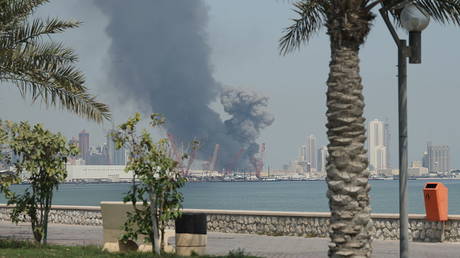
Iran is actively forcing its Arab neighbors into a corner, issuing stark, backchannel warnings to Gulf states to deny the United States and Israel use of their airspace or military bases for retaliatory strikes. Tehran is making it clear that any nation facilitating an attack will be treated as an enemy combatant. This diplomatic pressure campaign aims to insulate Iran from looming military action while testing the security guarantees Washington has provided to the region for decades. For the Gulf monarchies, true neutrality is becoming an impossible luxury as regional escalation threatens to pull them directly into the line of fire.
The Geopolitical Squeeze on the Arabian Peninsula
The threat from Tehran is not subtle. Behind the closed doors of recent regional summits, Iranian diplomats have explicitly stated that compliance with Western military initiatives will bring severe consequences. This is a calculated gambit designed to exploit the geographic vulnerability of the oil-rich Gulf states. You might also find this related story insightful: The Night the Sky Tore Open Again.
Consider the layout of the region. United States military assets are woven tightly into the fabric of the Gulf.
The US Fifth Fleet is stationed in Bahrain. Al Udeid Air Base in Qatar serves as the forward headquarters for US Central Command. Kuwait, the United Arab Emirates, and Saudi Arabia all host critical American logistical and aerial hubs. Iran knows it cannot match the raw technological superiority of the American military. Therefore, it targets the host nations, betting that the fear of domestic infrastructure destruction will force these governments to restrict American operational freedom. As highlighted in recent articles by BBC News, the results are worth noting.
This strategy creates a profound dilemma for leaders in Riyadh, Abu Dhabi, and Doha. They have spent the last several years pursuing a policy of de-escalation with Iran, seeking to secure their multi-billion-dollar economic diversification projects from the threat of missile and drone attacks. The memory of the 2019 strikes on Saudi Aramco facilities at Abqaiq and Khurais remains fresh. Those attacks temporarily knocked out half of Saudi Arabia's oil production, proving that Western air defense systems were not infallible.
The Myth of Closed Airspace
In public, Gulf officials try to project an aura of strict detachment. They whisper to international media that their airspace will remain closed to any offensive operations against Iran. It sounds like a clean, legalistic solution to avoid retaliation.
The reality on the ground is far messier. Modern military operations do not always require traditional overflight permissions in the way commercial airliners do. Refueling tankers, electronic warfare aircraft, and intelligence-gathering assets operate in international airspace or at altitudes where enforcement becomes a diplomatic nightmare rather than a military certainty.
Furthermore, if a regional conflict escalates to a sustained exchange of ballistic missiles and high-altitude interceptors, the concept of clean airspace boundaries disintegrates. Interceptions happen where the physics dictate, not where the maritime or land borders are drawn on a map. Shrapnel, failing boosters, and neutralized payloads fall indiscriminately. A nation cannot simply opt out of a regional war when its territory sits directly beneath the trajectory of the warring parties' arsenals.
The Problem of Base Access
The legal agreements governing American bases in the region are complex and often classified. They are not blanket permissions for the United States to launch any war it chooses from foreign soil. Host nations generally retain veto power over offensive operations launched directly from their territory.
- Qatar has historically balanced hosting the US military while maintaining open lines of communication with adversaries like Iran and Hamas.
- The United Arab Emirates has grown increasingly vocal about preserving its autonomy, refusing to be pulled into a wider regional war that could damage its status as a global trade hub.
- Saudi Arabia wants to protect its massive domestic development plans, which require absolute stability to attract foreign investment.
Because of these dynamics, the Pentagon cannot simply assume it can launch strike packages directly from Gulf runways. It forces American planners to rely more heavily on carrier-based aviation in the Arabian Sea or long-range assets flying out of the British territory of Diego Garcia or the continental United States. This logistical headache is exactly what Tehran wants to achieve.
The Shadow of Proxy Warfare
Iran does not need to declare conventional war on the Gulf states to inflict devastating costs. The network of regional proxies known as the Axis of Resistance provides Tehran with plausible deniability and immense leverage.
The Houthi movement in Yemen sits at the southern doorstep of Saudi Arabia. They have spent years refining their ability to launch long-range drones and cruise missiles into Saudi and Emirati territory. Even during periods of relative truce, the threat remains active. An Iranian green light to the Houthis could instantly reignite a conflict that Riyadh has spent years trying to wind down.
In Iraq, kata'ib Hezbollah and other Tehran-backed militias sit positioned to pressure Kuwait and Saudi Arabia's northern borders. These groups operate largely outside the control of the central government in Baghdad. They can launch localized drone strikes against infrastructure or oil pipelines, creating immediate economic panic without Iran ever having to fire a missile from its own soil. This asymmetric capability makes the Iranian warnings incredibly potent.
The Friction in the American Security Umbrella
For decades, the fundamental bargain in the Middle East was simple: the United States secured the flow of energy from the Gulf in exchange for a dominant geopolitical position in the region. That bargain is fraying.
Gulf leaders look at Washington and see a political system deeply divided and wary of long-term foreign entanglements. They remember the muted American response to the 2019 Aramco attacks under the Trump administration. They watched the chaotic withdrawal from Afghanistan under the Biden administration. These events created a crisis of confidence.
"The assumption that Washington will automatically risk a major war to protect Gulf oil fields is no longer taken as gospel in regional capitals."
This skepticism explains why nations like Saudi Arabia and the UAE have diversified their diplomatic portfolios. They have strengthened ties with Beijing and Moscow, seeking alternative brokers who can talk to all sides of the regional divide. China, as the primary buyer of both Iranian and Saudi crude, has a vested interest in keeping the shipping lanes open, but it lacks the military power projection capability to replace the US as a security guarantor.
The Strategic Miscalculation
Tehran’s aggressive posture carries its own immense risks. By turning the screws too tightly on its neighbors, Iran might inadvertently produce the exact outcome it fears most.
If the Gulf states conclude that neutrality offers no protection from Iranian anger, their strategic calculation alters. If you are going to be targeted regardless of your actions, it makes more sense to align fully with the stronger military coalition to ensure maximum defense capabilities. Iran's threats risk turning a cautious, hedging neighbor into a committed adversary that sees no choice but to facilitate a decisive blow against the regime in Tehran.
The assumption that the Gulf states can be bullied into submission also underestimates their growing domestic military capabilities. Over the past decade, nations like the UAE and Saudi Arabia have invested heavily in advanced missile defense systems, including Patriot batteries and THAAD. They are not completely defenseless targets waiting for instructions from abroad.
The Price of Escalation
The economic stakes extend far beyond the immediate geography of the Middle East. The Strait of Hormuz remains the ultimate choke point for global energy markets.
A full-scale conflict that shuts down or severely restricts shipping through the strait would immediately send global oil prices skyrocketing.
This reality gives the Gulf states a form of reverse leverage over the international community. They can argue to Washington and European capitals that any action provoking Iran into targeting energy infrastructure will trigger a global economic shockwave. It is a powerful argument, but it only works as long as all parties act rationally to avoid mutual economic ruin. In the heat of a escalating military crisis, rational economic calculations frequently give way to raw survival instincts.
The diplomatic dance taking place across the Gulf right now is a symptom of a deeper structural shift in the region. The old security architecture is crumbling, and nothing concrete has emerged to take its place. Iran is attempting to draw the borders of its influence through intimidation, while the Gulf states discover that their wealth cannot buy an exemption from geography. Neutrality requires the consent of the aggressive powers around you, and right now, Tehran is refusing to give that consent.


