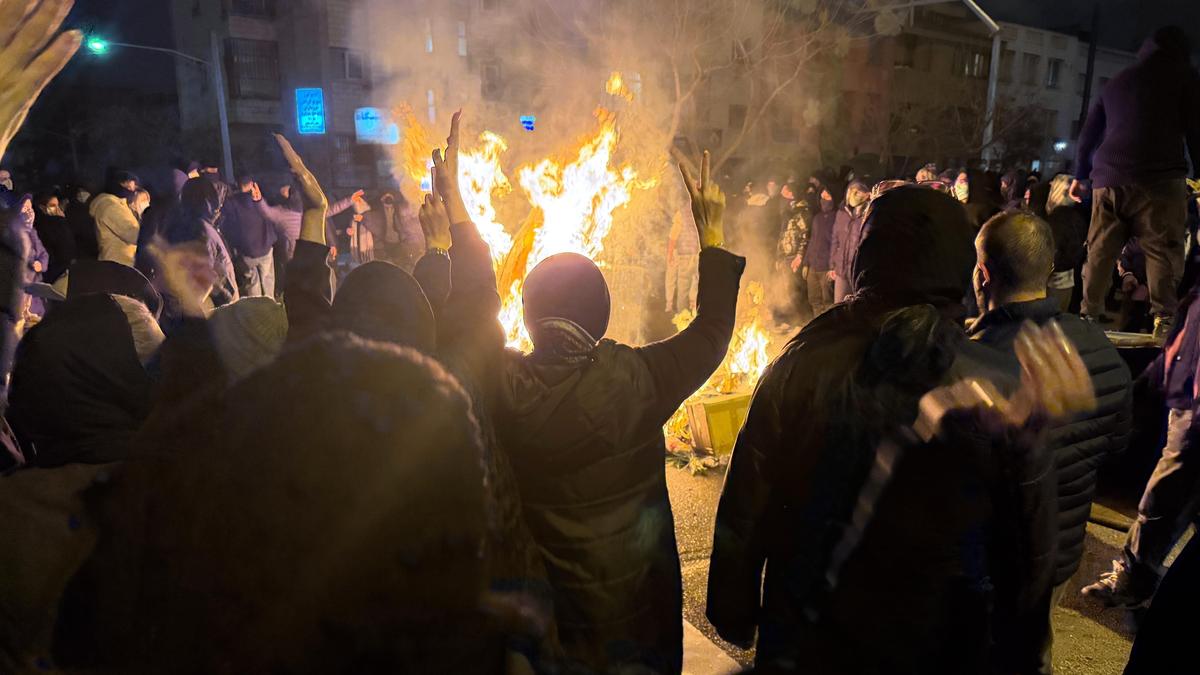
The Iranian judiciary carried out the execution of Amirali Mirjafari early Tuesday morning, marking a grim escalation in the state's response to the civil unrest that paralyzed the country in January. Mirjafari was convicted of arson at the Qolhak mosque in Tehran and accused of operating as a key operative for Israeli intelligence. His death follows a swift legal process that human rights observers characterize as a mechanism for political intimidation rather than a pursuit of justice. By framing a local act of property damage as a high-level act of international espionage, Tehran is signaling that the era of "protest management" has officially shifted into a doctrine of total elimination.
The Qolhak Fire and the Charge of Moharebeh
The incident at the center of this case occurred during the height of the January protests, a wave of demonstrations sparked by economic collapse and tightened social restrictions. According to Mizan, the official news outlet of the judiciary, Mirjafari was the primary instigator behind the fire at the Qolhak mosque, a site with significant symbolic value in northern Tehran.
However, the legal path from "arsonist" to "death row inmate" relies on the expansive application of Moharebeh, or "waging war against God." In the Iranian legal system, this charge is often used to bypass traditional criminal defense standards. When a defendant is accused of Moharebeh, the focus shifts from the physical act—in this case, a fire that resulted in no reported fatalities—to the intent to undermine the Islamic Republic's security.
Mirjafari's case was further complicated by the state's insistence that he led a "terrorist cell" linked to the Mossad. This is a recurring motif in Iranian state media. By tying domestic dissent to foreign intelligence agencies, the government can justify the use of revolutionary courts, where trials are frequently closed to the public and legal representation is limited to a pre-approved list of state-vetted attorneys.
The Acceleration of Capital Punishment
Mirjafari is not an isolated case. He is part of a broader, more lethal trend. Data from human rights monitoring groups indicate that the interval between arrest and execution has shortened significantly since the January protests began.
- Amirali Mirjafari: Arrested in January, executed in April.
- Saleh Mohammadi: A 19-year-old executed in March in Qom.
- Saeed Davodi: Co-defendant of Mohammadi, executed alongside him.
The speed of these cases suggests that the Supreme Court’s "review" process has become a formality. In previous years, death penalty cases involving political charges could linger for months or years as international pressure mounted. Now, the judiciary appears to be clearing its docket with a sense of urgency. This haste serves two purposes. First, it prevents the condemned from becoming a rallying cry for activists. Second, it creates a "shock and awe" effect intended to deter those considering returning to the streets.
The Strategy of the Invisible Gallows
The Islamic Republic has long mastered the art of the public-private execution split. While some hangings are carried out in public squares to provide a visceral warning, many, like Mirjafari’s, take place behind the walls of Evin or Rajai Shahr prisons. These "quiet" executions are often more effective at eroding the morale of the opposition. They create a vacuum of information where families are notified only hours before the sentence is carried out, leaving no time for legal appeals or public protest.
The accusation of "spying for Israel" acts as a shield against international condemnation. When the West critiques Iran’s human rights record, Tehran routinely counters by claiming they are merely defending their sovereignty against "Zionist-backed saboteurs." It is a narrative that plays well with the government's hardline base but falls apart under the scrutiny of due process. There has been no public evidence released linking Mirjafari to foreign assets beyond his forced "confession," a staple of the Iranian investigative process.
The Cost of the Crackdown
The January protests were different from the "Women, Life, Freedom" movement of 2022. They were more localized, more violent, and driven by a desperate segment of the population that feels it has nothing left to lose. By executing someone like Mirjafari for burning a building, the state is effectively closing the door on any form of non-lethal dissent.
When property damage is met with the noose, the message to the public is clear: there is no middle ground. This binary environment—total submission or total war—is a dangerous gamble for the regime. While the execution of Mirjafari might clear the streets today, it seeds a deeper, more resentful form of resistance for tomorrow. The gallows are high, but they have never been a permanent solution to the hunger for reform.
Amirali Mirjafari’s life ended at dawn. For the judiciary, a case is closed and a "terrorist" is neutralized. For the millions watching from the shadows of Tehran, it is another name added to a ledger that is becoming too heavy to carry.