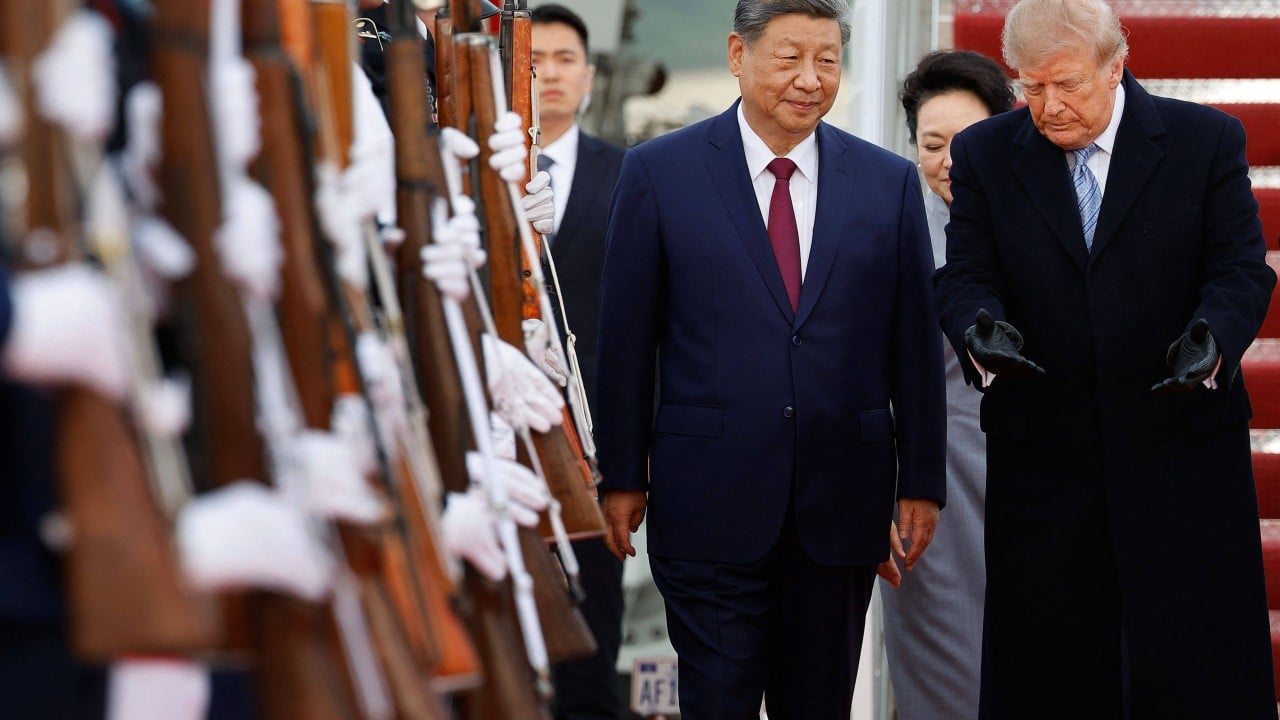
Bilateral summits between Donald Trump and Xi Jinping in 2026—first in Beijing in May and then in Washington in September—did not resolve the structural friction across the Taiwan Strait or the East China Sea. Instead, they exposed a widening gap between personal leader-to-leader diplomacy and durable deterrence. Tokyo now faces an acute strategic dilemma: Washington treats bilateral rapport with Beijing as a primary stabilization channel, while Prime Minister Sanae Takaichi remains locked in a high-cost dispute with Beijing over Taiwan contingencies, defense posture, and critical mineral supply chains.
Standard news roundups treat these developments as a collection of separate headlines—a White House dinner here, a phone call with Tokyo there, a dispute over rare earths or crisis hotlines somewhere in between. That framing misses the causal chain. Summits alter risk pricing across three linked arenas: declaratory signaling on Taiwan, coercive economic and diplomatic pressure on Japan, and alliance credibility inside the US-Japan security architecture.
Deconstructing Conventional Summit Coverage
Surface-level coverage of the 2026 Xi-Trump engagements typically relies on three analytical shortcuts that obscure strategic mechanics:
- Equating atmospherics with alignment: Ceremonial hospitality—such as state banquets, Rose Garden reviews, or warm public phrasing—signals short-term tactical restraint rather than converged strategic objectives. A summit can lower immediate diplomatic temperature while leaving core territorial and sovereignty disputes completely unresolved.
- Treating Taiwan and Japan as isolated tracks: In Beijing's strategic calculus, Taiwan is a core sovereignty claim and a test of regional security commitments. When Japanese leaders link regional stability or potential military contingencies involving Taiwan to Japan's own security posture, Beijing treats Tokyo's stance as direct interference in a core interest.
- Reading bilateral reassurance calls as policy guarantees: Post-summit calls between Washington and Tokyo reaffirm alliance solidarity in general terms. Yet reassurance rhetoric does not automatically resolve disagreements over how much risk Washington is willing to absorb over third-party disputes or trade retaliation.
Separating known facts from educated hypotheses clarifies what actually shifted. It is a documented fact that Trump and Xi held high-profile bilateral meetings in 2026, that Beijing pressed Washington on Taiwan-related positions and criticized Japan's security trajectory, and that China-Japan tensions have involved sharp diplomatic friction alongside dual-use and critical mineral export controls. By contrast, claims that Washington has quietly traded away core alliance commitments—or that Beijing has permanently abandoned coercive escalation—remain educated hypotheses that outrun verifiable evidence.
Three Pillars of Post-Summit Geopolitical Fallout
To evaluate how the Xi-Trump summits reshape East Asian security, analysts should track three interconnected mechanisms rather than individual diplomatic incidents.
1. The Signaling Asymmetry Over Taiwan
During high-level US-China engagements, declaratory nuance carries disproportionate weight because strategic ambiguity relies on calibrated uncertainty. Beijing seeks explicit movement from Washington toward opposing Taiwan independence and restricting arms transfers. Washington, even when emphasizing stability or cautioning against unilateral moves that alter the status quo, operates within a long-standing framework that balances deterrence against escalation control.
The resulting asymmetry creates friction even without a formal policy shift:
- Beijing's objective: Lock in rhetorical concessions that narrow Washington's diplomatic room to maneuver and signal to Taipei that external backing has limits.
- Washington's objective: Preserve enough predictability to avoid an accidental clash while keeping deterrent options open.
- Regional interpretation: Allies and partners in East Asia read every emphasis or omission in summit commentary as an indicator of how firmly the United States will contest coercive pressure around the Taiwan Strait.
Consider a practical scenario: a US president states publicly that bilateral talks with Beijing went smoothly and that Taiwan came up only briefly. Even if internal policy remains unchanged, observers in Taipei and Tokyo may infer that de-escalation with Beijing currently outweighs public pushback on cross-strait pressure. Conversely, if Beijing claims Washington agreed to stricter boundaries on Taiwan while Washington characterizes the exchange differently, ambiguity turns into a source of misperception.
2. Coercive Leverage and the Cost Function on Japan
For Tokyo, the fallout from Beijing's displeasure is not merely rhetorical. Under Prime Minister Sanae Takaichi, Japan has maintained a firm security posture and declined to walk back statements on Taiwan contingencies despite intense Chinese pushback. China's response illustrates a multi-channel cost function designed to raise the price of Tokyo's stance without crossing into outright military conflict:
- Diplomatic and consular pressure: Sharp official rebukes, public warnings, and strained leader-level engagement raise political friction and limit bilateral crisis management.
- Supply chain chokepoints: Because China holds a dominant share of global rare earth extraction and processing, export controls or stricter licensing on critical minerals and dual-use goods create tangible compliance and input costs for Japanese manufacturers.
- Security dilemma escalation: Japanese defense buildup and closer alignment with regional partners are framed by Beijing as remilitarization, which in turn reinforces Tokyo's perception of growing regional coercion.
When a major power pairs diplomatic isolation with targeted trade and mineral restrictions, the target government faces rising domestic pressure from affected industries alongside external security risks. Yet capitulating to demands to retract security positions carries its own domestic and strategic penalty: signaling vulnerability under coercion.
3. Alliance Management and Hedging Dynamics
The third pillar is how US-China summitry affects coordination inside the US-Japan alliance. Allies rarely expect identical threat perceptions on every tactical detail, but they look for alignment on core deterrence principles and shared burden-bearing.
When Washington conducts intensive bilateral diplomacy with Beijing, policymakers in Tokyo must continuously test whether bilateral stabilization comes at the expense of allied priorities—such as pushing back on economic coercion or maintaining unified deterrence around Taiwan. Even when Washington and Tokyo reaffirm close ties in follow-up calls or multilateral settings like the Quad, underlying anxiety persists whenever an ally feels it is absorbing asymmetric economic costs alone.
At the same time, Tokyo's room to maneuver is bounded by structural realities. Japan relies heavily on the US security umbrella and cannot credibly replace it with a standalone deterrent in the near term, nor can it easily decouple from regional trade networks overnight. That reality explains why Tokyo alternates between firm principled stances on sovereignty and security on one hand, and careful diplomatic outreach to prevent outright rupture on the other.
Operational Playbook for Tracking Regional Risk
For executives, policy planners, and analysts evaluating exposure across East Asia, headline sentiment is a lagging indicator. A disciplined monitoring workflow focuses on operational signals:
- Audit export-control licensing rather than diplomatic tone: Track actual customs enforcement, dual-use review timelines, and rare earth or specialty material supply lead times rather than relying on summit communiques or official statements.
- Separate crisis-channel mechanics from political concessions: Distinguish between technical guardrails—such as military communication protocols—and substantive political demands over Taiwan or regional security arrangements.
- Map cross-border supply chain concentration: Identify single-point dependencies in electronics, automotive components, and industrial inputs that sit at the intersection of US-China export rules and China-Japan trade friction.
- Stress-test against diplomatic frosts: Build contingency plans assuming leader-level meetings between Tokyo and Beijing may remain stalled or purely transactional even while US-China engagement continues.
Every analytical framework has blind spots. Focusing heavily on statecraft and supply chains can understate domestic political shifts in Washington, Beijing, or Tokyo, or overlook sudden maritime or cyber incidents that compress decision timelines. No single model predicts crisis triggers with certainty, which makes scenario planning and supplier diversification essential rather than optional.
Strategic Recommendation
Treat post-summit US-China stabilization as cyclical rather than permanent, and position regional operations and security planning for sustained friction around Taiwan and Japan. Organizations with exposure to East Asian hardware, critical minerals, or cross-border trade should diversify sourcing across multiple jurisdictions, maintain dual-track contingency plans for sudden licensing delays, and anchor strategic assumptions on verified policy actions and supply chain data rather than summit optics.


