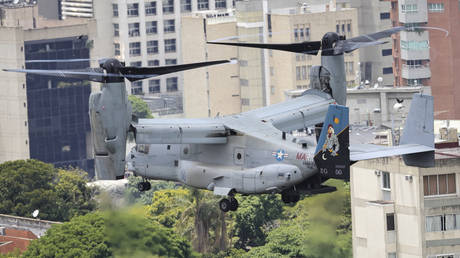
The landing of United States Marine Corps MV-22B Osprey tiltrotor aircraft inside the U.S. Embassy compound in Caracas is not merely a logistical readiness test. It is an explicit demonstration of operational access in a post-transition theater. Occurring four months after the ouster of Nicolás Maduro, the exercise serves as a physical baseline for U.S. power projection capabilities in South America. Evaluating this event requires bypassing sensationalist reporting and analyzing the precise mechanical, structural, and geopolitical variables at play.
The operation establishes a clear precedent: the U.S. military can execute rapid vertical insertion and extraction within a sovereign capital with the explicit coordination of the host nation's transitional government. Deconstructing this event reveals a deliberate convergence of tactical aviation mechanics, diplomatic security frameworks, and regional deterrence.
The Triad of Tactical Insertion Economics
The deployment of tiltrotor assets over a densely populated urban center like Caracas relies on three operational pillars. Each pillar represents a specific trade-off between speed, range, and vulnerability.
1. Velocity and Range Optimization
Traditional rotary-wing aircraft possess a structural velocity ceiling due to asymmetric blade stall, typically limiting maximum cruise speeds to approximately 150 knots. The MV-22B bypasses this aerodynamic constraint by rotating its nacelles 90 degrees forward once airborne, converting from a vertical lift asset into a turboprop aircraft.
This mechanical transition yields a cruise speed exceeding 240 knots and an unrefueled combat radius that extends directly from regional maritime platforms to inland South American capitals. The two Ospreys utilized in the Caracas exercise originated from Marine Medium Tiltrotor Squadron 263 (VMM-263), currently embarked on the amphibious assault ship USS Iwo Jima in the Caribbean Sea. The tiltrotor configuration reduces the transit window from international waters to the embassy compound by roughly 40% compared to conventional helicopters, minimizing the exposure window to potential ground threats during regional transit.
2. Urban Footprint Constraints
Urban extraction operations present severe spatial limitations. The U.S. Embassy compound in Caracas features tight structural boundaries and parking facilities not designed for traditional fixed-wing logistics.
- The Footprint Variable: The MV-22B requires zero runway infrastructure, executing vertical takeoffs and landings (VTOL) within a highly confined footprint.
- The Environmental Cost: This vertical capability introduces an intense environmental variable: downwash. The dual Rolls-Royce T406 turboshaft engines generate significant downward air velocity, capable of damaging nearby vegetation and unanchored structural components. Managing this risk requires precise landing zone calculations and structural reinforcement assessments of the embassy's parking facilities.
3. Rapid Force Ingress and Egress Mechanics
The primary purpose of an embassy evacuation drill is the minimization of the time-on-ground metric. Every second an aircraft remains static in an urban environment increases its vulnerability to asymmetric threats, such as rocket-propelled grenades or small arms fire. The rear-loading ramp architecture of the Osprey permits the simultaneous deployment or extraction of combat-equipped Marine security teams. This architectural layout optimizes the ingress and egress flow, allowing personnel to clear or board the aircraft far more rapidly than side-door helicopter configurations.
Geopolitical Friction Points and Sovereignty Transition
The physical presence of American military assets in Venezuelan airspace highlights a fundamental shift in regional power dynamics. The mechanisms driving this diplomatic and military coordination depend entirely on the altered political structures in Caracas.
The transitional government, currently led by Delcy Rodríguez following the January ouster of Maduro, authorized the operation as part of broader bilateral stabilization agreements with Washington. This authorization signals a formalized security architecture that contrasts sharply with the preceding administration's posture. By publicly announcing the exercise via Foreign Minister Yván Gil, the transitional government attempted to frame the military flight as a standardized contingency operation for medical and catastrophic emergencies.
The strategic reality is more complex. The exercise occurred less than two months after the formal reopening of the U.S. Embassy, establishing a visible deterrent against remnants of the previous regime. The choice of VMM-263 assets carries an explicit psychological weight: this identical squadron and its parent warship, the USS Iwo Jima, served as the primary processing and transport platform for Maduro and his wife, Cilia Flores, immediately following their capture by elite forces in January.
The primary structural bottleneck to this stabilization strategy is localized civilian friction. While the transitional government provides institutional compliance, localized protests—exemplified by factions displaying anti-intervention banners—illustrate that political transition does not equal immediate civilian consensus. This split creates a distinct security vulnerability where domestic actors may target U.S. diplomatic infrastructure to challenge the legitimacy of the interim government.
Tactical Vulnerabilities and Operational Limitations
A rigorous strategic assessment requires acknowledging the systemic limitations inherent to tiltrotor platforms in contested urban environments. The MV-22B is an effective tool for rapid transit, but it possesses distinct operational trade-offs.
- Aero-Mechanical Complexity: The tiltrotor design requires a complex interconnected driveshaft system. A mechanical failure in the nacelle tilt mechanism during the conversion phase creates a catastrophic vulnerability, particularly at low altitudes over urban centers where autorotation capabilities are severely degraded compared to standard helicopters.
- Acoustic Profile: The signature low-frequency thrum of the Osprey’s proprotors acts as an early acoustic warning system. In an uncoordinated or hostile environment, this acoustic footprint eliminates the element of tactical surprise long before the aircraft enters visual range of the urban center.
- Defensive Geometry Constraints: The spatial configuration of the tiltrotor nacelles restricts the placement of crew-served weapons. Defensive armaments are primarily constrained to the rear ramp system or specialized belly-mounted remote weapon stations, leaving the lateral flanks of the aircraft structurally vulnerable during low-altitude banking maneuvers over city streets.
The strategic play moving forward will not involve permanent U.S. military aviation detachments inside Caracas. Instead, expect a rotational cycle of amphibious readiness groups maintaining a high-tempo presence within the Caribbean basin. This posture enables the U.S. Southern Command to execute rapid-response operations within a four-hour window without maintaining a permanent, politically volatile boots-on-the-ground footprint on mainland Venezuelan soil. Diplomatic security will continue to rely on organic Marine Security Guard detachments, reinforced by a verified, tested pathway for rapid vertical extraction via sea-based tiltrotor assets whenever localized structural instability spikes.