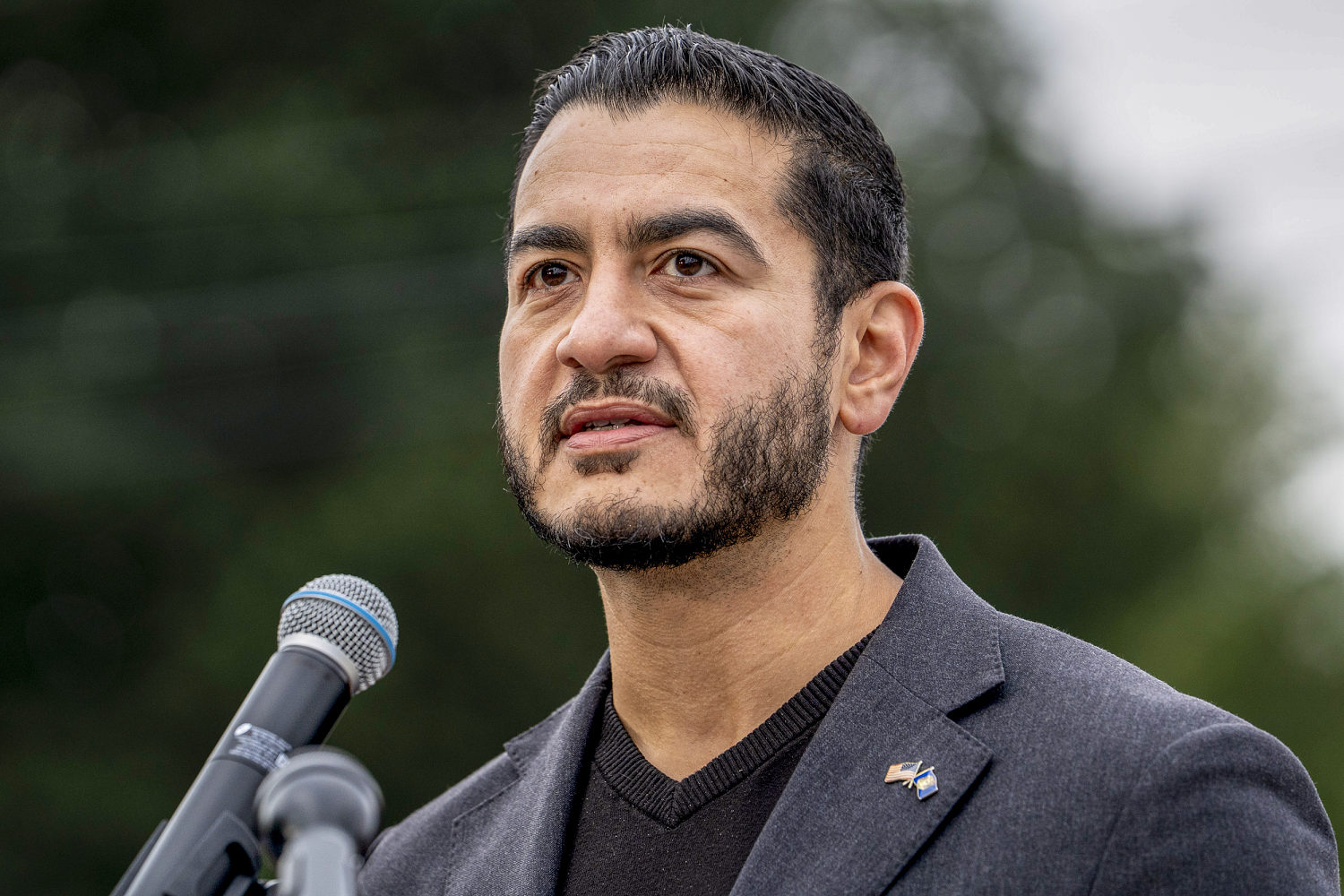
Democracy in America no longer breaks with a dramatic gun-shot echo; it frays quietly in the administrative backrooms of county clerks, partisan certification boards, and appellate dockets. When Abdul El-Sayed warned during the midterm campaign cycle that Democrats needed to secure massive, insurmountable margins to fend off modern election denial, he was not simply engaging in standard political hyperbole. He was describing a cold, mathematical necessity born from the systematic weaponization of doubt.
In tightly contested races, small margins are no longer viewed by bad-faith actors as a final score. They are treated as an open invitation for litigation, targeted disenfranchisement, and institutional paralysis. When victory is measured by a fraction of a percentage point, the losing side does not concede; they audit, obstruct, and delegitimize. El-Sayed’s thesis—borne out through a grueling Michigan Senate race where his victory over Republican Mike Rogers unfolded against a backdrop of manufactured controversies and systemic distrust—exposes the structural vulnerability of modern electoral politics.
To understand why massive margins are the only functional shield against subversion, one must examine the mechanics of contemporary vote suppression and post-election litigation.
The Mechanics of Manufactured Skepticism
For decades, American political strategy relied on conventional voter mobilization: register your base, persuade the median voter, and get them to the polls. That playbook is obsolete in an era where the rules of the game can be contested long after the ballots are cast. When an election is decided by ten thousand votes in a state of millions, the margin of victory sits comfortably within the margin of manufactured error.
Consider a hypothetical scenario in a swing state legislature. If a progressive candidate wins by 0.2 percent, the opposition does not need to prove widespread fraud to upend the result. They only need to create enough procedural friction to stall certification past the statutory deadline. County canvassing boards—once sleepy, bipartisan administrative bodies stacked with local bureaucrats—have transformed into ideological choke points. Members appointed to these boards now understand that refusing to sign off on vote tallies yields immediate national attention and political capital, regardless of legal consequences.
The strategy is designed to run out the clock. By weaponizing minor administrative discrepancies, missing signature logs, or delayed mail-in sorting, bad actors shift the battlefield from the ballot box to the courts. And in a judiciary increasingly populated by partisans, a close race provides all the legal gray area required to cast a long shadow over a legitimate mandate.
Why Landslides Alter the Calculus
A blowout breaks the machinery of denial. When a winning margin exceeds five or ten percentage points, the narrative architecture required to sustain claims of systemic theft collapses under its own weight.
Numbers dictate credibility in the public square. It is easy to convince a partisan base that a localized shift of two thousand votes represents a stolen outcome. It is exponentially harder to convince a skeptical public that a sprawling, multi-ethnic coalition encompassing urban centers and working-class suburbs was somehow artificially manufactured out of thin air.
During the heated final weeks of the 2026 midterms, campaigns that adopted a strategy of aggressively running up the score in overlooked districts did something vital: they bypassed the razor-thin vulnerability zone. By expanding the electorate into non-traditional demographics and engaging voters who had long written off the political process as an elite club, successful candidates rendered procedural sabotage mathematically impossible. You cannot litigate away a hundred-thousand-vote deficit with a handful of affidavits and a sympathetic judge.
The Cost of Playing Safe
The institutional wing of the Democratic Party has historically favored a risk-averse, defensive posture. This playbook assumes that playing down the middle, courting elusive moderate suburbanites through cautious triangulation, and avoiding sharp policy confrontations will yield a safe, stable plurality.
That approach is an invitation to defeat. Risk aversion treats elections as static mathematical equations rather than dynamic moral choices. When voters face skyrocketing costs of living, entrenched corporate monopolies, and crumbling public infrastructure, a platform built merely on being the alternative to the other party fails to inspire the ferocious turnout required to crush systemic obstruction.
El-Sayed’s campaign in Michigan defied traditional consultant wisdom by leaning into progressive economic populism, openly challenging corporate power, and refusing to sanitize its message for institutional comfort. Despite enduring a barrage of targeted Islamophobic attacks and dark-money spending meant to suppress enthusiasm, the campaign mobilized a massive coalition of working-class voters and marginalized communities who felt explicitly seen for the first time.
The lesson for the broader political landscape is unambiguous. Safety is found in scale, not in shrinking from bold fights.
The Road Ahead for Institutional Integrity
Securing massive margins does not automatically fix the underlying rot within American democratic institutions, but it buys the time necessary to repair them. Until Congress passes sweeping federal voting rights legislation that strips partisan actors of their ability to subvert election administration, the burden rests entirely on the breadth of the coalition built on election day.
Every candidate who enters the arena must now run two campaigns simultaneously. The first is against their direct opponent on the issues of healthcare, wages, and governance. The second is against the looming shadow of institutional disenfranchisement.
The firewall against election denialism is not a clever legal brief or a polite bipartisan appeal to norms. It is an overwhelming wave of ordinary citizens showing up to make their voices so loud that no machine can silence them and no court can ignore them.
This video provides additional context regarding Abdul El-Sayed's campaign strategies and his historic victory in the Michigan Senate race.