Disasters rarely end when the water stops rising. When a massive glacier collapse triggered catastrophic flash floods across Nepal on August 26, it didn't just wash away homes and bridges. It shattered the fragile economy of entire valleys, leaving thousands of displaced people stranded in relief camps.
If you're wondering how communities cope when standard infrastructure vanishes overnight, the reality on the ground is stark. In places like Devighat and Bidur in the Nuwakot district, survival means adapting to extreme improvisations. People aren't just waiting for government handouts. They're engineering their own workarounds to daily survival.
The Reality of Camp Life and Prescription Shortages
Relief supplies keep arriving, but they don't solve every problem. Authorities have distributed basic food items and noodles to nearly 4,000 displaced people staying across 34 relief centers. Yet, boxes of dry noodles won't treat chronic illnesses.
Suresh Kumar Karanjit knows this mismatch intimately. Staying at a relief camp after losing his younger brother to the floods, Karanjit faced a critical dilemma. The medical tents stocked basic supplies, but they didn't carry the exact prescription he needed for his heart condition. With zero cash in his pocket, he took matters into his own hands. He traded a carton of government-issued relief noodles for 400 rupees—about $2.60 USD—just to buy his heart medication.
This is the hidden economy of disaster zones. When cash is scarce and supply chains break down, relief items become currency.
Crossing Rivers on Makeshift Zip Lines
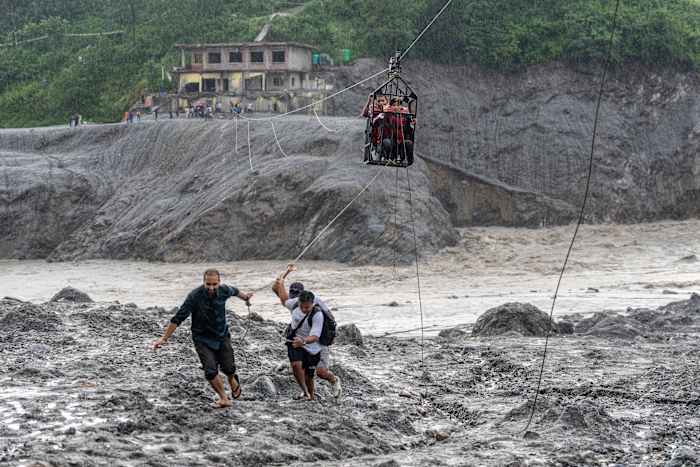
Infrastructure doesn't bounce back in a week. Roads, highways, and bridges were pulverized by the August floods, leaving communities completely isolated. Along the Trishuli River in Bidur, waiting for a rebuilt bridge isn't an option.
Instead, residents engineered a temporary zip line to cross between severed riverbanks. Army personnel now assist locals onto this makeshift Tyrolean crossing, pulling people across the rushing water. It's dangerous, frantic, and entirely necessary. Daily commutes now require trusting a rope line strung over churning debris.
The Scale of the Crisis Underground
While surface communities battle isolation and medical shortages, a massive rescue operation unfolds underground. The human toll of the disaster climbs daily, with the national disaster management agency reporting at least 1,252 deaths and over 4,200 people missing. Across the border in Tibet, Chinese authorities reported 21 dead and 541 missing.
A huge focus remains on hydroelectric project tunnels, where approximately 900 workers are still unaccounted for. Specialized rescue teams from the United States, China, and India are working alongside locals. At the Trishuli-3A tunnel, workers have started manually excavating the upper section of blocked passages. Building access roads took days, but heavy machinery still struggles against massive rock walls and debris.
Disaster response in the Himalayas requires immense patience and brute force. As rescue operations grind forward, the focus shifts to sanitation and hygiene in the camps to stave off outbreaks. For the thousands displaced, rebuilding means navigating these raw, improvised realities every single day.
Virginia-based nonprofit on the ground in Nepal
This video provides a look at relief efforts on the ground assisting families affected by the catastrophic floods in Nepal.