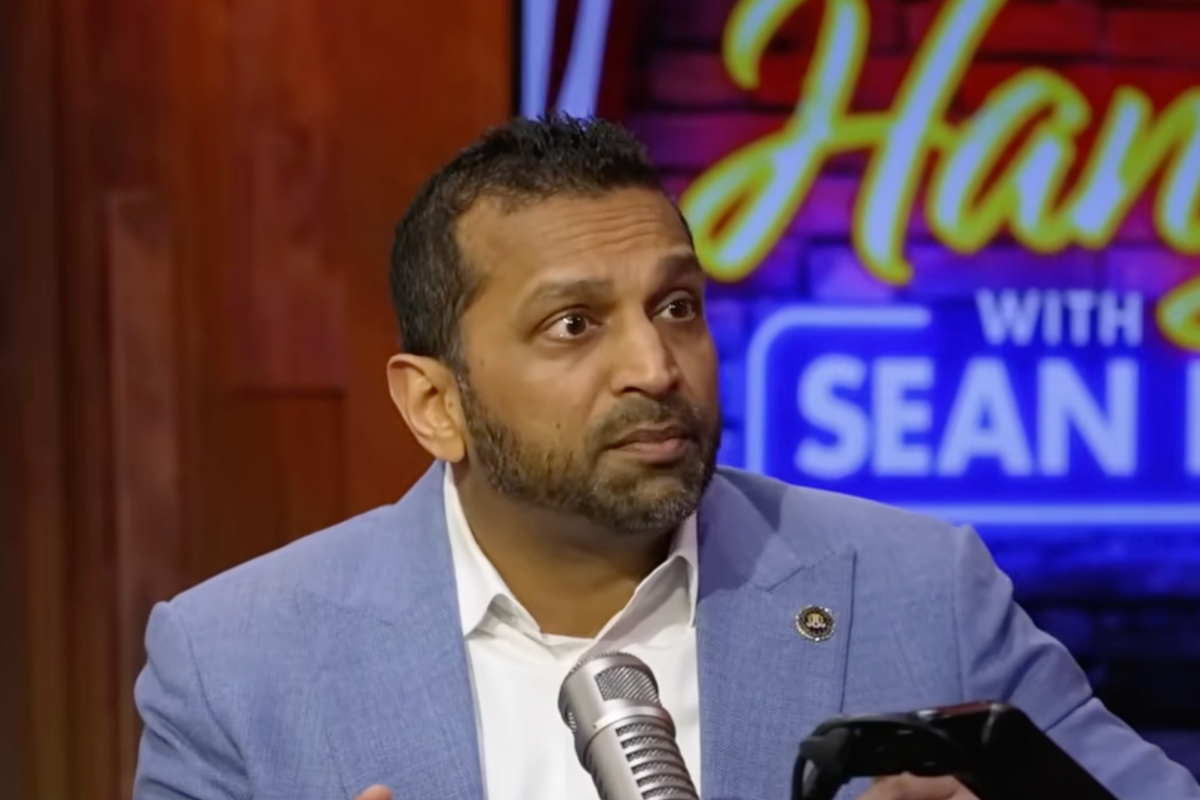
Kash Patel is selling a fantasy. The claim that pervasive AI surveillance has "stopped" school shootings is a masterclass in survivor bias and statistical gaslighting. It is the kind of rhetoric that sounds comforting to a panicked public but crumbles under the slightest weight of technical scrutiny. When law enforcement leaders say they are using AI "everywhere" to solve deep-rooted social violence, they aren't describing a breakthrough in public safety. They are describing the birth of a permanent, high-tech panopticon that treats every student as a pre-criminal while failing to address the actual mechanics of a tragedy.
The premise is simple: feed enough data—social media posts, hallway camera footage, thermal signatures, and private messages—into a "black box" algorithm, and it will spit out a red flag before a trigger is pulled. It’s a seductive lie. In reality, we are trading the privacy of millions for a "security" that exists mostly in press releases.
The Mathematical Impossibility of the False Positive
To understand why this tech fails, you have to understand the Base Rate Fallacy.
School shootings, while horrific and high-profile, are statistically "rare events" relative to the 50 million students in the American public school system. When you try to predict a rare event within a massive population, the math works against you every time. Even if an AI model is 99% accurate—a staggering feat in behavioral science—it will still produce hundreds of thousands of false alarms.
Imagine a school district of 100,000 students. If the AI is near-perfect, it still identifies 1,000 students as "potential threats." School resource officers and administrators cannot investigate 1,000 students with the depth required to prevent a shooting. The result? "Alarm fatigue." When the sensors go off every five minutes because a kid posted a dark lyric from a song or searched for a history project on the Civil War, the human operators start ignoring the pings.
The one time the threat is real, it gets buried under a mountain of digital noise. We saw this with the 2018 Parkland shooting. The "data" was there. The tips were there. The system didn't need more AI; it needed humans to do their jobs. Adding more layers of algorithmic surveillance doesn't fix a broken human process—it just gives the humans a more expensive place to hide.
Behavioral AI is Pseudoscience Wrapped in Silicon
The specific tech Patel is championing often relies on "sentiment analysis" and "threat assessment modeling." This is where the industry’s "battle scars" become visible. I’ve watched vendors pitch these systems to school boards, claiming their software can detect "aggression" through a camera lens or "depression" through a keyboard.
This is digital phrenology.
Human behavior is context-dependent. A student slamming a locker might be a mass shooter in the making, or they might have just failed a chemistry quiz. An AI cannot tell the difference because it lacks "theory of mind." It identifies patterns, not intent. By deploying these systems "everywhere," we are effectively telling an entire generation of children that their every emotional outburst or private thought is a data point for a federal database.
We aren't creating safer schools; we are creating high-stress environments that mirror the exact conditions of social isolation and resentment that lead to violence in the first place. If you treat a school like a prison, don't be surprised when the inhabitants start acting like inmates.
The "Success" Metric is a Lie
When officials claim AI "stopped" a shooting, ask for the evidence. You won't find it.
Security agencies often use "prevented incidents" as a metric, but these numbers are rarely audited. If a kid writes a "disturbing" poem, the AI flags it, and a counselor talks to him, the agency logs that as a "potential shooting stopped." There is zero proof that student was ever going to commit an act of violence. This is the Prevention Paradox: you can never prove that something which didn't happen was going to happen because of your intervention.
By inflating these "success" stories, proponents of AI surveillance avoid the harder conversations about mental health access, firearm legislation, and the collapse of community support structures. It’s much cheaper to buy a software license from a Silicon Valley donor than it is to hire ten more school psychologists.
The Stealth Cost of Constant Monitoring
There is a technical and social cost to this "AI everywhere" approach that the FBI won't admit.
- Data Poisoning and Evasion: The moment students realize they are being monitored by an algorithm, they change their behavior. The truly dangerous actors—those who are methodical and planning—will simply move their communications to encrypted platforms or use "coded" language that the AI hasn't been trained on yet. The only people caught by the dragnet are the "loud" kids who need help, not the "quiet" ones who pose a threat.
- The Privacy Debt: We are collecting biometric and behavioral data on minors without their informed consent. These databases are targets for hackers. Imagine a leak of a "Threat Assessment Database" containing the mental health flags and private communications of 10 million teenagers. We are building a goldmine for blackmailers and foreign adversaries.
- Algorithmic Bias: We know, through extensive research by organizations like the ACLU and the Algorithmic Justice League, that surveillance AI disproportionately flags students of color and those with neurodivergence. A student with autism who avoids eye contact or exhibits "repetitive behaviors" can be flagged as "suspicious" by a primitive computer vision model.
Stop Buying the "Magic Bullet"
The hard truth nobody wants to admit is that there is no technological fix for a sociological crisis.
The industry insiders pushing these "solutions" are often the same people who will profit from the inevitable "upgrades" when the first version fails to stop the next tragedy. They will claim they need "more data" and "more access." They will ask to monitor home computers and private phones.
If you want to stop school shootings, stop looking at a dashboard. Look at the student.
The most effective "threat assessment" in history isn't a neural network; it's a teacher who knows their students' names and notices when one of them stops showing up to class. It's a peer who feels safe enough to tell an adult when a friend is spiraling. These are human connections. They are messy, they are expensive, and they cannot be scaled by a server farm in Northern Virginia.
AI is a tool for processing information, not a crystal ball for human tragedy. Every dollar spent on "predictive" school security is a dollar stolen from the very programs that actually keep kids alive.
Put the sensors away and hire a counselor.