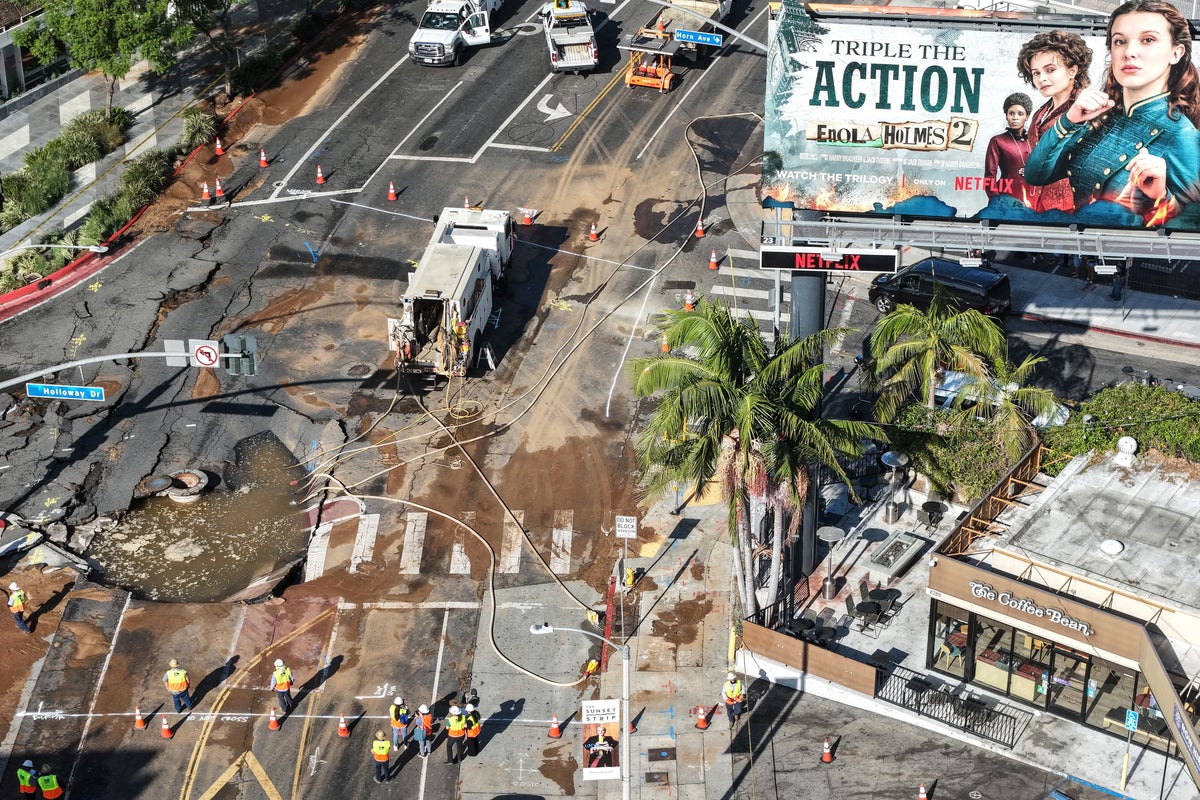
A river of mud and high-pressure water shouldn't be tearing through the heart of West Hollywood. Yet, early on a Thursday morning, the iconic Sunset Strip turned into a raging torrent of rapids. A massive 36-inch water main split wide open, buckling asphalt, swallowing cars, and tearing a giant sinkhole right into the pavement near Holloway Drive.
If you think this is just a localized Los Angeles headache, you're missing the bigger picture. This disaster is a loud, messy wake-up call for communities across the country. The pipe that failed wasn't a modern piece of engineering. It was laid down in 1916. It survived two world wars, dozens of historic earthquakes, and the radical transformation of Southern California from a quiet agricultural hub into a sprawling megacity.
It couldn't survive time.
When a century-old pipeline decides to give up, it doesn't just leak. It explodes. The structural failure on Sunset Boulevard proves that America's underground infrastructure is running on borrowed time. We are relying on systems built by people who couldn't even imagine the weight of modern city traffic or the sheer volume of water we consume daily.
The Anatomy of the Sunset Strip Rupture
The disaster kicked off around 3:55 a.m. near Palm Avenue and Harratt Street. While most of the city slept, a massive trunk line ripped open. This wasn't a standard neighborhood pipe. A 36-inch trunk line moves immense volumes of water across different zones of the city. Within minutes, millions of gallons of water broke through the surface, flooding streets down to Santa Monica Boulevard.
It looked like a movie set, but the destruction was entirely real. Local transit buses sat half-submerged in thick, murky water. Commuters faced sudden, sprawling road closures during the morning rush. The water quickly found its way into underground parking garages, first-floor apartments, and storefronts.
Dialog Cafe, a beloved local brunch staple, took a direct hit. The owners reported significant damage and had to shut down immediately with no clear timeline for when they can return to business. This is the hidden financial tax of old infrastructure. It isn't just about the cost of the pipe itself. It's about lost wages, destroyed property, and ruined small businesses.
Engineers later discovered that the failure happened because the pipe's ancient rivets simply snapped. The pipeline was made of riveted steel. Over 110 years, those rivets corroded under constant pressure and shifting soil. When they failed, a 25-foot section of the pipe literally peeled open like a tin can.
The Dangerous Physics of Midnight Water Breaks
You might wonder why these massive pipe breaks always seem to happen in the dead of night. It feels like bad luck, but it's actually simple physics. David Hanson, the interim general manager for the Los Angeles Department of Water and Power, pointed out a reality that water utility engineers know all too well. Water pressure surges when a city goes to sleep.
During the day, millions of people turn on faucets, flush toilets, run showers, and power up commercial cooling systems. This massive, distributed demand keeps water flowing constantly, which naturally lowers the overall pressure inside the main lines.
Around midnight, that demand plummets.
Everyone goes to sleep. Businesses close down. Suddenly, the same immense volume of water is pushing through the system, but there are no open valves to relieve the force. The pressure inside the trunk lines climbs to its highest point of the day. For a brand-new ductile iron pipe, that pressure hike is nothing. For a 110-year-old line held together by decaying rivets, it's a death sentence. The weak spot finally hits its breaking point, and the pipe tears itself apart.
Fixing a break like this isn't as simple as turning off a backyard garden hose. LADWP crews couldn't just slam the valves shut. Doing that too quickly creates a phenomenon known as water hammer. Think of it as a shockwave traveling through the plumbing system. If you halt thousands of gallons of rushing water instantly, that kinetic energy has to go somewhere. It will travel down the line and blow out three or four other weak pipes in the neighborhood.
Crews had to spend hours slowly, methodically turning massive high-pressure underground valves to isolate the break without triggering a domino effect of destruction across West Hollywood. It took until 7:00 a.m. just to stop the surface flooding.
The Massive Scale of the Repair Job
Once the water stopped flowing, the true scale of the mess became clear. Workers had to pump out nearly 195,000 gallons of pooled water just to get a clean look at the crater left behind. The rupture created a massive void beneath the street, leaving the asphalt completely unsupported.
Because you can't just buy a 1916 riveted steel pipe replacement at a local supply yard, LADWP engineers had to custom-fabricate a brand-new 25-foot steel section from scratch at one of their specialized facilities. The old, damaged pipe has to be cut away, the area shored up so walls don't collapse on workers, and the new section lowered into place.
The welding process alone takes roughly 16 hours of continuous, precise work. After that, crews can't just flip the switch back to full blast. They have to slowly re-pressurize the trunk line over hours, checking every single joint for signs of secondary stress or leaks. Only then can they begin backfilling the giant sinkhole with soil, compacting it, and laying down temporary asphalt so drivers can get their streets back.
The Impending Ballot Fight Over LA Water
This disaster arrived at a highly sensitive political moment. Los Angeles Mayor Karen Bass wasted no time linking the Sunset Strip flood directly to a broader fight over city funding. She noted that this mess is exactly why the city desperately needs a coordinated strategy to address aging utilities.
A couple of months ago, the city rolled out a comprehensive infrastructure plan. That plan is headed straight for the November ballot, where voters will decide whether to fund a massive overhaul of the city's hidden networks.
It is easy for voters to ignore infrastructure bonds when everything works fine. Potholes are annoying, but out-of-sight pipes are completely forgotten. Incidents like the West Hollywood break change the conversation rapidly. They remind everyone that the ground beneath our feet is filled with ticking time bombs. LADWP currently replaces roughly 45 miles of water pipes every year. In a system that spans more than 7,300 miles of water mains, that pace means it would take well over a century to replace everything just once.
We are losing the race against time.
How Cities and Property Owners Can Protect Themselves
You can't personally crawl under the street to fix a city trunk line, but you aren't completely helpless either. Municipalities and property owners need to shift from a mindset of reacting to disasters to actively preventing them.
What Municipalities Must Do Better
Cities cannot keep relying on reactive maintenance. Waiting for a pipe to explode before fixing it is the most expensive way to run a utility.
- Shift to acoustic monitoring. Modern utility companies use acoustic sensors placed throughout the pipe network. These sensors listen for the distinct, high-frequency sound of tiny pinhole leaks before a pipe catastrophic fails. Finding a leak early means you can schedule a controlled repair instead of dealing with an emergency midnight flood.
- Accelerate data-driven replacement schedules. Pipes shouldn't just be replaced based on age. Soil chemistry, historical pressure loads, and nearby traffic weight all dictate how fast a pipe degrades. Advanced predictive mapping helps target the highest-risk lines first.
- Create regional coordination frameworks. The Sunset Boulevard break happened in West Hollywood, but the pipe belonged to the Los Angeles Department of Water and Power. When infrastructure crosses city lines, bureaucratic friction slows down emergency responses. Clear, pre-negotiated operational plans between neighboring cities save critical hours when a crisis hits.
What Property Owners Can Do
If you own a building or rent a commercial space near an older metro area, you need to accept that infrastructure failures are part of your risk profile.
- Install commercial-grade backflow preventers and sump pumps. If your property has a basement, a sub-grade garage, or sits lower than the street level, high-capacity sump pumps with battery backups are non-negotiable.
- Review your insurance policies today. Standard commercial or residential property insurance rarely covers damage from a water main break outside your property line unless you have a specific flood or utility interruption rider. Read the fine print before you get flooded.
- Know where your building's main shut-off valve is located. If municipal water starts rushing toward your property, you need to be able to isolate your internal systems immediately to prevent cross-contamination or internal pressure backups. Ensure your staff or family members know exactly how to turn it off.
The mess on Sunset Boulevard will eventually be cleared away. The asphalt will be smooth again, and the cars will be towed. The real question is whether cities will look at this sinkhole and see a temporary traffic headache, or recognize it as a stark warning of what happens when you leave a century of progress resting on a foundation of decaying iron.