Catastrophic flash flooding along the Nepal-China border, triggered by high-altitude glacial collapses, has redirected international focus toward a severe structural vulnerability: the entrapment of maintenance and operational personnel inside subterranean hydropower tunnels. When millions of cubic meters of water, mud, and debris breach riverine barriers, underground facilities designed to regulate water flow instantly transform into lethal sediment traps. Understanding the mechanics of survival, the engineering constraints of subterranean rescue, and the operational bottlenecks of disaster response requires examining the fluid dynamics and geotechnical realities governing these environments.
The Fluid Dynamics of Subterranean Inundation
Hydropower tunnels are engineered for high-volume conveyance, featuring large cross-sectional areas capable of accommodating vehicular transit. When a glacial lake outburst flood or high-intensity rain event occurs, the hydraulic gradient shifts instantly. The volumetric flow rate entering the intake portals vastly exceeds the discharge capacity of the system, creating a sudden positive pressure wave. Read more on a related issue: this related article.
Subterranean flooding does not manifest as a gradual rise in water levels. High-velocity mudflows carry suspended bedloads of boulders, coarse gravel, and glacial silt. As this slurry enters a horizontal or gently sloping tunnel, kinetic energy dissipates against the rough concrete walls, causing immediate sediment drop-out. This sediment quickly forms dense plugs.
Personnel caught inside face a compound threat vector: Further analysis by USA Today highlights similar views on the subject.
- Hydrodynamic impact forces capable of sweeping individuals off walkways or destroying internal infrastructure.
- Rapid displacement of breathable air volume, creating localized pneumatic compression zones ahead of the advancing water front.
- Post-inundation sealing, where fine-grained clay and silt settle to encase entire passages in impermeable matrices.
Survival metrics in these environments depend entirely on micro-topography. Workers who manage to reach elevated service niches, structural anchor points, or interior air pockets face an immediate decay function regarding oxygen availability. As the ambient water level stabilizes and blocks both intake and outflow portals, the enclosed air volume degrades rapidly through human respiration and the chemical oxidation of organic debris swept inside.
The Engineering Constraints of Tunnel Extraction
Executing search and rescue operations inside debris-choked subterranean infrastructure presents distinct geotechnical challenges that standard urban search protocols cannot address.
Access points are invariably compromised. Portal entries are buried under meters of heterogeneous debris comprising massive boulders, uprooted timber, and compacted silt. Heavy earth-moving machinery, such as excavators and bulldozers, cannot enter the subterranean bore until initial clearance occurs. Because surface access roads are frequently obliterated by the same flood events that compromise the power stations, heavy equipment must be dismantled and airlifted via rotorcraft to the staging zones.
Once the portal is reached, rescue engineers must establish vertical or horizontal core-drilled access to pump compressed air and deploy fiber-optic inspection cameras. This phase introduces a critical operational dilemma:
- Drilling into a sealed tunnel risks destabilizing the structural crown head if the internal pore pressure or external overburden is miscalculated.
- Introducing heavy machinery or controlled small-scale blasting to break through concrete plugs generates vibrations that can shift unstable debris fields surrounding the bore, potentially burying pockets where survivors might reside.
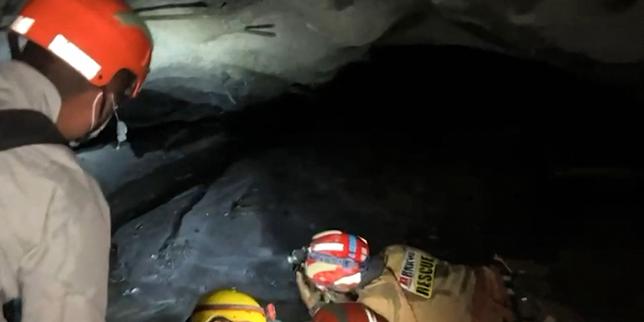
Thermal imaging drones and life-detection monitors operated by specialized regional teams from India, China, and local mountain rescue units provide limited utility. Concrete walls, thick layers of wet silt, and the attenuation of thermal signatures through dense rock masses severely restrict sensor range. Rescuers are frequently forced to conduct manual probings, wading through chest-deep, highly viscous mud where mobility is reduced to meters per hour.
Systemic Vulnerabilities in Infrastructure Placement
The concentration of missing personnel within subterranean networks highlights a deeper structural flaw in regional risk assessment frameworks. Hydropower architecture prioritizes hydraulic head, geological stability for turbine foundations, and optimal water conveyance angles. However, early-warning telemetry integration between high-altitude glacial accumulation zones and low-altitude intake portals remains fragmented.
When an upper-basin collapse occurs, the time delta between initial hydrological displacement and arrival at the intake structure can be measured in minutes. Standard administrative evacuation protocols—relying on manual alarms or surface spotters—fail when the velocity of the flood wave outpaces human transit capabilities across steep Himalayan terrain.
Furthermore, underground administrative and control stations are frequently sited near the lower portals or surge tanks for operational convenience. These subterranean spaces lack redundant, positive-pressure evacuation shafts that ascend vertically to uncompromised surface topography independent of the primary water conveyance tunnel. Consequently, any catastrophic compromise of the main portal traps all personnel downstream of the entry breach.
Operational Reconstruction Priorities
Mitigating future loss of life in mountainous subterranean infrastructure requires a fundamental shift in engineering mandates. Risk mitigation strategies must transition from reactive rescue protocols to built-in structural redundancies.
Primary engineering modifications must include:
- Independent, heavily armored egress shafts equipped with mechanical hoisting systems, situated at regular intervals along long-bore tunnels.
- Automated, rapid-closure pneumatic blast gates at intake portals linked to automated upstream seismic and hydrological sensors, designed to isolate water entry before the main bore is compromised.
- Integrated subsurface life-support nodes featuring independent oxygen generation, pressurized water reserves, and hardwired emergency communication lines embedded in protective conduit separate from the main power grid.
The operational focus must shift toward predictive hydrological modeling that accounts for accelerated glacial retreat and high-frequency monsoon extremes. Until subterranean infrastructure incorporates fail-safe egress architecture, rescue operations following catastrophic watershed failures will remain constrained by the physics of mud, pressure, and time.