Subsea fiber-optic cables in the Persian Gulf represent the single most vulnerable asymmetric pressure point in global telecommunications, offering state actors a low-cost mechanism to induce macroeconomic paralysis without triggering the immediate military escalations associated with oil blockades. While conventional geopolitical analysis treats maritime energy chokepoints like the Strait of Hormuz as the primary theater of economic deterrence, the physical infrastructure carrying international data traffic shares the exact same shallow, congested seabed. Disrupting these glass filaments does not require advanced naval warfare; it requires basic maritime sabotage, yet the second-order effects cascade across global financial clearinghouses, cloud computing regions, and sovereign defense networks within milliseconds.
The Structural Vulnerability of Gulf Seabed Infrastructure
To understand why submarine cables are attractive targets for asymmetric warfare, one must evaluate the physical topology of the Persian Gulf. Unlike the open Atlantic or Pacific oceans, where cable routes disperse across vast abyssal plains at depths exceeding 4,000 meters, the Persian Gulf is a shallow sedimentary basin with an average depth of just 50 meters and a maximum depth of roughly 90 meters.
This bathymetry creates three compounding engineering vulnerabilities:
- Spatial Compression: Every major submarine cable connecting Europe, Africa, and South Asia to the Gulf Cooperation Council (GCC) states must transit the Strait of Hormuz—a chokepoint narrowing to 33 kilometers at its tightest point. Over a dozen high-capacity systems, including FLAG Europe-Asia (FEA), SEA-ME-WE 3, SEA-ME-WE 4, SEA-ME-WE 5, FALCON, and the Gulf Bridge International (GBI) cable system, are bundled within tightly constrained maritime corridors.
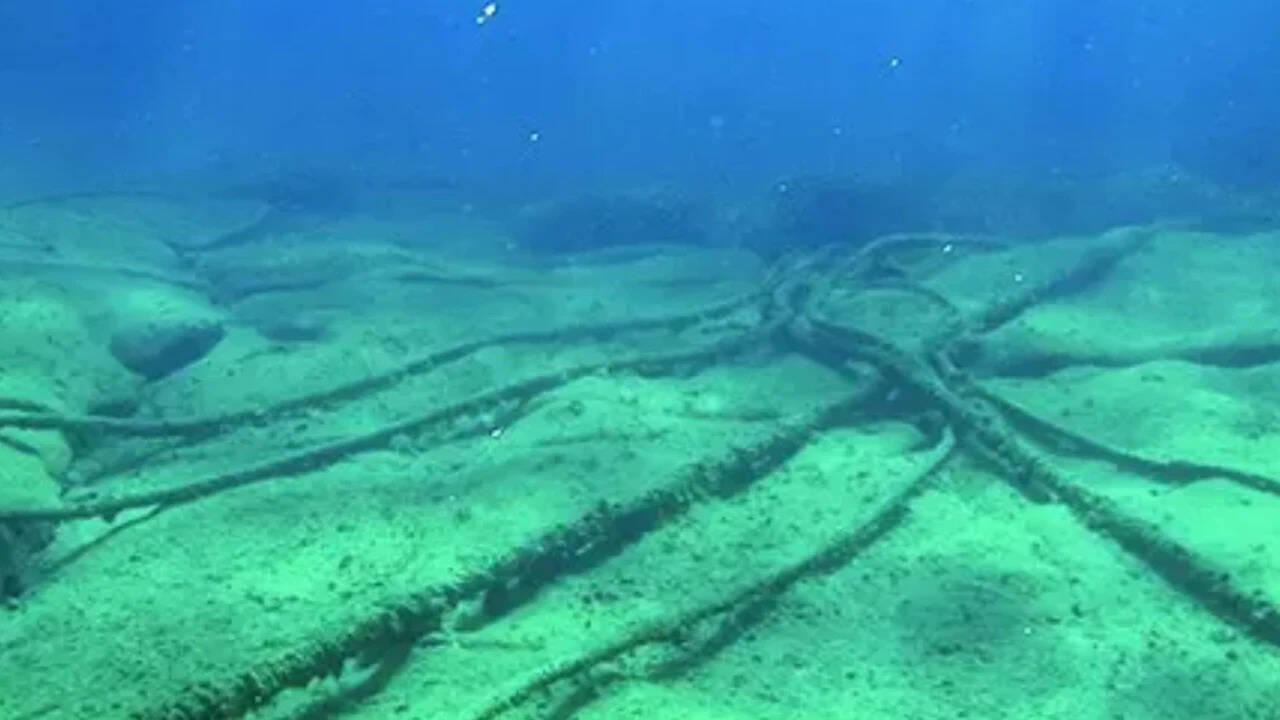
- Depth Accessibility: At depths under 100 meters, cables cannot rely on deep-water concealment. While cables in shallow waters are typically armored with steel wire sheathing and buried one to two meters beneath the seabed using specialized sea plows, shifting currents and dense maritime traffic routinely expose segments. At 50 meters, a cable is accessible to commercial anchors, bottom-trawling gear, basic remotely operated vehicles (ROVs), and combat divers.
- Landing Station Concentration: Submarine cables do not terminate in the ocean; they connect to terrestrial networks at specific coastal Cable Landing Stations (CLSs). In the Gulf, key landing hubs in Fujairah (United Arab Emirates), Al Khobar (Saudi Arabia), and Doha (Qatar) aggregate massive percentages of regional capacity into hardened but geographically fixed facilities.
In open-ocean environments, accidental damage accounts for roughly 70% to 80% of all submarine cable faults, primarily caused by commercial fishing vessels and dragging anchors. In the Persian Gulf, the baseline frequency of accidental cuts is already elevated due to intense hydrocarbon shipping traffic. This high background noise provides a built-in mechanism for plausible deniability. A state actor utilizing commercial dhows, unflagged tugboats, or proxy maritime assets can execute targeted anchor drags across known cable coordinates, masking deliberate infrastructure sabotage as routine maritime negligence.
Asymmetric Deterrence and the Shift from Hydrocarbons to Data
Traditional Iranian deterrence doctrine relies on the threat of closing the Strait of Hormuz to halt the transit of roughly 20% of global petroleum liquids. However, executing a kinetic blockade of oil tankers carries severe strategic penalties for Tehran. It immediately alienates major crude importers—most notably China, Iran’s primary economic lifeline—and guarantees an overwhelming, multinational naval response led by the United States to reopen the waterway.
Targeting subsea fiber-optic cables alters this strategic calculus by decoupling economic disruption from physical energy supply. The Threat-to-Escalation Ratio of cable sabotage is fundamentally different from that of tanker seizures or mine warfare:
- Attribution Latency: When an oil tanker is struck by a limpet mine or an anti-ship ballistic missile, satellite imagery, radar tracks, and physical debris establish attribution within hours. When a subsea cable loses optical signal at a depth of 60 meters, network operators initially register only a sudden loss of light (LOS) on specific fiber pairs. Determining whether the fault resulted from a shifting seabed, a stray merchant anchor, or a shaped explosive charge requires dispatching a specialized cable-laying and repair vessel—a process that takes days or weeks.
- Asymmetric Cost-to-Damage Ratios: A commercial-grade grapnel hook dragged by a modified fishing vessel costs less than $50,000 to deploy. Repairing a single severed submarine cable requires mobilizing a specialized repair ship—such as those operated by E-Marine in the UAE—at operational charter rates exceeding $100,000 per day, alongside tens of millions of dollars in lost economic output per hour of downtime for affected financial and enterprise sectors.
- Selective Regional Impact: While cutting transoceanic transit cables affects latency between Europe and Asia, severing localized spurs and regional rings isolates specific GCC economies without immediately halting physical oil shipments to East Asia. This allows a coercive actor to calibrate pressure against neighboring Gulf states while minimizing direct blowback from energy-importing superpowers.
The Architecture of Digital Contagion
A common misconception in non-technical reporting is that cutting a single submarine cable turns off the internet for an entire country. Modern telecommunications networks operate on mesh topologies designed around redundancy and Border Gateway Protocol (BGP) automated rerouting. When a primary fiber path fails, routers dynamically recalculate the shortest available path and shift traffic onto backup cables or terrestrial overland routes.
The vulnerability in the Gulf does not stem from a single point of failure, but from correlated capacity exhaustion.
Submarine cables are engineered with specific design capacities measured in terabits per second (Tbps). Network operators typically run primary cables at 40% to 60% utilization specifically to preserve headroom for rerouting traffic during a single-cable outage—a standard known as $N+1$ redundancy. However, if three or four parallel systems in the Strait of Hormuz are severed simultaneously within a 24-hour window, the remaining intact cables cannot absorb the aggregate traffic load.
This triggers a predictable cascade of network degradation:
- Packet Loss and Bufferbloat: As routers attempt to push 100 Tbps of regional traffic through 30 Tbps of remaining subsea capacity, network buffers overflow. Non-essential traffic drops, TCP sessions time out, and enterprise applications fail.
- Latency Spikes and Financial Desynchronization: High-frequency trading, interbank settlement systems (such as SWIFT messaging), and algorithmic market-making rely on deterministic, ultra-low latency. Rerouting Gulf traffic around the Cape of Good Hope or through congested terrestrial links across Iraq and Turkey adds 100 to 250 milliseconds of round-trip delay. For modern financial infrastructure, this latency spike is functionally equivalent to an outage.
- Cloud Region Isolation: Over the past five years, hyperscale cloud providers—including Amazon Web Services (AWS), Microsoft Azure, and Google Cloud—have established major regional availability zones in Bahrain, the UAE, and Saudi Arabia. These data centers rely on continuous, high-bandwidth synchronization with global control planes in Europe and North America. Prolonged subsea isolation degrades cloud authentication, database replication, and enterprise SaaS availability across the Middle East.
The February 2024 incident in the Red Sea—where the anchor of the Houthi-struck cargo vessel Rubymar dragged across the seabed and severed four major cables (AAE-1, EIG, SEACOM, and TGN-Gulf)—demonstrated this exact vulnerability. That single unintended physical event degraded approximately 25% of all data traffic flowing between Asia and Europe, forcing massive rerouting across the entire Eastern Hemisphere. A coordinated, deliberate campaign in the narrower confines of the Persian Gulf would amplify this disruption by an order of magnitude.
Bottlenecks in Maritime Repair Logistics
The true leverage of subsea cable sabotage lies not in the act of cutting the glass, but in obstructing the repair. Fixing a severed submarine cable is one of the most logistically constrained operations in civil engineering.
Once a fault is localized using Coherent Optical Time-Domain Reflectometry (COTDR)—which measures light reflection to pinpoint a break within meters—a cable repair ship must steam to the exact coordinates. The vessel lowers a grapnel to hook the severed ends, hauls them to the surface one by one, splices in a new section of fiber-optic cable, tests the optical integrity, seals the joint in a copper-and-polyethylene housing, and lowers the repaired bight back to the seabed.
In the Persian Gulf, this repair pipeline faces three severe operational bottlenecks:
- Fleet Scarcity: Globally, fewer than 70 specialized cable repair ships exist, and only a fraction are stationed in the Middle East and Indian Ocean. The regional fleet is sized for peacetime accidental fault rates, not simultaneous multi-cable wartime sabotage.
- Permitting and Clearance Delays: Even in peacetime, obtaining maritime security clearances, diplomatic permits, and environmental approvals to operate a stationary repair vessel in disputed or sensitive Gulf waters can delay mobilization by two to four weeks.
- Area Denial Vulnerability: A cable repair ship must hold a fixed GPS position using dynamic positioning thrusters for 48 to 72 hours per splice. During this window, the vessel is completely stationary and defenseless. The mere presence of hostile fast-attack craft, unmanned surface vessels (USVs), or loitering munitions in the vicinity prevents commercial insurers from underwriting the mission and forces civilian crews to abort. By simply denying safe passage to repair vessels, a state actor can turn a two-week technical outage into a multi-month economic siege without firing a single shot at the repair ship itself.
Limitations of Current Defensive Countermeasures
Strategic planners across the GCC and Western defense establishments recognize these vulnerabilities, yet every proposed mitigation strategy encounters hard physical or economic limits:
- Terrestrial Overland Corridors: Projects like the Trans-Europe-Asia (TEA) terrestrial networks and regional fiber links running through Saudi Arabia and Jordan to the Mediterranean aim to bypass the Strait of Hormuz entirely. While terrestrial cables provide essential route diversity, they introduce new vulnerabilities. Overland fiber runs through politically volatile border regions, is easily located via surface infrastructure markers, and can be severed with a standard backhoe or handheld wire cutters. Furthermore, terrestrial fiber suffers from higher signal attenuation and maintenance complexity compared to undisturbed subsea segments.
- Low Earth Orbit (LEO) Satellite Constellations: Systems like Starlink and OneWeb offer vital emergency backup for military command-and-control, diplomatic missions, and critical infrastructure telemetry during subsea blackouts. However, LEO constellations cannot replace submarine cables at scale. A single modern subsea cable system carries between 150 and 400 Tbps of data. The entire global capacity of a multi-thousand-satellite LEO constellation is measured in tens of terabits per second distributed across the whole planet. Satellites provide continuity for low-bandwidth operations, not bulk commercial internet or cloud data center replication.
- Subsea Acoustic and Distributed Sensing: Distributed Acoustic Sensing (DAS) technology allows operators to use unused "dark fiber" strands within a cable as continuous underwater microphones, detecting the acoustic signature of a ship's anchor dragging or a submersible approaching miles before physical contact occurs. While DAS provides early warning, detection is not prevention. Unless a naval quick-reaction force is positioned within minutes of the threat vector, an operator watching an acoustic spike on a monitor still cannot stop a grapnel from snapping the cable.
Strategic Imperatives for Infrastructure Resilience
Treating subsea cables purely as private telecommunications assets is an obsolete governance model. Because international bandwidth now functions as core sovereign infrastructure—on par with electrical grids and desalination plants—resilience requires shifting from passive commercial redundancy to active architectural hardening.
Telecommunications operators, hyperscale cloud providers, and regional defense ministries must execute four concrete structural adjustments:
- Mandate Multi-Path Routing at the Layer-1 Level: Enterprise and financial institutions operating in the Gulf must audit their network service providers to eliminate hidden single points of failure. Many "redundant" circuits sold by regional carriers run on different virtual wavelengths (lambdas) inside the exact same physical submarine cable, or on separate cables that share the same physical conduit into the Fujairah landing station. True resilience requires contractual and physical verification that backup capacity transits geographically independent routes—specifically combining Gulf subsea paths with Red Sea subsea paths and terrestrial overland links through Jordan and Saudi Arabia.
- Establish Pre-Cleared Sovereign Repair Protocols: Regional governments must replace ad-hoc peacetime permitting with standing bilateral maritime agreements that grant pre-approved diplomatic and naval clearance for cable repair vessels in exclusive economic zones. Simultaneously, state sovereign wealth funds should underwrite the permanent stationing of additional regional repair vessels and strategic stockpiles of spare cable and repeaters outside the Strait of Hormuz, ensuring repair capacity is not trapped inside the chokepoint during a crisis.
- Harden and Decentralize Cable Landing Stations: Concentrating ten international cable systems into a single coastal building creates an irresistible kinetic target. Future subsea deployments in the Gulf must enforce geographic dispersion of landing stations, moving termination points away from exposed, low-lying coastal urban zones into hardened, subterranean facilities located further inland, connected via deeply buried, concrete-encased terrestrial conduits.
- Integrate Subsea Telemetry into Maritime Domain Awareness: Naval coalition forces monitoring the Strait of Hormuz and the Gulf of Oman must ingest real-time Distributed Acoustic Sensing (DAS) feeds directly from commercial cable operators into joint maritime operations centers. Pairing acoustic anomaly detection with Automatic Identification System (AIS) vessel tracking and synthetic aperture radar (SAR) imagery allows naval patrols to intercept "dark" vessels loitering over cable corridors before they deploy subsea cutting gear, converting passive glass fibers into an active early-warning perimeter.